







Definition & Meaning
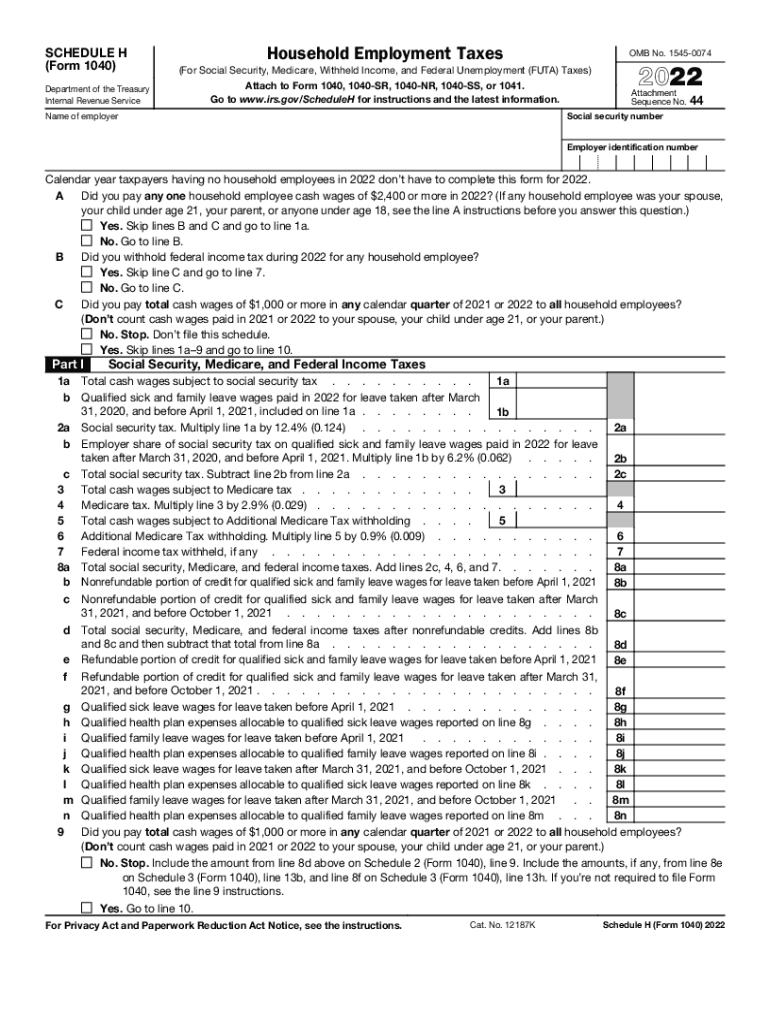
Schedule H (Form 1040) is a tax document used mainly by household employers in the United States. It allows these employers to report and remit taxes for household employees such as nannies, cleaners, and gardeners. Specifically, the form covers Social Security, Medicare taxes, and the Federal Unemployment Tax Act (FUTA) obligations. Understanding this form is crucial for legally employing and paying household workers in compliance with IRS requirements.
How to Use the Schedule H (Form 1040)
To use Schedule H effectively, you need to first determine if you qualify as a household employer. If you hire a household employee and pay them cash wages, this form helps you calculate the owed Social Security, Medicare, and FUTA taxes. After collecting all necessary payroll details, you will complete the form by entering the relevant information and submitting it along with your annual Form 1040 tax return to the IRS.
Steps to Complete the Schedule H
- Determine Employee Status: Confirm the status of your workers as household employees.
- Gather Information: Collect payroll records indicating wages paid.
- Calculate Taxes: Use the form to compute Social Security, Medicare, and FUTA taxes.
- Complete Form Sections: Fill in each section based on your payroll data.
- Attach to Form 1040: Submit Schedule H with your annual tax return.
Key Elements of the Schedule H
Schedule H is segmented into specific sections that each serve a unique purpose in tax calculations:
- Part I: Social Security and Medicare Taxes – Calculate the total of these taxes owed for household workers.
- Part II: Federal Unemployment (FUTA) Tax – Determine FUTA tax obligations based on wages paid over $1,000 in any calendar quarter.
- Part III: Total Household Employment Taxes – Sum of amounts from all previous sections for payment with your income tax return.
IRS Guidelines
For successful completion, it’s essential to follow IRS instructions to avoid errors:
- Wage Thresholds: Verify if wages paid exceed IRS-specified thresholds.
- Withholding Methods: Use the IRS rate schedules to collect and calculate taxes.
- Recordkeeping: Maintain payroll records for each household employee for at least four years.
Filing Deadlines and Important Dates
Schedule H must be filed along with Form 1040 on the annual tax return deadline, generally April 15th. Missing this deadline can incur penalties and interest on unpaid tax amounts. The IRS may also mandate estimated payments or background submissions of previous employment taxes.
Required Documents
Before submitting, ensure you have these critical documents:
- Payroll Records: Detailed wage records for all household employees.
- W-2 Forms: Issued to employees, detailing their earnings and withholding.
- Employer Identification Number (EIN): Must be used for all IRS employment documents.
Penalties for Non-Compliance
Non-compliance can have serious repercussions, including:
- Fines: Monetary penalties based on underreported taxes.
- Interest Charges: Accrued on late payments.
- Audits: Potential for detailed IRS audits if non-compliance is suspected.
Digital vs. Paper Version
Schedule H can be completed:
- Digitally: Using tax preparation software like TurboTax and QuickBooks.
- Paper: By hand, using printed forms submitted via mail.
Filing electronically often reduces errors and speeds up processing times, allowing for quicker refunds and resolution of tax liabilities.
By integrating these comprehensive insights, household employers can efficiently manage their tax obligations with clarity and foresight.




