




01. Edit your 1042 form online
Type text, add images, blackout confidential details, add comments, highlights and more.

Type text, add images, blackout confidential details, add comments, highlights and more.

Draw your signature, type it, upload its image, or use your mobile device as a signature pad.

Send 1042 tax form via email, link, or fax. You can also download it, export it or print it out.
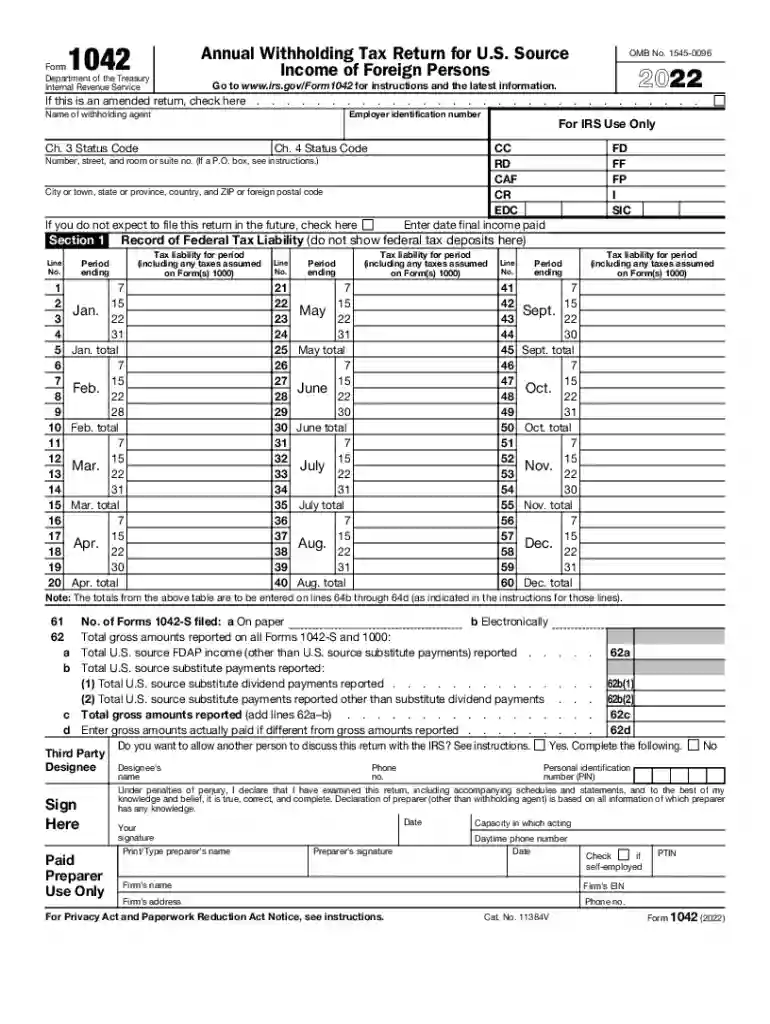
Form 1042, officially titled the "Annual Withholding Tax Return for U.S. Source Income of Foreign Persons," is issued by the Internal Revenue Service (IRS) for reporting taxes withheld on payments to foreign persons. Withholding agents, such as financial institutions or employers, use this form to report and pay taxes on U.S. source income distributed to foreign individuals or entities. Notably, it includes sections to declare tax liabilities, reconcile accounts, and detail potential adjustments linked to Foreign-Derived Amounts Paid (FDAP) income, Section 871(m) transactions, and dividend equivalent payments.
When preparing Form 1042, withholding agents report all relevant income payments with corresponding tax withholdings. This involves a thorough review and entry of details concerning the identity of each recipient, the type of income paid, and the amount withheld in U.S. dollars. Additionally, withheld taxes must be matched with the payments made throughout the tax year. This form helps the IRS monitor and ensure proper taxation and compliance with U.S. tax laws regarding foreign income.
The IRS provides Form 1042 through its official website, where users can download and print the form. Furthermore, taxpayers can receive it by mail upon request or by visiting local IRS offices. Online accessibility ensures that withholding agents can efficiently acquire and prepare forms as part of their tax documentation process.
Form 1042 must be submitted annually by March 15. This deadline is crucial to avoid penalties for late filing. Withholding agents should ensure that all supportive documentation, such as Form 1042-S, is prepared timely alongside the primary form. Meeting this deadline helps maintain compliance with tax regulations.
Form 1042 holds significant legal weight, serving as a formal declaration of withheld taxes and payments to foreign persons. It plays a vital role in U.S. tax law enforcement, requiring precise information to maintain compliance and avoid legal issues. Inaccurate reporting or omission could result in severe penalties or audits by the IRS.
Failure to file Form 1042 accurately or submit it on time may lead to penalties. The IRS imposes fines based on the severity and intent of the non-compliance. Deliberate evasion could lead to higher fines, while honest mistakes usually result in lesser penalties. Ensuring accurate and timely filing is key to avoiding these repercussions.
We've got more versions of the 1042 form form. Select the right 1042 form version from the list and start editing it straight away!
| Versions | Form popularity | Fillable & printable |
|---|---|---|
| 2025 | 4.9 Satisfied (28 Votes) | |
| 2024 | 4.2 Satisfied (34 Votes) | |
| 2023 | 4.7 Satisfied (30 Votes) | |
| 2022 | 4.1 Satisfied (53 Votes) | |
| 2021 | 4.8 Satisfied (53 Votes) | |
| 2020 | 4.3 Satisfied (113 Votes) | |
| 2019 | 4.3 Satisfied (86 Votes) | |
| 2018 | 4.2 Satisfied (99 Votes) | |
| 2017 | 4 Satisfied (36 Votes) | |
| 2016 | 4.4 Satisfied (282 Votes) | |
| 2015 | 4.4 Satisfied (198 Votes) | |
| 2014 | 4.4 Satisfied (46 Votes) | |
| 2011 | 4.3 Satisfied (30 Votes) | |
| 2010 | 4.4 Satisfied (26 Votes) |
At DocHub, your data security is our priority. We follow HIPAA, SOC2, GDPR, and other standards, so you can work on your documents with confidence.
Natural Attenuation for Groundwater Remediation. Chapter 1 outlines the factors that led the National Research Council to form this committee. Fiscal Year
Form 1042, annual withholding tax return for U.S. source income of foreign persons.-journal.
Mar 30, 2026 Use Form 1042 to report the following: The tax withheld under chapter 3 on certain income of foreign persons, including nonresident aliens,Read more


