




01. Edit your form online
Type text, add images, blackout confidential details, add comments, highlights and more.

Type text, add images, blackout confidential details, add comments, highlights and more.

Draw your signature, type it, upload its image, or use your mobile device as a signature pad.

Send it via email, link, or fax. You can also download it, export it or print it out.
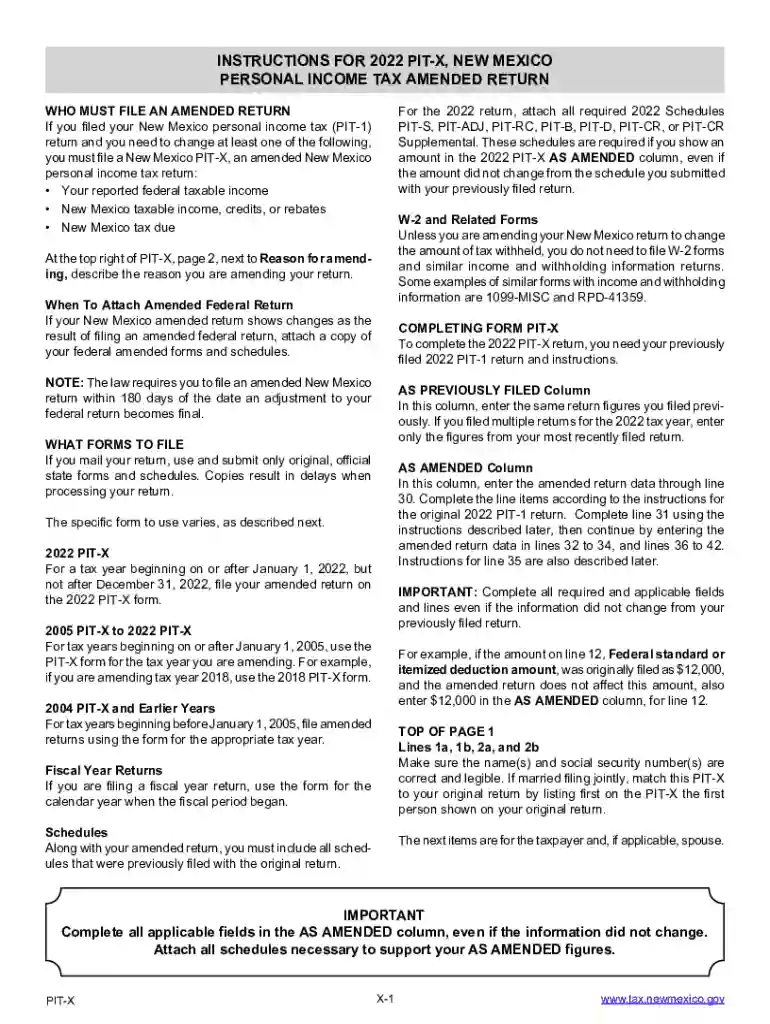
Amending your New Mexico tax return involves a structured process that ensures all corrections and adjustments are accurately made. The New Mexico Personal Income Tax Amended Return, known as the PIT-X, is the official form used for this purpose. Here are the steps to complete the process effectively:
Identify Necessity to Amend: Amend your return if there are changes in your federal taxable income, New Mexico taxable income, or the amount of tax due. Look for discrepancies or new information that affects your filed return.
Gather Required Documents: Obtain the necessary documents, including your original tax return, W-2s, 1099s, and any other form substantiating income or deductions. If changes pertain to federal filings, have the corresponding IRS documents ready.
Download and Complete the PIT-X Form: Access the PIT-X form from the New Mexico Department of Taxation and Revenue website. Ensure all relevant fields, such as income adjustments and tax credits, are accurately filled. Use the guide provided by the state for item-specific instructions.
Attach Schedules and Explanations: If specific changes need additional documentation, include the relevant schedules and worksheets. Provide a clear explanation of each amendment to help the assessing officer understand the changes.
Determine Balance or Refund: Calculate if you owe additional taxes or are entitled to a refund. Adjust your payment or refund request accordingly. Ensure all calculations align with the changes reported.
Submit Your Amended Return: Send the completed PIT-X form and all attachments either by e-file or mail. Ensure all pages and supporting documentation are securely included in the submission package.
Track Your Amendment Status: After submission, monitor the status of your amendment through the New Mexico Taxation and Revenue Department’s online portal, especially if expecting a refund or confirmation of payment.
Filing deadlines are crucial when amending your New Mexico tax return. While the standard deadline for filing an amended state tax return is typically three years from the original due date, keep an eye out for specific dates:
Amending involves comprehensive documentation to support changes:
Amending provides accurate financial reporting and compliance with state tax laws. It is particularly important for:
When dealing with New Mexico tax amendments, awareness of state-specific regulations is essential:
Different taxpayer situations can lead to filing an amendment. Some typical scenarios include:
Failure to amend in a timely manner can result in:
Utilizing tax software can streamline the amendment process:
Understanding these elements ensures a structured and compliant process for amending a New Mexico tax return.
We've got more versions of the How to Amend a New Mexico Tax Return - e-File form. Select the right How to Amend a New Mexico Tax Return - e-File version from the list and start editing it straight away!
At DocHub, your data security is our priority. We follow HIPAA, SOC2, GDPR, and other standards, so you can work on your documents with confidence.
The request must be on the form prescribed by the department and must be received by the department at least 30 days before the taxpayers electronic return orRead more
Feb 1, 2018 Form 7004 can be filed electronically for most returns. For details on electronic filing, visit IRS.gov/efile7004.
If the amended New Mexico return reports changes as the result of filing an amended federal return, attach copies of the applicable federal forms andRead more


