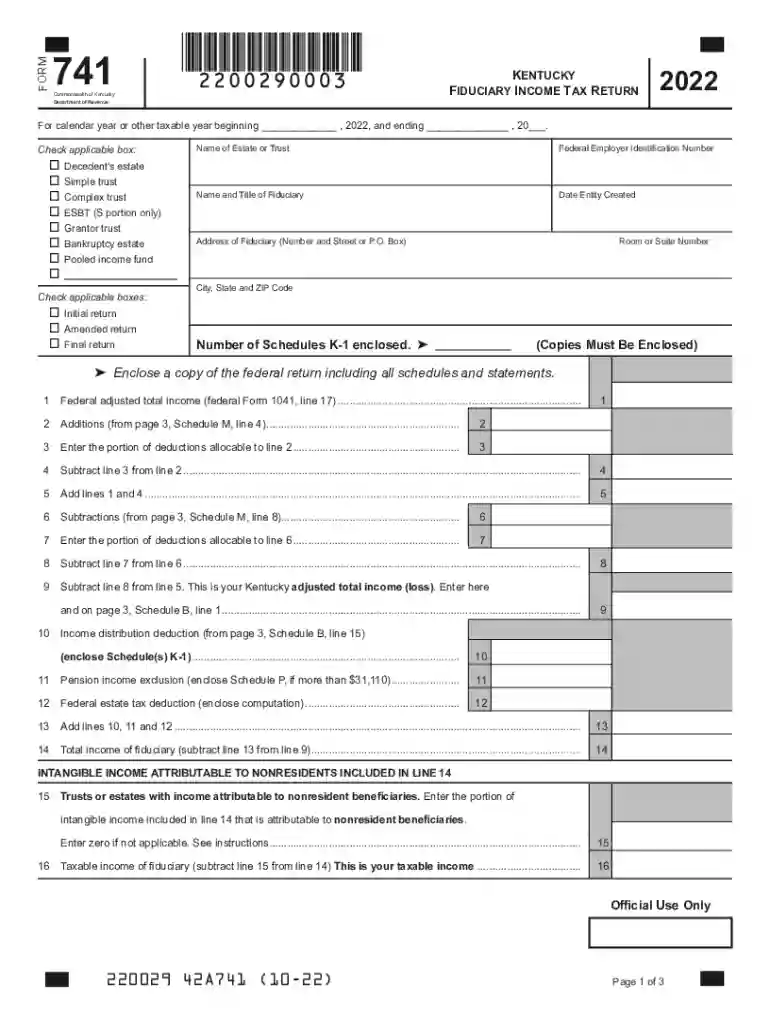
About Form 1041, U.S. Income Tax Return for Estates and TrustsIncome Taxes - TAXANSWERS - KentuckyIncome Taxes - TAXANSWERS - KentuckySC1041 DEPARTMENT OF REVENUE FIDUCIARY INCOME TAX RETUR-2026

Get Form
About Form 1041, U.S. Income Tax Return for Estates and TrustsIncome Taxes - TAXANSWERS - KentuckyIncome Taxes - TAXANSWERS - KentuckySC1041 DEPARTMENT OF REVENUE FIDUCIARY INCOME TAX RETUR Preview on Page 1

Here's how it works

01. Edit your form online
Type text, add images, blackout confidential details, add comments, highlights and more.

02. Sign it in a few clicks
Draw your signature, type it, upload its image, or use your mobile device as a signature pad.

03. Share your form with others
Send it via email, link, or fax. You can also download it, export it or print it out.

Definition & Meaning

Form 1041, officially known as the U.S. Income Tax Return for Estates and Trusts, serves as a federal tax document required for estates and trusts to report their income, deductions, gains, and losses. These entities are obligated to file Form 1041 if they accumulate gross income of $600 or more during the tax year. By reporting such details, the form helps determine the estate's or trust's tax liability.

Key Components

  1. Income Reporting: Estates and trusts disclose income generated from various sources, such as interest, dividends, and rentals.
  2. Tax Deductions: Expenses related to property management, administrative fees, and fiduciary fees can be deducted.
  3. Gains and Losses: Capital gains or losses from sales of assets must be declared.

Steps to Complete Form 1041

Completing Form 1041 requires careful attention to detail to ensure accuracy and compliance with tax regulations.

  1. Gather Necessary Information: Collect details on the estate's or trust's income and expenses, along with any beneficiary distributions.
  2. Form Selection: Use the official IRS Form 1041 and refer to the IRS instructions specific to the form.
  3. Income Section: Report all income types, including interest and dividends, accurately in Part I.
  4. Deduction Sections: Enter allowable deductions in Part II, considering legal allowances for individual estates and trusts.
  5. Tax and Payments: Calculate the tax owed using the trust's tax rate, subtract taxes already paid or withheld.
  6. Beneficiary Information: Detail any income allocated to beneficiaries in Schedule K-1.
  7. Review and Submit: Double-check all entries for precision before filing electronically or via mail.

Who Typically Uses Form 1041

Form 1041 is employed by executors or personal representatives of estates, and by fiduciaries or trustees managing trusts. It is particularly relevant for those overseeing the financial affairs of a deceased individual's estate or a trust set up either during a person's lifetime or as part of their will.

Specific Scenarios

  • Testamentary Trusts: Created upon someone's death based on terms in the will.
  • Revocable/Irrevocable Trusts: These differ in terms of amendments allowed by the grantor and their impact on tax filing obligations.

Filing Deadlines and Important Dates

The filing deadline for Form 1041 is the 15th day of the fourth month following the close of the estate's or trust's tax year. For calendar-year entities, this means the due date is typically April 15.

Extensions

  • An automatic five-and-a-half-month extension is available by filing Form 7004, extending the deadline to September 30 for calendar-year filers.

IRS Guidelines for Form 1041

The IRS provides detailed instructions that accompany Form 1041, specifying which incomes must be reported and deductions allowed.

Compliance Practices

  • Adhere to IRS standards for recording capital gains, dividends, and allocable expenses.
  • Follow the specific thresholds and exceptions applicable to particular forms of income and types of trusts.

Required Documents for Filing

Accurate completion of Form 1041 necessitates the following documents:

  • Income Statements: 1099 forms covering interest, dividends, and miscellaneous income.
  • Expense Records: Documentation for deductible expenses like fiduciary and legal fees.
  • Prior Year’s Tax Return: Helps in providing comparison and continuity.

Form Submission Methods

Form 1041 can be submitted using multiple methods, depending on convenience and the resources available:

  1. Online Submission: Electronic filing through the IRS's e-file system or third-party tax software, ensuring faster processing and confirmation of receipt.
  2. Mail: Send the completed forms and related documents to the IRS address noted in Form 1041 instructions.

Penalties for Non-Compliance

Failure to properly file Form 1041 or meet the deadlines may result in various penalties:

  • Late Filing: May incur a penalty calculated based on the tax due and the delay's length.
  • Inaccurate Reporting: Misstatements can lead to audits, fines, or further scrutiny.

Each aspect of dealing with Form 1041 demands a precise understanding of IRS rules and timely action to ensure both legal compliance and financial accuracy.

See more About Form 1041, U.S. Income Tax Return for Estates and TrustsIncome Taxes - TAXANSWERS - KentuckyIncome Taxes - TAXANSWERS - KentuckySC1041 DEPARTMENT OF REVENUE FIDUCIARY INCOME TAX RETUR versions

We've got more versions of the About Form 1041, U.S. Income Tax Return for Estates and TrustsIncome Taxes - TAXANSWERS - KentuckyIncome Taxes - TAXANSWERS - KentuckySC1041 DEPARTMENT OF REVENUE FIDUCIARY INCOME TAX RETUR form. Select the right About Form 1041, U.S. Income Tax Return for Estates and TrustsIncome Taxes - TAXANSWERS - KentuckyIncome Taxes - TAXANSWERS - KentuckySC1041 DEPARTMENT OF REVENUE FIDUCIARY INCOME TAX RETUR version from the list and start editing it straight away!
Versions Form popularity Fillable & printable
2023 4.4 Satisfied (41 Votes)
2022 4.1 Satisfied (33 Votes)
2021 4.2 Satisfied (51 Votes)
2020 4.3 Satisfied (51 Votes)
2019 4.1 Satisfied (36 Votes)
2018 4.1 Satisfied (56 Votes)
2017 4.1 Satisfied (34 Votes)
2016 4 Satisfied (50 Votes)
2015 4 Satisfied (57 Votes)
2014 4.6 Satisfied (34 Votes)
2013 4 Satisfied (24 Votes)
2012 4.5 Satisfied (37 Votes)
2011 4.1 Satisfied (34 Votes)
2010 4.5 Satisfied (44 Votes)
2009 4.3 Satisfied (46 Votes)
be ready to get more

Complete this form in 5 minutes or less

Get form

Got questions?

We have answers to the most popular questions from our customers. If you can't find an answer to your question, please contact us.
Contact us
What are the top mistakes made on Form 1041? Filing when the trust is grantor-type (they dont need a 1041 tax return) Missing state-level filing requirements. Failing to report rental real estate income. Skipping or misusing Schedules A, G, J, or Schedule K-1. Forgetting Form 8978 for certain entity adjustments.
Schedule D (Form 1041), Capital Gains and Losses Use Schedule D (Form 1041) to report gains and losses from the sale or exchange of capital assets by an estate or trust.
Who pays the income tax for estates or trusts? The beneficiaries are responsible for paying income tax on the income distributed to them by the estate. They are only responsible for paying taxes on the income distributed to them consistent with the income distribution deduction, not the whole amount.
Average Price to File Taxes in 2025 Tax FormAverage Cost per FormAverage Hourly Fees Form 1041 (Fiduciary) $576 $172.66 Form 1065 (Partnership) $733 $177.29 Form 990 (Exempt Organization) $735 $171.48 Form 1120-S (S Corporation) $903 $179.819 more rows
The maximum tax rate for long-term capital gains and qualified dividends is 20%. For tax year 2025, the 20% rate applies to amounts above $15,900. The 0% and 15% rates continue to apply to amounts below certain threshold amounts. The 0% rate applies to amounts up to $3,250.

Security and compliance

At DocHub, your data security is our priority. We follow HIPAA, SOC2, GDPR, and other standards, so you can work on your documents with confidence.

Learn more
ccpa2
pci-dss
gdpr-compliance
hipaa
soc-compliance
be ready to get more

Complete this form in 5 minutes or less

Get form

People also ask

Average Price to File Taxes in 2025 Tax FormAverage Cost per FormAverage Hourly Fees Form 1040 (Itemized) $323 $161.34 Form 709 (Gift Tax) $421 $178.29 Form 1041 (Fiduciary) $576 $172.66 Form 1065 (Partnership) $733 $177.299 more rows
If the estate generates more than $600 in annual gross income, you are required to file Form 1041, U.S. Income Tax Return for Estates and Trusts. An estate may also need to pay quarterly estimated taxes. See Form 1041 instructions for information on when to file quarterly estimated taxes.
The fiduciary (or one of the joint fiduciaries) must file Form 1041 for a domestic trust taxable under section 641 that has: Any taxable income for the tax year, Gross income of $600 or more (regardless of taxable income), or. A beneficiary who is a nonresident alien.