




01. Edit your form online
Type text, add images, blackout confidential details, add comments, highlights and more.

Type text, add images, blackout confidential details, add comments, highlights and more.

Draw your signature, type it, upload its image, or use your mobile device as a signature pad.

Send it via email, link, or fax. You can also download it, export it or print it out.
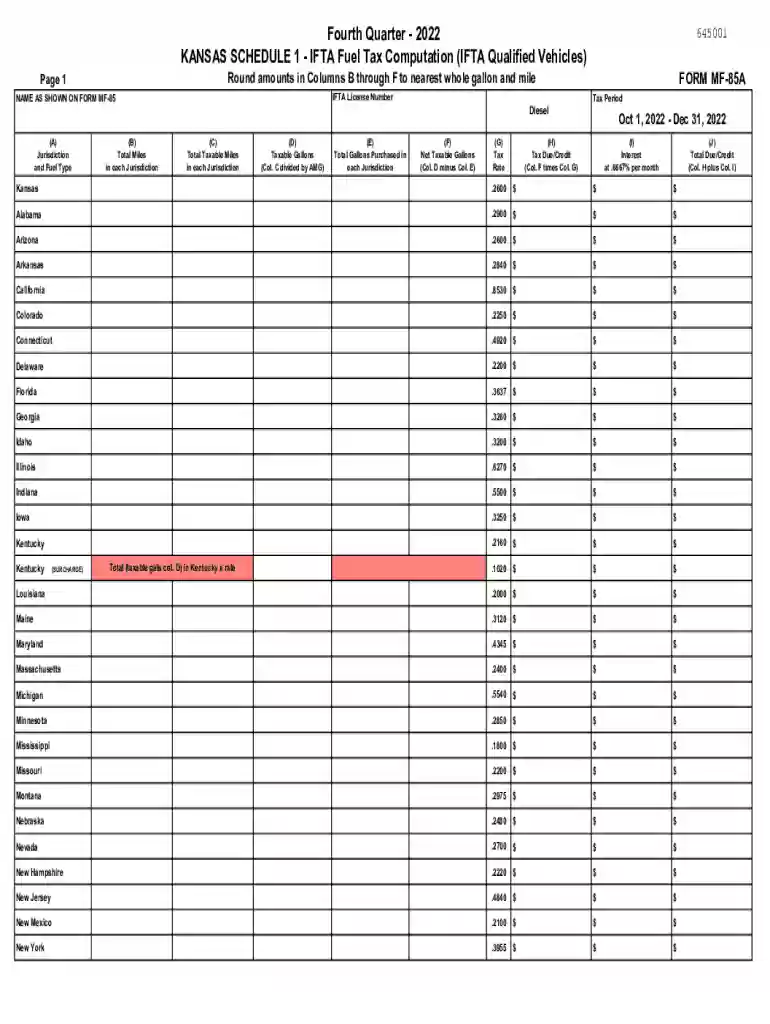
The IFTA Inc 4thq2022 Gasoline - Kansas Department of Revenue form is a fuel tax computation document used by qualified motor carriers operating across multiple jurisdictions. This form, often referred to as IFTA Schedule 1, is essential for calculating fuel taxes for each jurisdiction in which the carrier operates. The main components of the form include total miles driven, taxable miles, gasoline gallons purchased, net taxable gallons, applicable tax rates, and the total tax due or credit for each jurisdiction.
To accurately complete the IFTA Inc 4thq2022 Gasoline form:
Collect Necessary Data: Gather all travel and fuel purchase records for the fourth quarter of 2022. This includes total miles driven and gallons of gasoline purchased in each jurisdiction.
Calculate Total Miles: Record the total distance traveled by the fleet. This figure is crucial for determining taxable miles.
Determine Taxable Miles: Subtract any non-taxable miles (such as exempt miles under specific jurisdiction regulations) from the total miles.
Input Gallons Purchased: Enter the total gallons of gasoline purchased in each jurisdiction.
Compute Net Taxable Gallons: Use the formula: [Total gallons purchased - Taxable gallons] for each jurisdiction.
Apply Tax Rates: Input the jurisdiction-specific tax rates to calculate the taxes due or any credit owed.
Review and Finalize the Form: Double-check all entries and calculations for accuracy before submission.
The IFTA Inc 4thq2022 Gasoline form includes several critical elements that need careful attention:
Utilizing the IFTA Inc 4thq2022 Gasoline form comes with legal obligations:
Understanding key terms is crucial for accurate form completion:
For the IFTA Inc 4thq2022 Gasoline form, the filing deadlines are:
Failing to submit the IFTA Inc 4thq2022 form by the deadline can lead to:
Although the IFTA framework aims for consistency, variations exist:
Consider these examples:
Scenario 1: A Kansas-based trucking company files their IFTA form covering operations in Missouri, Oklahoma, and Nebraska, calculating tax liabilities based on state-specific tax rates and total travel metrics.
Scenario 2: A fleet manager explores potential fuel credits due to overpayment when estimates were initially higher than actual fuel usage.
Each situation requires precise data tracking and careful adherence to the form's instructions to optimize tax outcomes.
We've got more versions of the IFTA Inc 4thq2022 Gasoline - Kansas Department of Revenue form. Select the right IFTA Inc 4thq2022 Gasoline - Kansas Department of Revenue version from the list and start editing it straight away!
With DocHub, you can quickly approve your IFTA Inc 4thq2022 Gasoline - Kansas Department of Revenue or any other paperwork on iOS, even without setting up additional programs. You can access your DocHub account from any internet-connected browser and fill out and sign your form in any preferred method with just a couple of clicks.
If you need to edit your IFTA Inc 4thq2022 Gasoline - Kansas Department of Revenue online swiftly, it does not matter what web browser you employ. DocHub’s straightforward editing instruments are available using any internet browser. Just open the appropriate tab within our editor, add your file, and fill it out without stress.
At DocHub, your data security is our priority. We follow HIPAA, SOC2, GDPR, and other standards, so you can work on your documents with confidence.


