DR 0204 Tax Year Ending Computation of Penalty Due Based ...-2026

Get Form
dr 0204 Preview on Page 1

Here's how it works

01. Edit your dr 0204 online
Type text, add images, blackout confidential details, add comments, highlights and more.

02. Sign it in a few clicks
Draw your signature, type it, upload its image, or use your mobile device as a signature pad.

03. Share your form with others
Send colorado dr 0204 via email, link, or fax. You can also download it, export it or print it out.

Importance of the DR 0204 Form for Colorado Taxpayers

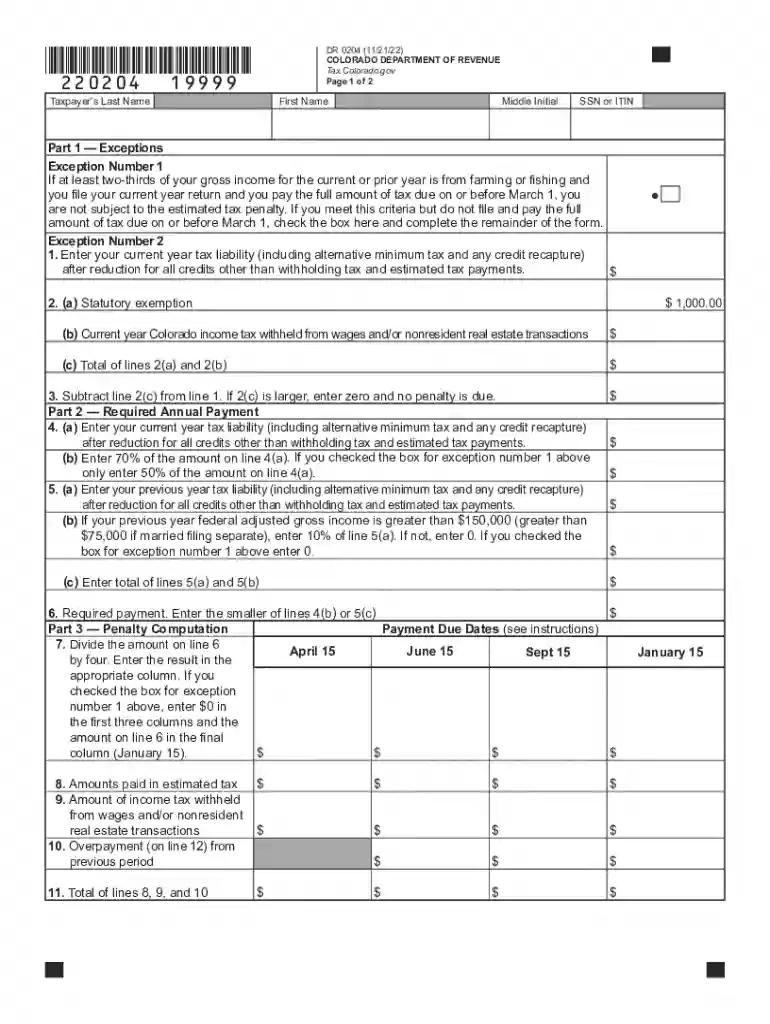
The DR 0204 Tax Year Ending Computation of Penalty Due Based on Estimated Tax Underpayment is crucial for ensuring compliance among Colorado taxpayers. This form is used to calculate any penalties owed due to the underpayment of individual estimated taxes in the state. Taxpayers use this document to determine if their estimated payments fall short of what was owed, which can prevent unexpected liabilities during the tax session. Utilizing this form correctly helps avoid penalties, ensuring that taxpayers remain in good standing with the Colorado Department of Revenue.

How to Use the DR 0204 Form Accurately

  1. Gather Necessary Information: Prior to completing the DR 0204 form, ensure you have all requisite tax documents, including previous year tax returns and current year income and tax data. This information is essential for accurate calculations.

  2. Determine Required Annual Payment: Calculate the required annual payment based on a percentage of your previous year's tax liability or your current year's estimated liability, whichever is lower.

  3. Compute Any Penalties: Use the form to calculate penalties by determining the shortfall between what was paid and what was owed. If no exceptions apply, penalties are calculated based on these figures.

  4. Utilize the Annualized Income Installment Method: If your income varied throughout the year, this method allows for adjusting estimated payments accordingly.

  5. Review for Accuracy: Double-check all entries on the form to ensure accuracy, which minimizes the risk of discrepancies and potential penalties.

Steps to Complete the DR 0204 Form

Filing the DR 0204 form involves a structured approach to ensure precision:

  1. Download the Form: Access the DR 0204 form from the Colorado Department of Revenue website.

  2. Fill Out Personal Information: Enter taxpayer identification information, such as name and Social Security Number.

  3. Calculate Estimated Payments: Determine total estimated payments made throughout the year.

  4. Determine Underpayment: Analyze if there are any discrepancies between what should have been paid and what was paid.

  5. Apply Penalty Calculations: Using the form instructions, compute any penalties due for payments under the required threshold.

  6. Submit the Form: Once complete, submit the DR 0204 with your annual tax return to the Colorado Department of Revenue.

Who Uses the DR 0204 Form?

Typically, the DR 0204 form is applicable to Colorado taxpayers required to pay estimated taxes. This includes:

  • Self-Employed Individuals: Subject to quarterly estimated tax payments due to non-withheld income.
  • Contract Workers: Those receiving income without automatic withholding are required to self-calculate their obligations.
  • Retired Individuals with Sufficient Income: Retirees with substantial income from sources like investments.
  • Small Business Owners and Partners: Business entrepreneurs who have pass-through income.

Key Elements of the DR 0204 Form

  • Taxpayer Identification: Essential to correctly identify the payee, ensuring calculations and any correspondence are accurate.
  • Annualized Income Installment Method Calculation: Allows taxpayers with uneven income to adjust estimated payments accordingly.
  • Penalty Calculation: Detailed instructions provide a step-by-step mechanism for calculating any applicable penalties.

Penalties for Non-Compliance

Failure to file the DR 0204 form or underpayment of estimated taxes can result in significant penalties:

  • Underpayment Penalty: Calculated on discrepancies between estimated and actual payments.
  • Late Payment Penalty: Additional fines incurred by not making timely estimated payments.
  • Interest Accrual: Continued underpayment can result in accruing interest on owed taxes.

Filing Deadlines and Important Dates

  • Quarterly Payment Deadlines: Estimated tax payments are typically due on April 15, June 15, September 15, and January 15 of the following year.
  • Annual Filing Deadline: The DR 0204 form must coincide with the annual tax filing deadline, generally April 15.

Methods for Form Submission

Taxpayers can submit the DR 0204 form in a variety of ways to ensure compliance with state requirements:

  • Online Submission: Electronically file via the Colorado Department of Revenue's website.
  • Mail Submission: Send the completed form via postal services to the designated department address.
  • In-Person Submission: Drop off the form at an authorized collection point, if available.

State-Specific Rules for Colorado

Understanding and adhering to Colorado-specific requirements is essential:

  • Legal Framework: Colorado law dictates the guidelines for compliance, including specific requirements for the estimation method.
  • Variable Penalties and Rates: Specific penalties may change based on legislative adjustments affecting tax liabilities and compliance expectations.

See more DR 0204 Tax Year Ending Computation of Penalty Due Based ... versions

We've got more versions of the DR 0204 Tax Year Ending Computation of Penalty Due Based ... form. Select the right DR 0204 Tax Year Ending Computation of Penalty Due Based ... version from the list and start editing it straight away!
Versions Form popularity Fillable & printable
2023 4.8 Satisfied (45 Votes)
2022 4.9 Satisfied (28 Votes)
2021 4.8 Satisfied (62 Votes)
2020 4.3 Satisfied (206 Votes)
2019 4.2 Satisfied (92 Votes)
2018 4.4 Satisfied (100 Votes)
2017 4.4 Satisfied (102 Votes)
2014 4.3 Satisfied (28 Votes)
be ready to get more

Complete this form in 5 minutes or less

Get form

Got questions?

We have answers to the most popular questions from our customers. If you can't find an answer to your question, please contact us.
Contact us
Generally, most taxpayers will avoid this penalty if they either owe less than $1,000 in tax after subtracting their withholding and refundable credits, or if they paid withholding and estimated tax of at least 90% of the tax for the current year or 100% of the tax shown on the return for the prior year, whichever is
Underpayment penalties accrue interest until the debt is paid. The IRS usually calculates the penalty automatically, but you can proactively check your liability using Form 2210 or an IRS tax underpayment penalty calculator.
The annualized income installment method refigures estimated tax payment installments so it correlates to when the taxpayer earned the money in the year. It is designed to limit underpayment and corresponding underpayment penalties related to uneven payments when a taxpayers income fluctuates throughout the year.
Work out the underpayment amount: amount A = how much the employee should have been paid with respect to a particular entitlement. amount B = how much the employee was actually paid with respect to a particular entitlement. underpayment amount = amount A - amount B.
The penalty will be the appropriate Colorado income tax interest rate times the underpayment for each quarter times the underpayment period. (b) No penalty is due if the Colorado tax liability is less than $5,000.

Security and compliance

At DocHub, your data security is our priority. We follow HIPAA, SOC2, GDPR, and other standards, so you can work on your documents with confidence.

Learn more
ccpa2
pci-dss
gdpr-compliance
hipaa
soc-compliance

People also ask

To calculate the penalty, the IRS multiplies the unpaid tax by the applicable interest rate, prorated for the period the payment is late from the tax returns due date until the date of payment.
You will receive an IRS notice if you underpaid estimated taxes. They determine the tax underpayment penalty by calculating the amount based on the taxes accrued (total tax minus tax credits) on your original tax return or a more recent one you filed.
The Failure to Pay Penalty will not exceed 25% of the total unpaid tax amount. The Failure to Pay Penalty is calculated the following way: The Failure to Pay Penalty is 0.5% of the unpaid taxes for each month or part of a month the tax balance remains unpaid.

colorado tax underpayment penalty