
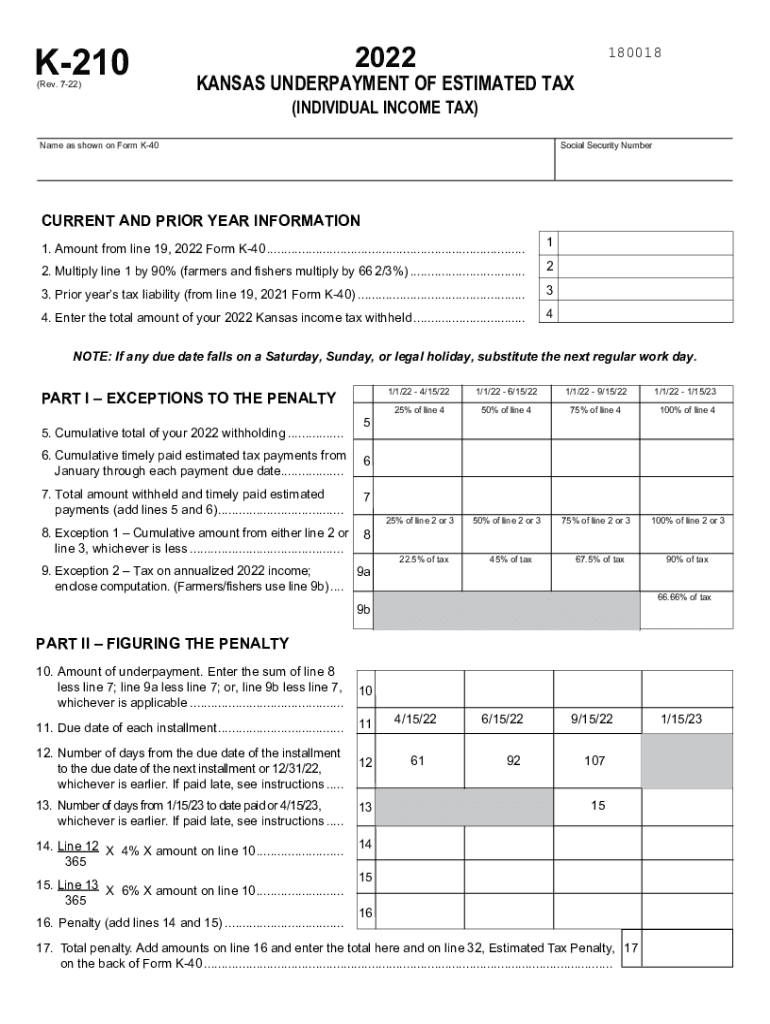







Definition and Purpose of K-210 Underpayment Form
The K-210 Underpayment of Individual Estimated Tax form is a document used by Kansas taxpayers to assess whether they have adequately paid their income tax obligations throughout the year. This is particularly significant for individual taxpayers, including farmers and fishers, who may not have regular withholding but are required to make estimated tax payments. The form helps determine potential penalties for underpayment by comparing estimated tax payments and withholding against actual tax liabilities.
Unique Aspects for Farmers and Fishers
Farmers and fishers often have variable income streams, which can lead to challenges in making accurate estimated tax payments. The K-210 form considers these fluctuations by providing special rules and exceptions that align with IRS guidelines for these professions. It ensures that these groups are not disproportionately penalized due to income variability, thus supporting sustainable agricultural and fishing practices.
Steps to Complete the K-210 Form
-
Gather Required Documents: Start by collecting all relevant documents, such as prior year tax returns, employment pay stubs, and records of estimated tax payments.
-
Calculate Total Income: Determine your total income for the year, including earnings from employment, self-employment, dividends, and other sources.
-
Determine Estimated Tax Payments and Withholding: Identify the amounts pre-paid through estimated tax payments or withheld from your income during the year.
-
Compute Tax Liability: Use the K-210 form to calculate your total tax liability for the year based on Kansas tax laws.
-
Assess Underpayment: Compare the estimated payments and withholding against the total tax liability to identify any underpayment.
-
Calculate Penalties: If there is an underpayment, the form provides guidelines on calculating any applicable penalties.
Key Elements of the K-210 Form
-
Income Calculation Section: This section helps in determining total taxable income, incorporating both earned and unearned income.
-
Estimated Tax Payments: Details spaces to list each estimated payment made during the year, helping in totaling these for comparison with tax liabilities.
-
Penalty Calculation Guidelines: Detailed instructions guide you through assessing penalties for underpayment based on the amount and duration of the shortfall.
Variations for Different Professions
Depending on your occupation, particularly for farmers and fishers, the form offers adjusted calculations to account for income variability. Instructions help tweak the standard computations to more accurately reflect your unique tax scenario.
Filing Deadlines and Important Dates
Kansas residents must adhere to specific deadlines for submitting the K-210 form alongside their state tax returns. Typically, these align with federal tax deadlines, though exceptions exist, notably for farmers and fishers who may qualify for alternative filing dates.
Filing Considerations for Farmers and Fishers
Because their income can be unpredictable, these taxpayers often benefit from extended deadlines. Ensuring compliance with these adjusted timelines is crucial for avoiding penalties.
State-Specific Rules for Kansas
The K-210 form is specific to Kansas and occasionally reflects state-specific tax rules that differ from federal regulations. Understanding these nuances is essential for accurate filing and avoiding unintended penalties. For instance, certain credits available at the state level do not translate directly from federal credits.
Examples of Using the K-210 Form
Example 1: Standard Taxpayer
Scenario: A salaried employee realizes they underpaid their estimated taxes after calculating their year-end liabilities. By using the K-210, they quantify their penalty and adjust their tax strategies for next year.
Example 2: Farmer
Scenario: A Kansas farmer, with fluctuating income due to varying crop yields, uses the K-210 form to apply special tax rules. They determine no penalty is due due to the adjusted methodologies for calculating estimated taxes in their occupation.
Penalties for Non-Compliance
Failing to submit the K-210 form or committing errors in calculations can result in penalties, including financial fines. These penalties often depend on the extent of underpayment and the time frame involved. Understanding these repercussions underscores the importance of accuracy in completing the form.
Calculating Penalties
Using the step-by-step guidelines in the form, taxpayers can determine potential penalties and take corrective action, such as adjusting estimated payments for the next tax year, to avoid future infractions.
Digital vs. Paper Version
The K-210 form is available in both digital and paper formats. Digital submissions allow for quicker processing and immediate confirmation of receipt, while traditional paper submissions might appeal to those less comfortable with technology. Compatibility with tax software can streamline the digital filing process.
Who Typically Uses the K-210 Form
Typically, individuals with irregular income streams or those who engage in self-employment, such as freelance consultants, utilize the K-210 form. Retirees with fluctuating investment income might also find this form valuable. Understanding the diverse user scenarios helps tailor approaches to filing and compliance.


State-by-State Differences
While the K-210 form is specific to Kansas, other states might have analogous forms with different rules and deadlines. Understanding these differences is critical for taxpayers who might move between states or hold multiple state-specific tax obligations.




