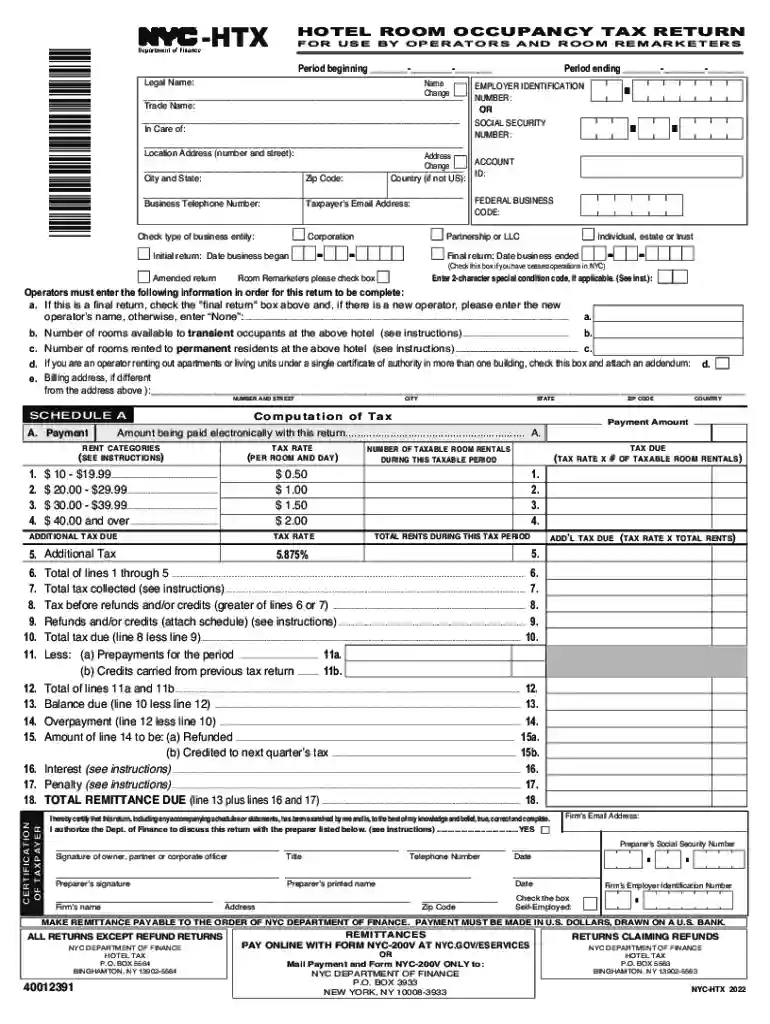
Request for Ruling Hotel Room Occupancy Tax FLR#024791 ... 2026

Get Form
Request for Ruling Hotel Room Occupancy Tax FLR#024791 ... Preview on Page 1

Here's how it works

01. Edit your form online
Type text, add images, blackout confidential details, add comments, highlights and more.

02. Sign it in a few clicks
Draw your signature, type it, upload its image, or use your mobile device as a signature pad.

03. Share your form with others
Send it via email, link, or fax. You can also download it, export it or print it out.

Definition & Meaning

The Request for Ruling Hotel Room Occupancy Tax FLR#024791 is a formal document used by hotel operators and room remarketers to seek clarification on specific tax obligations related to room occupancy. It encompasses the evaluation and interpretation of tax regulations, allowing entities to ensure compliance with New York City's hotel room occupancy tax laws. This form is essential in determining how particular rules apply to unique circumstances, providing businesses with guidance to correctly compute and remit applicable taxes.


Steps to Complete the Request for Ruling Hotel Room Occupancy Tax FLR#024791

  1. Gather Required Information: Collect all pertinent details about your business, including legal name, business address, and tax identification numbers. Ensure you have comprehensive information about the types of room rentals you offer.
  2. Understand Tax Regulations: Familiarize yourself with the city-specific rules and recent changes in hotel occupancy tax laws. This will assist in accurately completing the form.
  3. Complete the Form: Fill out the form with precise information regarding your queries or situations requiring a tax ruling. Provide detailed scenarios or descriptions to facilitate a clear understanding of your request.
  4. Attach Supporting Documentation: Include any documents that support your request, such as previous tax filings, business contracts, or any correspondence relating to tax obligations.
  5. Submit the Form: Determine the appropriate submission method, whether online, through mail, or in person, following the guidelines provided by the relevant tax authority.

Who Typically Uses the Request for Ruling Hotel Room Occupancy Tax FLR#024791

  • Hotel Operators: Businesses operating hotels in New York City need clarity on how occupancy taxes apply to their specific situations.
  • Room Remarketers: Entities involved in reselling room occupancy, such as travel agents or booking platforms, use this form to understand their tax liabilities.
  • Tax Professionals: Accountants or legal advisors assisting clients in determining precise tax compliance standards can facilitate filling out and submitting the form.
decoration image ratings of Dochub

Key Elements of the Request for Ruling Hotel Room Occupancy Tax FLR#024791

  • Legal Name and Business Address: Essential for identifying the entity requesting a ruling.
  • Tax Computations and Scenarios: Sections for outlining specific tax questions or scenarios, including detailed descriptions of room rentals.
  • Supporting Documentation: A requirement to attach documents that provide evidence or context for the ruling request.

Legal Use of the Request for Ruling Hotel Room Occupancy Tax FLR#024791

This form serves as a formal mechanism to obtain an official interpretation of tax rules applicable to specific business activities within the hotel and accommodation sector. By using this form, businesses can proactively address potential compliance issues and avoid penalties associated with misinterpretation of tax laws. It is legally binding in that it provides a precedent or basis for tax computations once a ruling is issued.

Penalties for Non-Compliance

Failure to obtain or follow a ruling on hotel occupancy tax can result in significant penalties. These might include:

  • Fines and Interest: Monetary penalties due to underpayment or late payment of taxes.
  • Legal Action: Potential legal proceedings for continued non-compliance or negligence in tax reporting.
  • Increased Scrutiny: Enhanced audits or investigations by tax authorities.

State-Specific Rules for the Request for Ruling Hotel Room Occupancy Tax FLR#024791

While this form addresses New York City-specific occupancy tax rules, businesses should be aware of variations in tax regulations if operating in multiple states. Each state may have its own definitions, rates, and filing procedures that impact how hotel occupancy taxes are applied.

IRS Guidelines

Though primarily a state-level tax issue, compliance with the Request for Ruling Hotel Room Occupancy Tax FLR#024791 may also involve alignment with federal tax policies. The IRS provides overarching guidelines for the documentation and reporting of income and expenses related to lodging services, which may impact the information supplied in this request.

Filing Deadlines / Important Dates

Adhering to filing deadlines is crucial to avoid penalties. The specific timing for submitting the Request for Ruling Hotel Room Occupancy Tax FLR#024791 should coincide with any relevant tax reporting periods or changes in business practices. Timeliness ensures that businesses receive the ruling before a tax liability arises.

See more Request for Ruling Hotel Room Occupancy Tax FLR#024791 ... versions

We've got more versions of the Request for Ruling Hotel Room Occupancy Tax FLR#024791 ... form. Select the right Request for Ruling Hotel Room Occupancy Tax FLR#024791 ... version from the list and start editing it straight away!
Versions Form popularity Fillable & printable
2022 4.4 Satisfied (47 Votes)
2021 4.9 Satisfied (43 Votes)
2020 4.3 Satisfied (162 Votes)
2019 4.3 Satisfied (36 Votes)
2018 4.4 Satisfied (135 Votes)
2017 4.3 Satisfied (135 Votes)
2015 4.4 Satisfied (315 Votes)
be ready to get more

Complete this form in 5 minutes or less

Get form

Got questions?

We have answers to the most popular questions from our customers. If you can't find an answer to your question, please contact us.
Contact us
Every facility providing short-term lodging (less than 30 days) for a fee in Suffolk County is required to collect an occupancy tax from persons occupying such rooms at the rate of 5.5% of the per-diem rental rate charged for each room effective June 1, 2023.
Employees of the federal government (including military personnel) and New York State and its political subdivisions who occupy hotel rooms or short-term rental units while traveling on official business are not subject to sales tax.
Provide the completed Form ST-129 to the hotel operator, short-term rental unit operator, or booking service upon booking or check in. You must also provide the operator or booking service with proper identification. Sign and date the exemption certificate.
Yes, hotel occupancy tax is 14.875% in NYC. It all depends who you have booked with (thatll determine if youve already paid it) All hotels charge 14.75% plus $3.50 per night tax. Governed by the city.
The tax rate is 5.875% of the room rate. Additionally, theres a flat fee of $2 per day for rooms costing more than $40 per night. New York City also has a luxury tax on items like high-end jewelry, furs, and certain other expensive goods, although this is less commonly encountered.

Security and compliance

At DocHub, your data security is our priority. We follow HIPAA, SOC2, GDPR, and other standards, so you can work on your documents with confidence.

Learn more
ccpa2
pci-dss
gdpr-compliance
hipaa
soc-compliance
be ready to get more

Complete this form in 5 minutes or less

Get form

People also ask

New York City Tax 5.875% NYC Hotel Room Occupancy Tax Rate $2 per room. New York State Hotel Unit Fee (aka Javits Center fee) $1.50 per unit per day.
Exemption from taxes imposed on purchases of hotel stays and other lodging (including short-term property rentals and corporate housing arrangements) in the United States on the basis of the diplomatic or consular status of the purchasing foreign mission or accredited mission member or dependent is authorized by the
Occupancy tax is simply another name for hotel tax, lodging tax and bed tax. Its the name, or one of the names, used by many states, including Alabama, California, Connecticut, Illinois, New Jersey, Tennessee, Texas, Virginia and West Virginia.

Related links