




01. Edit your form online
Type text, add images, blackout confidential details, add comments, highlights and more.

Type text, add images, blackout confidential details, add comments, highlights and more.

Draw your signature, type it, upload its image, or use your mobile device as a signature pad.

Send it via email, link, or fax. You can also download it, export it or print it out.
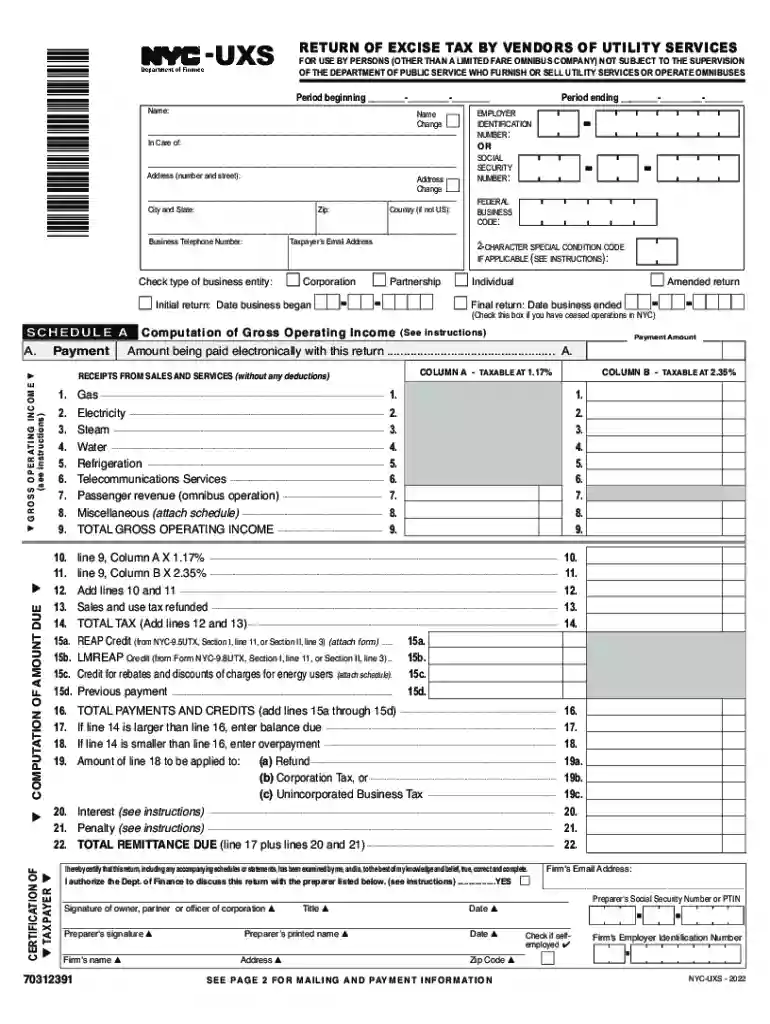
The "Return of Excise Tax by Vendors of Utility" form is a crucial document for vendors providing utility services in New York City. This form pertains specifically to the declaration and payment of excise taxes on the gross operating income derived from services like gas, electricity, steam, water, and telecommunications. Excise taxes are imposed by municipal governments and are levied on specific goods and services, making this form an essential compliance requirement for utility vendors. The form serves to ensure vendors accurately report their income and remittances, aligning with New York City tax regulations.
Completing the "Return of Excise Tax by Vendors of Utility" form involves several systematic steps to ensure compliance and accuracy.
Gather Necessary Information: Before beginning the form, collect all relevant financial documents reflecting your gross operating income from utility services.
Fill out Taxpayer Information: Enter your business details, including name, address, and taxpayer identification number.
Computation of Tax Due: Calculate the excise tax owed by taking into account the gross income from your utility services. This may involve detailed calculations based on varied tax rates applicable to different services.
Payment Instructions: Include information about how you intend to make the payment, whether electronically or via mail, ensuring the funds are readily available to prevent delays.
Review for Accuracy: Before submission, double-check all inputs for accuracy to avoid penalties or interest from incorrect filing.
File Your Return: Submit the completed document by the due date using the appropriate submission method, which can be online through a tax portal or by mail.
Vendors providing essential utility services such as gas, electricity, steam, water, and telecommunications within New York City are the primary users of this form. These vendors are generally businesses that have a substantial customer base relying on consistent service provision. The form is pertinent not only to large corporations but also to smaller utilities and service providers that generate taxable income within city limits.


Understanding specific terms related to the form is crucial for accurate completion.
The legal aspect of this form ensures that businesses comply with New York City tax regulations. Filing it correctly and timely is not just a procedural requirement but a legal obligation. Non-compliance can result in penalties or legal challenges, underscoring the need for accurate and timely submission.
The form includes several critical elements that facilitate the accurate reporting of taxes.
The "Return of Excise Tax by Vendors of Utility" is specifically configured to align with New York City's unique taxation laws and requirements. Vendors need to be attentive to NYC-specific regulations, such as differing tax rates and exemption criteria for certain services.
An understanding of crucial deadlines is vital for timely compliance.
Failure to accurately complete and file the "Return of Excise Tax by Vendors of Utility" form within the specified timeline can result in financial penalties.
Vendors can use this form to:
Understanding these examples helps tailor the form usage to specific utility types.
The eligibility to file this form is predicated on:

The process of form submission is generally straightforward but necessitates attention to detail to ensure swift approval and avoid rejections or amendments.
Employing the right approach ensures rightful compliance with state tax requirements.
We've got more versions of the RETURN OF EXCISE TAX BY VENDORS OF UTILITY ... form. Select the right RETURN OF EXCISE TAX BY VENDORS OF UTILITY ... version from the list and start editing it straight away!
| Versions | Form popularity | Fillable & printable |
|---|---|---|
| 2025 | 4.6 Satisfied (51 Votes) | |
| 2024 | 4.3 Satisfied (48 Votes) | |
| 2023 | 4.3 Satisfied (43 Votes) | |
| 2022 | 4.8 Satisfied (47 Votes) | |
| 2021 | 4.8 Satisfied (69 Votes) | |
| 2020 | 4.3 Satisfied (271 Votes) | |
| 2019 | 4.1 Satisfied (31 Votes) | |
| 2018 | 3.9 Satisfied (31 Votes) | |
| 2017 | 4.4 Satisfied (50 Votes) | |
| 2016 | 4.4 Satisfied (636 Votes) | |
| 2015 | 4 Satisfied (24 Votes) | |
| 2014 | 4 Satisfied (27 Votes) | |
| 2013 | 4 Satisfied (47 Votes) |
At DocHub, your data security is our priority. We follow HIPAA, SOC2, GDPR, and other standards, so you can work on your documents with confidence.


