
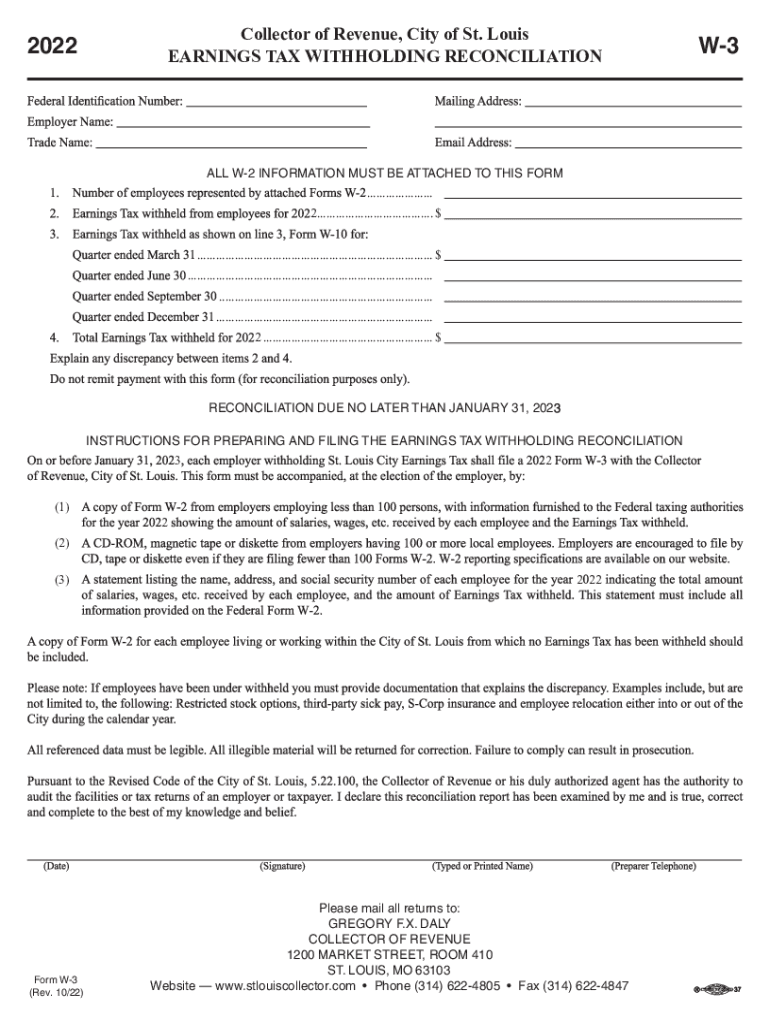







Definition and Meaning of Form W-3
Form W-3, also known as the Transmittal of Wage and Tax Statements, is a critical document used by employers in the United States to transmit information regarding their employees' earnings and withheld taxes to the Social Security Administration (SSA). This form accompanies the W-2 forms for each of the employer's employees. The "NEW 398 Form W-3 (Oct 2022)" version reflects updates made to accommodate any legislative changes in its design or filing requirements, ensuring that employers submit accurate and complete tax information for compliance purposes.
Steps to Complete Form W-3
-
Gather Necessary Documents: Before filling out the form, collect all W-2 forms for the tax year. Each employee's earnings and tax withholdings should be thoroughly reviewed.
-
Complete Employer Information: Enter the employer's identification details, including the Employer Identification Number (EIN), name, address, and contact information.
-
Summarize Employee Data: On Form W-3, consolidate the total wages, tips, and other compensation from all the W-2 forms. Ensure accurate tallies for federal income tax withheld, Social Security wages, and Medicare wages.
-
Validate Totals: Double-check that the totals on Form W-3 match the combined totals from all submitted W-2 forms. Discrepancies can lead to processing errors or penalties.
-
Final Review and Submission: Verify all entered information. Submit the completed Form W-3 alongside the W-2 forms to the SSA by the designated deadline, either electronically or through mail.
How to Obtain the Form W-3
Employers can obtain the latest version of Form W-3 from the Social Security Administration's website or the IRS. Often included with W-2 forms in tax software packages, it ensures seamless preparation and submission. Employers can request physical copies directly from the IRS if unable to print from the digital formats.
Legal Use of Form W-3
Form W-3 serves a crucial legal purpose by enabling employers to report annual tax information about their employees to the SSA. It facilitates the accurate processing of tax returns and Social Security contributions, ensuring that employee earnings are appropriately recorded and substantiated for federal purposes. Compliance with federal tax filing requirements hinges on thorough and timely submission of Form W-3.
Important Terms Related to Form W-3
- W-2 Forms: Detailed employee wage statements that include total earnings and tax withholdings over the year.
- EIN (Employer Identification Number): A unique number assigned to employers for tax filing and reporting purposes.
- Social Security Wage Base: The maximum amount of wages subject to Social Security tax for a given year.
Filing Deadlines and Important Dates
Form W-3, accompanied by W-2 forms, must be filed by January 31st following the tax year. Employees must also receive their copies of the W-2s by this date, ensuring ample time for taxpayers to prepare their individual income tax returns. Late filings may incur penalties, making attention to deadlines imperative.
Software Compatibility
Form W-3 can be completed and submitted using various tax filing software such as TurboTax or QuickBooks. These programs streamline the process by pre-filling relevant information and validating entries against employee W-2 data. Additionally, such software facilitates electronic filing, reducing errors and providing confirmation of receipt by the SSA.
Penalties for Non-Compliance
Failing to submit Form W-3 by the deadline, or providing inaccurate information, can lead to substantial penalties. The IRS may impose fines up to a certain amount per form, multiplied by the number of returns. Penalties increase for flagrant non-compliance or deliberate misinformation, underscoring the importance of diligence in preparation and submission.
Digital vs. Paper Version
Employers have the option to file Form W-3 using either a digital or paper format. Electronic filing, usually through the SSA's Business Services Online portal, is encouraged for accuracy, quick processing, and confirmation of receipt. Notably, employers submitting 250 or more W-2 forms are required to file electronically unless granted a waiver by the IRS.




