Type text, add images, blackout confidential details, add comments, highlights and more.

02. Sign it in a few clicks
Draw your signature, type it, upload its image, or use your mobile device as a signature pad.

03. Share your form with others
Send it via email, link, or fax. You can also download it, export it or print it out.

How to use or fill out Rental Surcharge Tax Information - CT.gov with our platform
Ease of Setup
DocHub User Ratings on G2
Ease of Use
DocHub User Ratings on G2
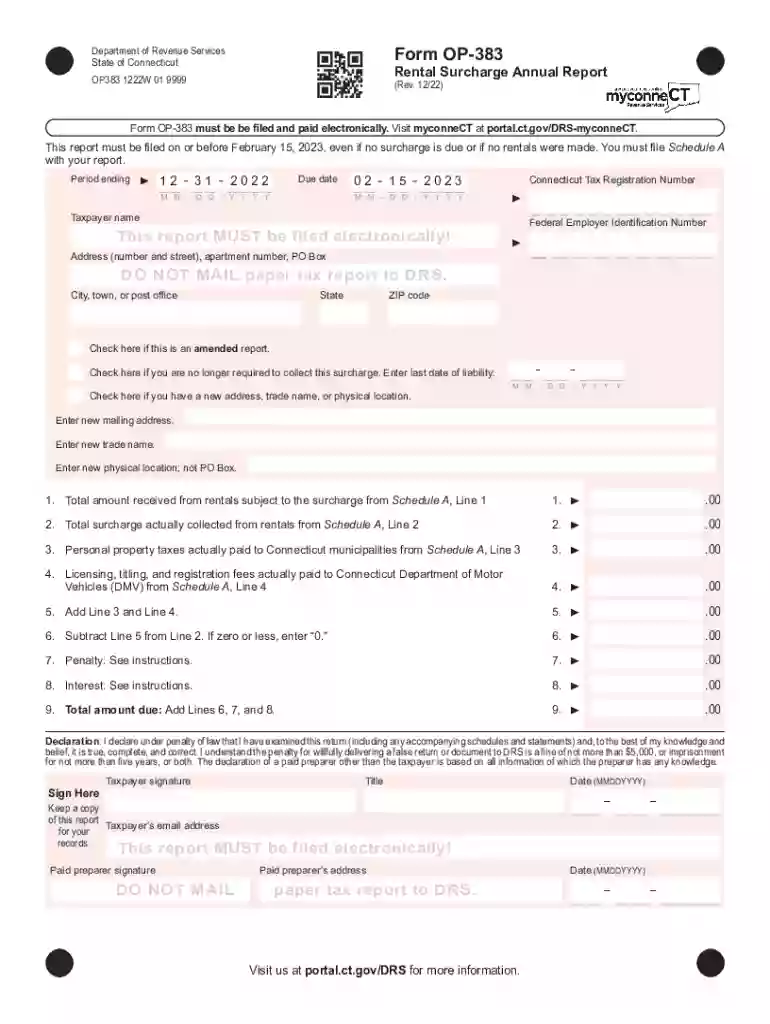
Click ‘Get Form’ to open the Rental Surcharge Annual Report (Form OP-383) in the editor.
Begin by entering your Connecticut Tax Registration Number and Federal Employer Identification Number in the designated fields.
Fill in your taxpayer name, address, and check any applicable boxes regarding amended reports or changes in your business status.
Complete Schedule A first by reporting each piece of machinery rented during the year. Enter details such as vehicle identification numbers and amounts received from rentals.
Calculate the total surcharge collected and personal property taxes paid, ensuring to enter these amounts on Form OP-383 as instructed.
Review all entries for accuracy, sign where indicated, and ensure you keep a copy of the report for your records before submitting electronically.
Start using our platform today to streamline your form completion process for free!
Fill out Rental Surcharge Tax Information - CT.gov online It's free
See more Rental Surcharge Tax Information - CT.gov versions
We've got more versions of the Rental Surcharge Tax Information - CT.gov form. Select the right Rental Surcharge Tax Information - CT.gov version from the list and start editing it straight away!
Rental income is considered taxable income and must be reported on your tax return. If unreported it can lead to penalties and interest, audits, criminal charges, or in extreme cases liens and levies.
What is rental surcharge?
Equipment Rental Surcharges refer to an extra charge, tax, or a fee added on to the cost of equipment rental agreement. Traditionally, it not included in the quoted price and is often very difficult to determine the true cost.
What is the 7.35% tax in Connecticut?
Added to the base state sales tax rate of 6.35%, that makes Connecticuts prepared food tax rate 7.35% . Connecticuts restaurant tax applies to: Food and beverages sold for human consumption at the sellers location. Food products sold in forms and portions that make them ready for immediate consumption (ex.
Do renters pay property tax in CT?
The owner of the property is responsible for property taxes. It is one of the reasons that the cost of rent increases every year.
Is rental income taxable in Connecticut?
For real estate owners of apartment buildings, rental homes, or even individual rental units, they must report rental income on Form 1040, Schedule E.
Security and compliance
At DocHub, your data security is our priority. We follow HIPAA, SOC2, GDPR, and other standards, so you can work on your documents with confidence.
Also exempt are: Food products, including meals, sold through coin-operated vending machines. Meals delivered to persons who are sixty years of age or older, have physical disabilities or are otherwise homebound. Purchases made with supplemental nutrition assistance program benefits.
What taxes do you have to pay on rental income?
In addition to federal taxes, rental income may be subject to state and local taxes, varying based on property location and jurisdiction. Some states, like California, impose progressive income tax systems with rates ranging from 1% to 13.3%, contingent upon income level and filing status.
What is the tourism account surcharge in CT?
A surcharge of $1 per day or portion of a day is imposed on every lessor for the rental or lease of a passenger motor vehicle delivered to a lessee in Connecticut (regardless of where the vehicle is subsequently used) for a term of 30 consecutive calendar days or less.
Related links
Postal Bulletin 22539: Your 2020 Election and Political Mail
Feb 14, 2020 General for Tax Administration at treasury.gov/tigta. More information is available on the official IRS web- site (irs.gov/). Never use your
Rental Surcharge Information First offense 10% penalty on the amount of the required tax payment, but not more than $2,500; Second offense 10% penalty,
Cookie consent notice
This site uses cookies to enhance site navigation and personalize your experience.
By using this site you agree to our use of cookies as described in our Privacy Notice.
You can modify your selections by visiting our Cookie and Advertising Notice.