




01. Edit your california bonus depreciation 2022 online
Type text, add images, blackout confidential details, add comments, highlights and more.

Type text, add images, blackout confidential details, add comments, highlights and more.

Draw your signature, type it, upload its image, or use your mobile device as a signature pad.

Send ftb 3885l via email, link, or fax. You can also download it, export it or print it out.
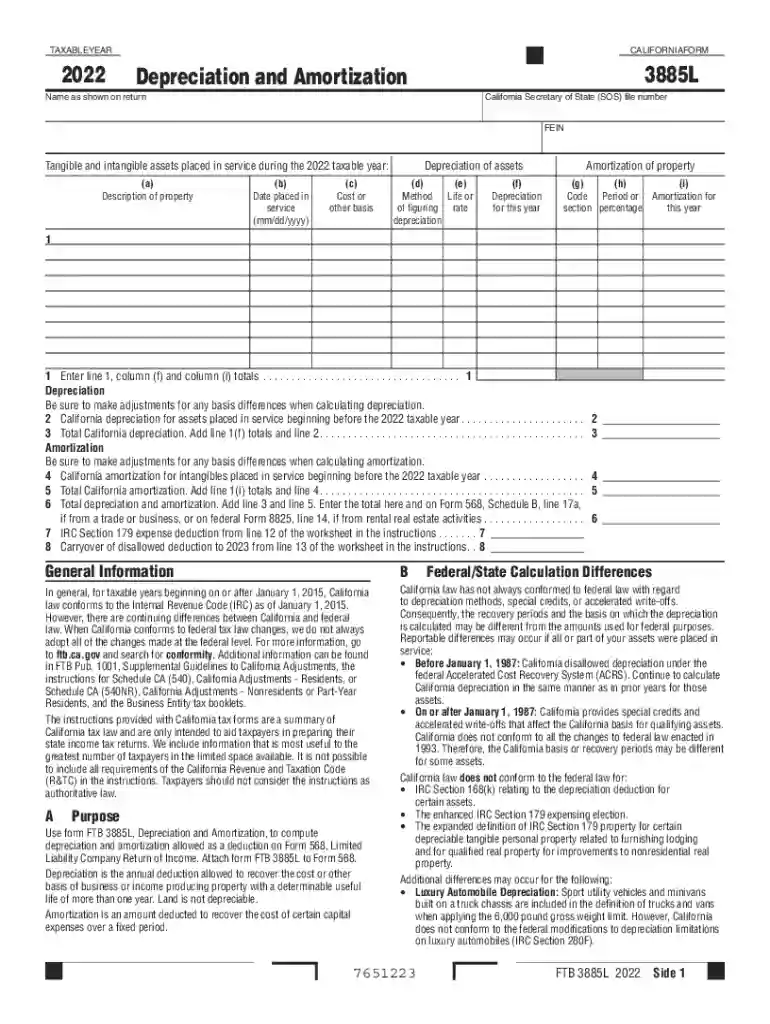
The 2022 California Form 3885L is specifically designed for Limited Liability Companies (LLCs) to compute the depreciation and amortization of tangible and intangible assets placed in service during the taxable year. This form captures information essential for calculating deductions that align with both state-specific and federal tax regulations. By detailing asset descriptions, costs, depreciation methods, and adjustments for California-federal differences, LLCs can precisely report and deduct asset depreciation while ensuring compliance with tax laws.
Using the 2022 California Form 3885L requires a systematic approach to accurately reflect asset depreciation. Begin by detailing each asset's description, acquisition cost, and service start date. Allocate the correct depreciation method for each, such as straight-line or declining balance, based on asset type and intended use. Amend entries to account for variations between California and federal tax laws, ensuring all calculations reflect these differences before finalizing the form for submission.
The primary users of the 2022 California Form 3885L are Limited Liability Companies (LLCs) operating within California. These entities typically seek to accurately document and report depreciation to optimize taxable income deductions. LLCs with a wide range of asset portfolios spanning equipment, property, and vehicles are frequent utilizers of this form, benefiting from structured depreciation reporting.


California's unique tax laws may result in differences from federal regulations. Significant variations often include limits on bonus depreciation and adjustments for prior year’s AMT (Alternative Minimum Tax). Understanding and integrating these state-specific rules is crucial to avoid inaccuracies and potential penalties.
For instance, an LLC acquiring a fleet of delivery vehicles will use Form 3885L to determine the depreciation for each vehicle. By reporting accurate cost and service dates, selecting a depreciation method, and applying California-related tax adjustments, the LLC optimizes their deductions and tax filings. Similarly, intangible assets such as patents would be amortized, considering specific service periods and costs.
The filing deadline for the 2022 California Form 3885L aligns with the annual state tax return due dates. For most taxpayers, this date typically falls on April 15, with extensions possible until October 15 if applied before expiration. Timely submission prevents late fees and additional interest charges.
Entities have the option of submitting the form through traditional mail, electronic filing (e-file), or in-person at authorized state offices. Each method provides flexibility in line with the LLC’s preferences or technological capabilities. E-filing is recommended due to its speed and efficiency, reducing processing time and manual handling errors.
While LLCs are the principal users, other entities such as S corporations, C corporations, and partnerships operating with substantial assets within California may also benefit. Utilizing this form ensures consistent and precise asset reporting across different business structures, facilitating effective financial management and compliance.
We've got more versions of the california bonus depreciation 2022 form. Select the right california bonus depreciation 2022 version from the list and start editing it straight away!
At DocHub, your data security is our priority. We follow HIPAA, SOC2, GDPR, and other standards, so you can work on your documents with confidence.
Jun 15, 2023 SINCE YOU HAVE THE FINAL RESPONSIBILITY FOR THE TAX RETURNS, YOU. SHOULD REVIEW THEM CAREFULLY BEFORE YOU SIGN AND FILE THEM OR AUTHORIZE THEM.Read more
Use form FTB 3885L, Depreciation and Amortization, to compute depreciation and amortization allowed as a deduction on Form 568, Limited. Liability CompanyRead more


