







Definition & Meaning
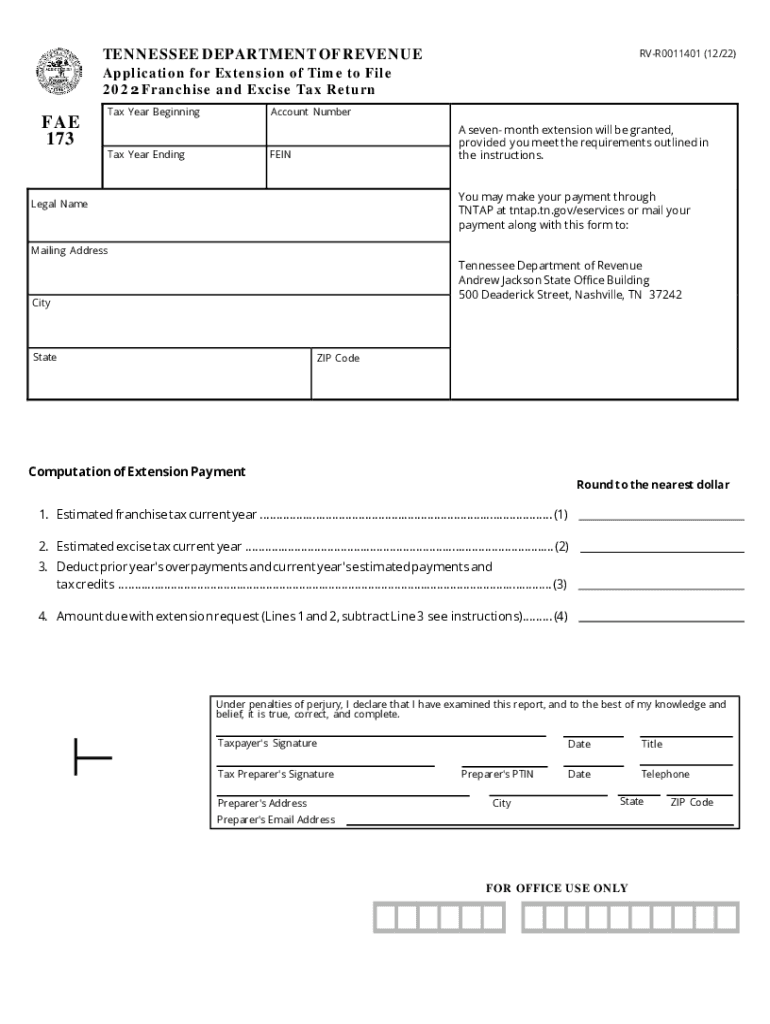
The FAE173, also known as the Application for Extension of Time to File, is crucial for taxpayers seeking additional time to submit their Franchise and Excise Tax Return. This form is issued by the Tennessee Department of Revenue and is particularly relevant for entities that require a delay beyond the standard deadline. The application serves to formalize the request for a seven-month extension, providing businesses with the necessary time to gather and submit accurate tax information. This form is essential for compliance, ensuring that businesses can meet tax obligations without incurring penalties due to late filing.
How to Use the FAE173
Utilizing the FAE173 effectively involves understanding its purpose and process. This form is designed to extend the deadline for filing the Franchise and Excise Tax Return, offering businesses an additional seven months to submit their paperwork. To use the form, taxpayers must ensure they are eligible and comply with the outlined conditions, such as paying any estimated taxes due. Once eligibility is confirmed, the form must be completed with detailed information about the taxpayer and the estimated taxes paid or owed. Submission options include online, by mail, or in person, accommodating a range of preferences and needs.
How to Obtain the FAE173
The FAE173 form can be accessed directly from the Tennessee Department of Revenue's official website. This ensures that users have the most up-to-date version of the form and follow current procedures. Additionally, the form can be requested through tax preparation software compatible with state tax filing, such as TurboTax or QuickBooks, facilitating seamless integration with other tax documents. Taxpayers may also consult with a tax professional, who can provide guidance on accessing and completing the form based on specific business needs.
Steps to Complete the FAE173
- Verify Eligibility: Ensure your business meets the criteria for requesting an extension.
- Gather Necessary Information: Collect details about your business entity, tax identification number, and estimated tax liabilities.
- Complete the Form: Fill in the required sections, including business details and the estimated tax payment amount.
- Calculate Estimated Payments: Determine and pay any estimated taxes owed before submitting the extension request.
- Review for Accuracy: Double-check all entered information to prevent errors that could delay the approval process.
- Submit the Form: Choose a submission method—online, mail, or in-person—that best fits your preference.
- Retain Proof of Submission: Keep a copy of the submitted form and any confirmation received for your records.
Important Terms Related to FAE173
- Franchise Tax: A tax imposed on businesses for the privilege of operating in the state.
- Excise Tax: A tax calculated based on the net income of a business.
- Estimated Tax Payments: Payments made towards anticipated tax liability for the year.
- Extension Period: The additional time granted beyond the original filing deadline.
- Tax Liability: The total amount of tax that a business owes to the state.
Filing Deadlines / Important Dates
The standard deadline for filing the Franchise and Excise Tax Return is the 15th day of the fourth month following the close of the fiscal year. With an approved FAE173, this deadline extends by seven months. It's critical to meet the initial extension request deadline to avoid penalties. For entities operating on a calendar year basis, this typically means filing the extension by April 15 or October 15 with the extension.
Required Documents
Businesses must provide documentation that supports their request for an extension. Required documents include the completed FAE173 form, proof of estimated tax payments, and any relevant financial statements that substantiate the estimated liability. Accurate and comprehensive documentation ensures that the extension request is processed without unnecessary delays or complications.
Penalties for Non-Compliance
Failure to submit the FAE173 by the designated deadline or failure to pay estimated taxes can result in significant penalties. These may include a late filing penalty, calculated as a percentage of the unpaid tax liability, and interest on any unpaid balance. Ensuring compliance with the rules outlined for the FAE173 is essential to avoid financial repercussions and maintain good standing with the Tennessee Department of Revenue.




