




01. Edit your form online
Type text, add images, blackout confidential details, add comments, highlights and more.

Type text, add images, blackout confidential details, add comments, highlights and more.

Draw your signature, type it, upload its image, or use your mobile device as a signature pad.

Send it via email, link, or fax. You can also download it, export it or print it out.
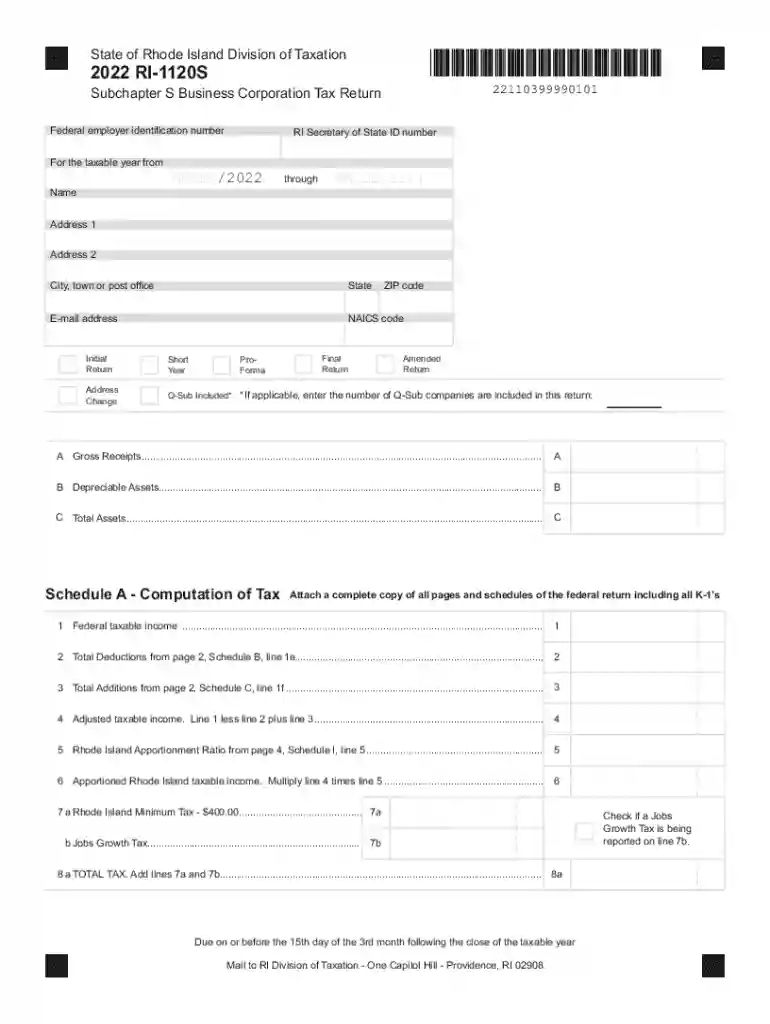
The Corporate Tax FormsRI Division of Taxation - RI.gov refers to a series of documents issued by the Rhode Island Division of Taxation to facilitate the tax filing process for businesses operating within the state. These forms are essential for corporations to report their taxable income, calculate their corporate tax liabilities, and claim any applicable deductions or credits. They ensure compliance with state tax laws and contribute to maintaining accurate records for audits and assessments by tax authorities.
To effectively use these forms, businesses should begin by identifying the specific form that corresponds to their entity type and tax obligations. For instance, S corporations in Rhode Island would typically complete the RI-1120S form, among others. The form includes sections for reporting gross receipts, allowable deductions, and any adjustments to federal taxable income. Proper completion involves filling out each section accurately, supported by financial documentation where necessary. It is crucial to follow the instructions provided with these forms to avoid errors and potential penalties.
Corporate tax forms from the Rhode Island Division of Taxation can be obtained through multiple channels. They are accessible via the Rhode Island Division of Taxation's official website, where businesses can download the necessary forms in PDF format. Additionally, forms may be available at the Division of Taxation's physical offices for in-person pick-up. Moreover, tax professionals and software platforms often provide access to these forms as part of their service offerings, ensuring businesses can select the most convenient method for acquiring the documentation.
Identify Required Forms: Determine which specific forms are required based on your business type and tax structure.
Gather Required Documentation: Assemble all financial records, including income statements, balance sheets, and any relevant tax documents.
Complete Each Section: Methodically fill out each section of the form, ensuring accuracy in reporting financial figures.
Review for Accuracy: Double-check all entered information, as errors can lead to delays or additional tax liabilities.
Submit Form: Choose a submission method—online, by mail, or in-person—that aligns with deadlines and convenience.
These forms are primarily used by business entities operating within Rhode Island, including corporations, S corporations, and LLCs. They are essential tools for accountants, tax professionals, and business owners tasked with managing corporate tax responsibilities. Additionally, the forms are indispensable for legal advisors assisting businesses in maintaining compliance with state tax requirements.


Taxpayer Information: Details including the business name, address, and federal employer identification number (FEIN).
Income and Deductions: Sections to report gross income and allowable deductions that reduce taxable income.
Tax Calculation: Fields to compute state corporate tax based on reported figures and applicable rates.
Signatures and Declarations: A section requiring authorized representatives to certify the accuracy of the information provided.
The Rhode Island Division of Taxation prescribes specific deadlines for corporate tax filings. Typically, corporate tax returns must be filed by the fifteenth day of the fourth month after the end of the company's fiscal year. It is crucial for businesses to adhere to these deadlines to avoid penalties and interest on unpaid taxes. Extensions may be available, but they usually require a formal request and, in some cases, a prepayment of estimated tax.
While the IRS provides overall frameworks for corporate taxation under federal law, businesses must also comply with state-specific rules outlined by the Rhode Island Division of Taxation. These rules may include unique deductions or tax credits applicable only within the state, differing apportionment formulas for multi-state corporations, and specific reporting requirements distinct from federal mandates.
Failure to comply with filing requirements of Rhode Island’s corporate tax forms can result in significant penalties. These may include fixed monetary fines, interest on unpaid taxes, and potential legal action by the state against non-compliant entities. Moreover, inaccuracies in filing can trigger audits or investigations that disrupt business operations. To mitigate these risks, businesses often engage tax professionals for guidance and verification before submission.
We've got more versions of the Corporate Tax FormsRI Division of Taxation - RI.gov form. Select the right Corporate Tax FormsRI Division of Taxation - RI.gov version from the list and start editing it straight away!
At DocHub, your data security is our priority. We follow HIPAA, SOC2, GDPR, and other standards, so you can work on your documents with confidence.
Federal Form W-4 can no longer be used for Rhode Island withholding purposes. You must complete Form RI W-4 for your employer(s).Read more
Corporate Tax Forms To have forms mailed to you, please call 401.574.8970 Corporate tax forms now contain a 1D barcode. Please use Microsoft Edge to get theRead more


