




01. Edit your oxford hip score online
Type text, add images, blackout confidential details, add comments, highlights and more.

Type text, add images, blackout confidential details, add comments, highlights and more.

Draw your signature, type it, upload its image, or use your mobile device as a signature pad.

Send oxford hip score calculator via email, link, or fax. You can also download it, export it or print it out.
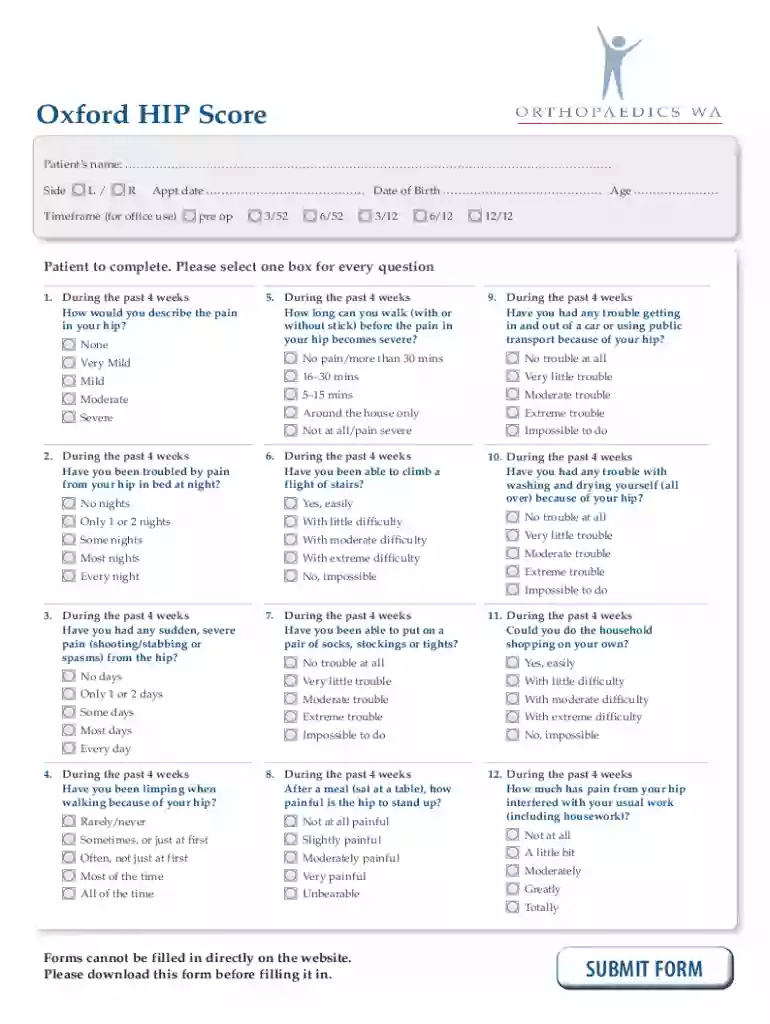
The Oxford HIP Score is a validated questionnaire used in clinical settings to evaluate hip-related issues and assess a patient's pain and functional limitations. Specifically, it captures the patient's experience concerning their hip health over the last four weeks, which is crucial for both diagnosing conditions and planning treatments. This score is measured on a scale from zero to forty-eight, where a lower score indicates more severe symptoms.
The score is primarily utilized in orthopaedic settings to gauge the effectiveness of surgical interventions, such as total hip arthroplasty, and track rehabilitation progress over time. The questions included in the questionnaire address various aspects of daily living and mobility, enabling healthcare professionals to obtain a comprehensive view of the patient's condition.
Using the Oxford HIP Score requires a systematic approach to ensure accurate assessment. Healthcare professionals typically administer the score during consultations with patients experiencing hip pain or discomfort.
Explain the Process: Before administering the score, the clinician should explain the purpose and significance of the questionnaire to the patient, ensuring they understand its role in assessing their condition.
Questionnaire Completion: Patients answer a series of questions related to their pain levels, mobility, and how their hip problems affect daily activities. Each question provides multiple-choice answers, reflecting varying degrees of difficulty or pain.
Calculating the Score: Once the patient completes the questionnaire, the clinician tallies the scores for each question. The total score gives insights into the patient's current health status.
Interpreting Results: Based on the total score, healthcare providers can devise an appropriate treatment plan, whether that involves conservative management, further investigations, or referral for surgical options.
The Oxford HIP Score is structured around several key elements that contribute to its effectiveness in clinical settings. Understanding these components is vital for accurate interpretation and application.
Question Format: The score consists of twelve key questions addressing pain, function, and daily activity impacts due to hip problems. Each question is designed to elicit a straightforward response from the patient, enhancing reliability and clarity.
Scoring Mechanism: Each question contributes to the overall score, ranging from zero to forty-eight. This scoring system allows for a standardized assessment of hip problems across different patient demographics.
Assessment Timeline: The score evaluates the patient's experience over the prior four weeks, which is essential for understanding both acute and chronic hip issues and their impact on quality of life.
Clinical Relevance: The score aids in monitoring changes in a patient's condition over time, making it particularly useful for tracking recovery progress post-surgery or during rehabilitation.
Completing the Oxford HIP Score is a straightforward process when both patients and healthcare providers follow specific steps.
Provide the Questionnaire: Distribute the Oxford HIP Score form to the patient in a comfortable setting.
Guide the Patient: Offer assistance if the patient has questions regarding how to interpret or answer any of the questions on the form, ensuring they feel at ease.
Collect Responses: Once the patient has completed the questionnaire, collect the completed forms for further action.
Score Calculation: Calculate the total score by summing the values assigned to the patient’s responses.
Discuss Results: Schedule a follow-up appointment to discuss the score's implications with the patient, focusing on treatment options tailored to their assessed needs.
The Oxford HIP Score holds significant importance in the field of orthopaedics for various reasons.
Treatment Planning: It provides essential data that helps clinicians create personalized treatment plans based on the severity of the patient's symptoms and their level of functional impairment.
Monitoring Changes: The score allows healthcare providers to monitor a patient's progress over time, offering a quantifiable measure that can reflect the effectiveness of treatments or interventions.
Research and Development: The Oxford HIP Score contributes to ongoing research in orthopaedics by providing data that can lead to improvements in clinical practices and patient care standards.
Patient Empowerment: It engages patients in their care by facilitating discussions about their symptoms and treatment goals, fostering a collaborative approach to health management.
Several practical scenarios illustrate how the Oxford HIP Score is utilized to enhance patient care in orthopaedic settings.
Pre-Operative Evaluation: A patient preparing for hip replacement surgery may complete the Oxford HIP Score questionnaire to help the surgical team understand the extent of their symptoms and the expected outcomes of surgery.
Post-Surgical Assessment: After hip surgery, a patient may be reassessed using the same score to evaluate recovery progress and identify any lingering issues that may require further intervention.
Long-Term Follow-Up: For patients with chronic hip pain, ongoing assessments using the Oxford HIP Score help track changes in their condition, providing valuable data that informs future treatment decisions.
Research Application: In clinical trials studying new hip-related interventions, the Oxford HIP Score can serve as a primary outcome measure to assess the efficacy of the investigated procedures or therapies.
These examples underscore the versatility and significance of the Oxford HIP Score in both clinical practice and research contexts, enhancing the quality of care delivered to patients with hip-related issues.
We've got more versions of the oxford hip score form. Select the right oxford hip score version from the list and start editing it straight away!
At DocHub, your data security is our priority. We follow HIPAA, SOC2, GDPR, and other standards, so you can work on your documents with confidence.
Score (IPSS) score 19] represent other contraindications, as there is hip and spine BMD were similar in both studies. However, available data areRead more
Oct 14, 2013 Killampalli (2009) Oxford Hip Score. Pre. 44.4 (31-57). 46.1 (16-60). NR. Oxford Hip Score. Post 16.6 (12-31). 18.8 (12-45). 0.82. Mean F/U: 5Read more
by YP Chaudhry 2022 Cited by 20 oxford hip score and western ontario and mcmaster universities osteoarthritis index useful predictors of clinical meaningful improvement andRead more


