




01. Edit your form online
Type text, add images, blackout confidential details, add comments, highlights and more.

Type text, add images, blackout confidential details, add comments, highlights and more.

Draw your signature, type it, upload its image, or use your mobile device as a signature pad.

Send it via email, link, or fax. You can also download it, export it or print it out.
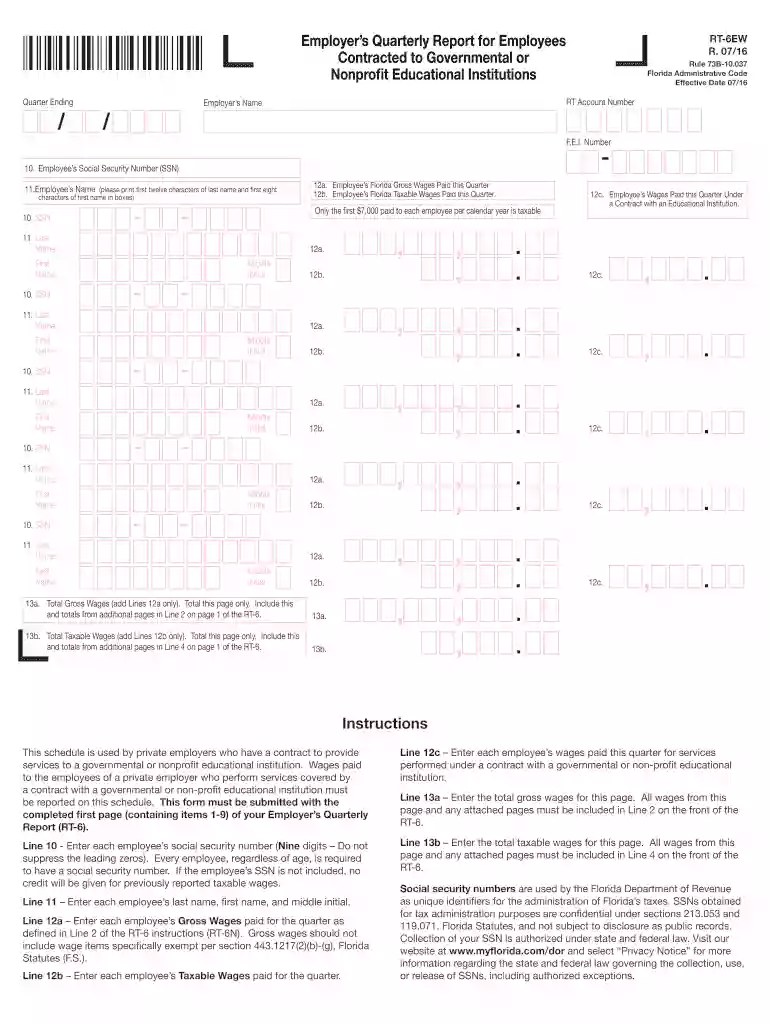
The Florida RT-6EW form, officially called the Employer’s Quarterly Report for Employees contracted to governmental or nonprofit educational institutions in Florida, plays a critical role in ensuring accurate reporting of employee wages. This form is necessary for specific organizations in Florida, primarily governmental and nonprofit educational institutions, to document employed personnel's earnings. The form specifically deals with the requirements for timely and precise reporting of both gross and taxable wages while securing employees' social security numbers for tax administration purposes.
The structure of the Florida RT-6EW form encompasses various components, all essential for comprehensive wage reporting. Key elements include:
Understanding these components is essential for accurate completion and submission of the form, thereby ensuring compliance with state regulations.
Employers in qualified institutions must utilize the Florida RT-6EW form to systematically report information. This entails accurately entering detailed employee wage data and ensuring alignment with their quarterly fiscal responsibilities.
Each of these steps involves careful attention to detail to avoid common mistakes that could compromise data integrity or lead to penalties.
Acquiring the Florida RT-6EW form is a straightforward process. Here are several methods:
These options provide flexibility to accommodate varying preferences and technical capabilities among employers.
Compliance with legal standards is crucial when handling the Florida RT-6EW form. Organizations must ensure that:
These legal considerations underscore the form’s critical role in maintaining regulatory compliance and organizational transparency.
Familiarity with specific terminology is necessary for effective form completion:
Mastering these terms assists in precise reporting and mitigates errors that could lead to compliance issues.
Florida distinguishes itself with unique rules governing the use of the RT-6EW form. Specifics include:
Being conversant with these state-specific mandates is critical for institutional compliance and effective document management.
Failure to comply with the RT-6EW form requirements subjects employers to potential penalties:
Awareness of these repercussions emphasizes the importance of proper form management and adherence to regulatory standards.
While the RT-6EW form serves a specific purpose, awareness of alternate forms is beneficial for context:
Understanding these variants aids organizations in selecting the correct form based on their specific circumstances, ensuring comprehensive compliance along federal and state lines.
We've got more versions of the florida rt 6ew form form. Select the right florida rt 6ew form version from the list and start editing it straight away!
At DocHub, your data security is our priority. We follow HIPAA, SOC2, GDPR, and other standards, so you can work on your documents with confidence.
Nov 24, 2025 This page provides links to the specific forms and provides resources for correcting previously filed employment tax returns.
4) writing the Florida Department of Revenue, Taxpayer Services, 5050 West Tennessee Street, Tallahassee, Florida 32399-0112. (c): RT-6EW. EmployersRead more


