







Definition & Meaning
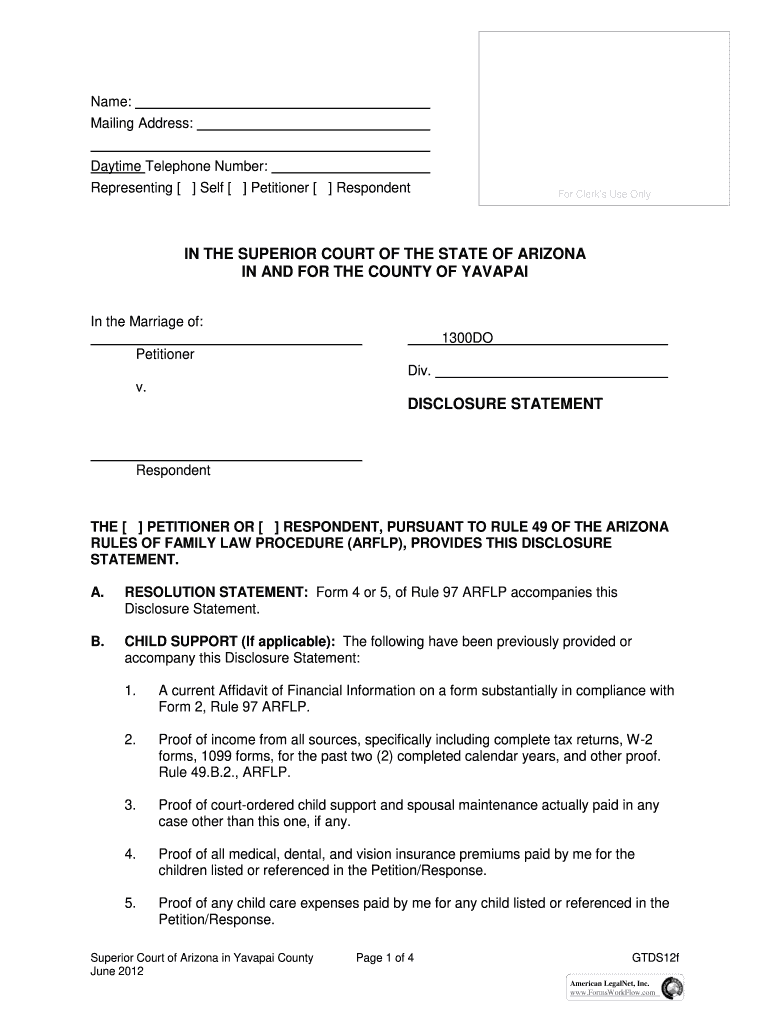
The "Rules of Family Law Procedure (ARFLP), Provides This Disclosure" refers to the legal guidelines imposed by family law courts to ensure transparency and fair proceedings in family-related legal matters. The ARFLP governs the necessary disclosures during divorce, child custody, and other family law cases, requiring parties to reveal crucial financial and personal information. This disclosure is vital for establishing objective and equitable resolutions in disputes, ensuring that all involved parties have access to the same level of pertinent information.
How to Use the ARFLP Disclosure
Understanding how to use the ARFLP disclosure is crucial for anyone involved in family law proceedings. This involves:
-
Identifying Required Documents: Parties must accurately identify and obtain necessary documents that fulfill the ARFLP criteria, such as financial statements, income records, and property documents.
-
Filling Out the Disclosure Statement: Ensuring all sections of the disclosure statement are completed accurately and thoroughly is essential. This includes providing detailed financial information as required.
-
Timely Submission: Submission of the completed disclosure statement must adhere to the court-established deadlines to avoid legal repercussions.
Steps to Complete the ARFLP Disclosure
Fulfilling the ARFLP disclosure requirements involves several detailed steps:
-
Document Collection: Gather all relevant financial documents, such as tax returns, bank statements, and evidence of income.
-
Completion of Financial Schedules: Include detailed financial schedules, providing a comprehensive picture of assets, liabilities, and other fiscal obligations.
-
Verification and Confirmation: Review documents for accuracy and ensure all information is current and complete.
-
Submission: Deliver the completed disclosure statement to the court and ensure copies are provided to the opposing party as per the legal requirements.
Key Elements of the ARFLP Disclosure
The ARFLP disclosure consists of several key elements designed to provide a clear financial picture:
-
Income Detailing: Parties must itemize sources of income, including employment, investments, and other financial inflows.
-
Asset Declaration: A comprehensive list of assets, such as real estate holdings, investments, and significant personal property, must be disclosed.
-
Liability List: Details of existing debts and financial obligations are required to offer a full perspective of one's financial responsibilities.
-
Support Obligations: Disclosure of any current obligations or responsibilities for child or spousal support.
Legal Use of the ARFLP Disclosure
Legally, the ARFLP disclosure serves as a critical component in ensuring fair proceedings within family courts. It provides transparency and lays the groundwork for informed decision-making by:
-
Facilitating Equitable Division: Ensures that both parties in a dispute have a level playing field by sharing pertinent financial details.
-
Supporting Legal Arguments: Provides documented proof to back claims related to support payments, asset division, or custody trials.
-
Preventing Fraud: Helps to prevent fraudulent claims by requiring sworn statements and legal testimonies gathered during discovery.
Who Typically Uses the ARFLP Disclosure
The ARFLP disclosure is typically used by:
-
Petitioners and Respondents: Individuals initiating or responding to family law cases, such as divorce or custody disputes.
-
Attorneys: Legal professionals who prepare and review disclosure material to build strong family law cases.
-
Judges and Court Officials: Officials who rely on comprehensive disclosures to make fair judgments and enforce equitable resolutions.


State-Specific Rules for the ARFLP Disclosure
While the ARFLP is a standardized guideline, each state may impose specific rules or modifications:
-
Arizona Adjustments: As these rules are enforced by Arizona courts, the state may require unique forms or additional documentation pertinent to its jurisdiction.
-
Variations in Deadlines: Different regions may have unique deadlines or submission requirements based on state-specific legal practices.
Penalties for Non-Compliance
Failure to comply with the ARFLP disclosure requirements could result in:
-
Legal Sanctions: Parties may face fines or court sanctions for failing to meet disclosure obligations.
-
Adverse Judgments: Non-compliant parties may be disadvantaged in court rulings, experiencing adverse decisions related to asset division or custody arrangements.
-
Delays in Legal Proceedings: Prolonged timelines in resolving family law disputes due to incomplete or insufficient disclosure documentation.




