Arkansas small estate affidavit form 23 2026

Get Form
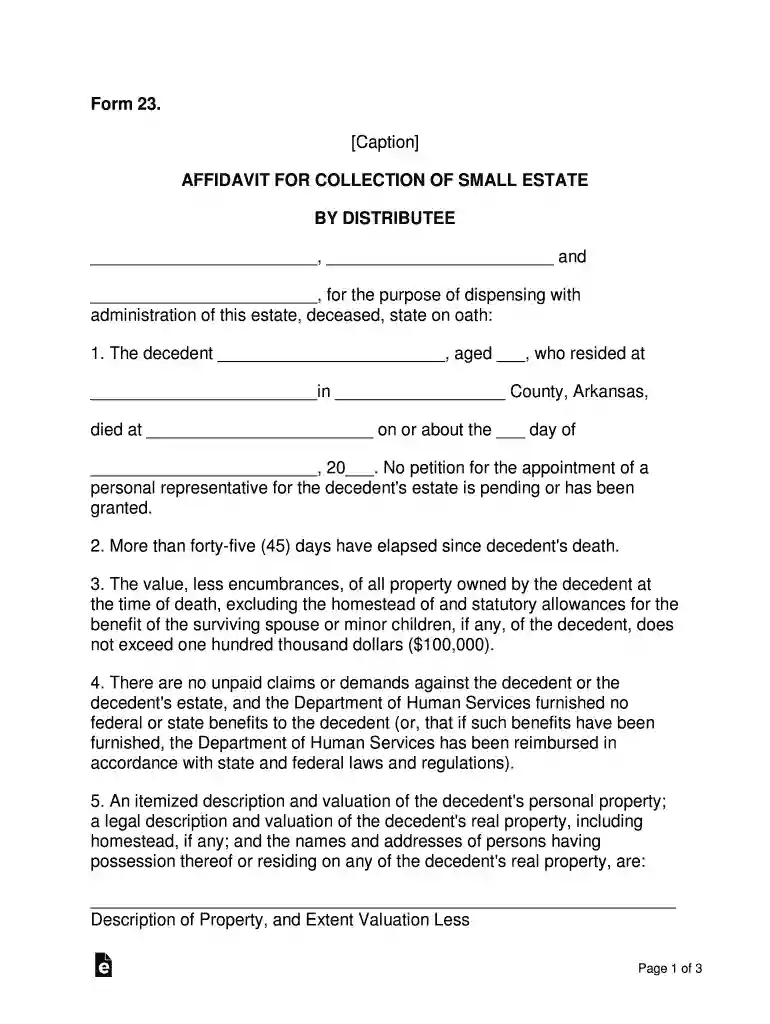
small estate affidavit arkansas Preview on Page 1

Here's how it works

01. Edit your small estate affidavit arkansas online
Type text, add images, blackout confidential details, add comments, highlights and more.

02. Sign it in a few clicks
Draw your signature, type it, upload its image, or use your mobile device as a signature pad.

03. Share your form with others
Send arkansas small estate affidavit form 23 via email, link, or fax. You can also download it, export it or print it out.

Definition & Purpose of the Arkansas Small Estate Affidavit Form 23

The Arkansas Small Estate Affidavit Form 23, officially recognized as the "Affidavit for Collection of Small Estate by Distributee," is a legal document utilized in the state of Arkansas. This form is primarily intended for heirs or distributees to collect a decedent's assets without the need for formal court administration. The process facilitates the efficient transfer of property to rightful heirs, provided the total value of the estate does not exceed $100,000. This affidavit signifies a streamlined probate alternative, simplifying the estate settlement for small estates by verifying that there are no outstanding claims against the estate and confirming the petitioner's right to the inheritance.

Eligibility Criteria for Using the Form

To utilize the Arkansas Small Estate Affidavit Form 23, certain criteria must be met:

  • Estate Value Limitation: The total appraised value of the decedent's estate should not exceed $100,000.
  • Time Requirement: A minimum of 45 days must have passed since the decedent's death before the affidavit can be submitted.
  • No Unpaid Claims: There should be no pending or unpaid claims against the estate, ensuring all debts and liabilities are settled.
  • Entitled Heirs or Distributees: The form is available only to individuals legally entitled to inherit the assets, including immediate family members or primary beneficiaries outlined in the will.
  • Certification: The affidavit must be certified by a clerk from the probate court, confirming the information's accuracy and completeness.
decoration image ratings of Dochub

Steps to Complete the Arkansas Small Estate Affidavit Form 23

  1. Gather Required Information: Collect all pertinent details, including the decedent's full name, death certificate, asset descriptions, and valuations.
  2. Prepare the Affidavit: Complete the form by detailing personal information, listing properties, and declaring the absence of outstanding claims.
  3. Certification: Have the form certified by the probate court's clerk to verify its validity.
  4. Signature of Distributees: All distributees claiming the estate must sign the affidavit to confirm their acknowledgment of the terms and conditions.
  5. Submission to Relevant Parties: Submit the completed and certified affidavit to financial institutions or other entities holding the decedent's assets.

Important Terms Related to the Affidavit

Understanding these terms is crucial when dealing with the Arkansas Small Estate Affidavit:

  • Distributee: An individual who is entitled to receive a distribution from the decedent's estate.
  • Decedent: The deceased person whose estate is being managed or distributed.
  • Probate: The legal process through which an estate is administered and distributed. With the Small Estate Affidavit, formal probate is typically circumvented.
  • Asset Valuation: The process of determining the fair market value of the decedent's property at the time of death.

State-Specific Rules for Arkansas

Certain rules are unique to Arkansas regarding the Small Estate Affidavit Form 23:

  • The affidavit is specifically crafted to accommodate the needs of small estates within the state’s legal framework, focusing on efficiency and cost-effectiveness.
  • Arkansas law prohibits the use of this affidavit if the estate involves real property not covered by an existing deed of transfer.
  • All distributees must collectively assume responsibility for any claims made against the estate post-transfer by signing the affidavit.

How to Obtain the Arkansas Small Estate Affidavit Form 23

Obtaining this form involves a straightforward procedure:

  • Online Access: The form is often accessible through legal websites or the official Arkansas court website, which may provide downloads in editable formats.
  • County Probate Court: Forms can also be collected directly from the clerk's office in the county where the decedent lived.
  • Legal Assistance: Engaging with an attorney or legal service provider can ensure accurate completion and acquisition of the form, particularly for complex estates.

Submission Methods and Considerations

Once the form is completed, submission methods vary based on asset types:

  • Direct Filing: Submit to financial institutions or entities holding the assets, with each entity potentially providing specific submission instructions.
  • Certified Mail: For official documentation, employing certified mail guarantees acknowledgment of receipt.
  • In-Person Submission: This may be required for particular institutions and ensures immediate processing.

Legal Use and Compliance

Utilizing the affidavit assures compliance with Arkansas estate laws. It serves a dual purpose of legal declaration and administrative convenience by:

  • Helping heirs avoid extensive probate proceedings when the estate meets specified thresholds.
  • Enabling the seamless transfer of personal property, securing rightful ownership for distributees.

When appropriately completed, the affidavit safeguards against legal disputes and facilitates a smooth transition of asset ownership.

be ready to get more

Complete this form in 5 minutes or less

Get form

Got questions?

We have answers to the most popular questions from our customers. If you can't find an answer to your question, please contact us.
Contact us
Of course, you should always be prepared to consult your estate planning attorney if matters are complicated. Otherwise, most individuals can complete their small estate affidavit on their own.
the total value of the estate is less than $100,000 and claims (debts or judgments) against the estate have been paidthere are other exclusions and exemptions from this amount, such as the homestead exemption and spouse and child allowances. 45 days have passed since the death before filing the affidavit.

Security and compliance

At DocHub, your data security is our priority. We follow HIPAA, SOC2, GDPR, and other standards, so you can work on your documents with confidence.

Learn more
ccpa2
pci-dss
gdpr-compliance
hipaa
soc-compliance