




01. Edit your form online
Type text, add images, blackout confidential details, add comments, highlights and more.

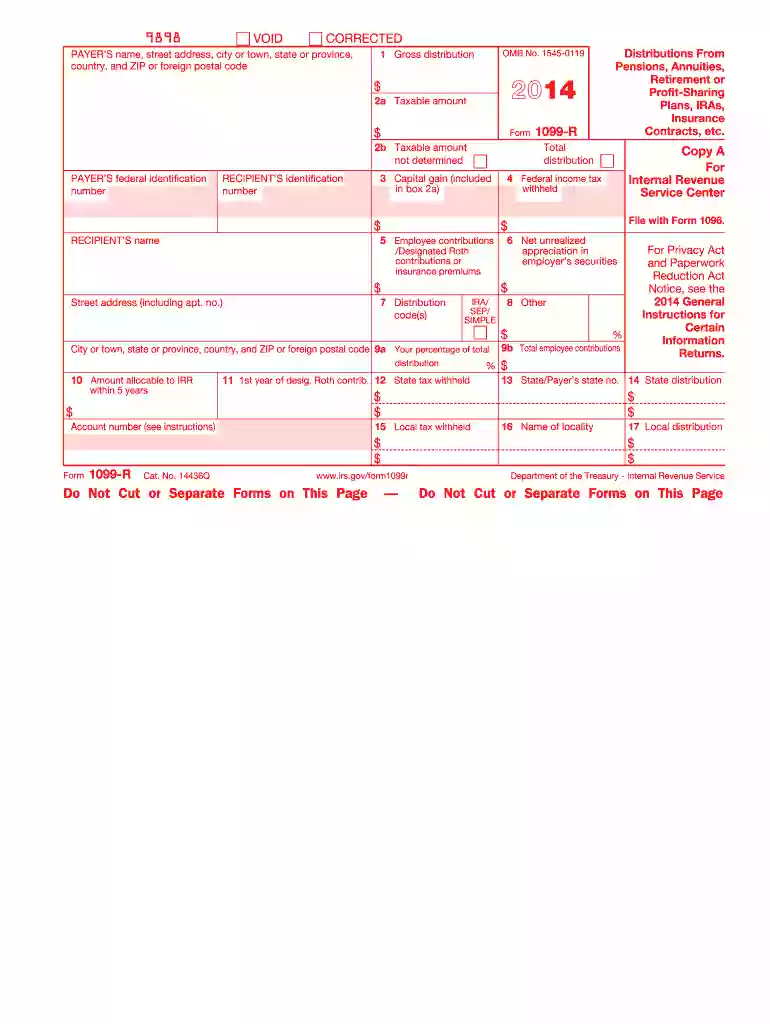
Type text, add images, blackout confidential details, add comments, highlights and more.

Draw your signature, type it, upload its image, or use your mobile device as a signature pad.

Send it via email, link, or fax. You can also download it, export it or print it out.
Form 1099-R is an important tax document used in the United States to report distributions from pensions, annuities, retirement plans, IRAs, and similar sources. This form is crucial for both the payers and recipients of such income distributions as it outlines the taxable amount that must be reported on their yearly tax returns. Issued primarily by financial institutions, insurers, or retirement plan custodians, the 2014 Form 1099-R captures specific details on the type of distribution and its tax implications, ensuring that recipients accurately reflect their income from these sources.
Individuals can obtain the 2014 Form 1099-R typically through the entity disbursing the retirement-related funds. Most institutions send this document by January 31 of the year following the tax year in question. In case of a non-receipt scenario, individuals should reach out directly to their financial institution or retirement plan administrator to request a copy. The IRS also provides downloadable PDFs of their official forms on their website, although these versions should not be filed directly due to non-scannability concerns.
The Form 1099-R is a federally mandated document that complies with various taxation regulations. The IRS requires that payers furnish this form to both the recipient and the IRS itself, detailing income derived from retirement accounts and related plans. Legal compliance involves accurate and timely filing, failure of which can result in penalties for both the payer (financial institutions or plan administrators) and the recipient.
Form 1099-R is typically used by retirees, beneficiaries of retirement account holders, individuals receiving annuities, and those who have executed a rollover of funds from one retirement plan to another. Financial institutions and employers disbursing retirement benefits are responsible for generating and issuing this form to the relevant recipients for tax filing purposes.
The IRS imposes penalties for inaccuracies or late submissions concerning Form 1099-R. Payers who fail to issue this form promptly to recipients or report inaccurately to the IRS may incur financial penalties. Similarly, recipients risk fines if they underreport taxable distributions derived from retirement accounts on their tax returns. Being informed about these responsibilities helps prevent unnecessary penalties and ensures compliance with tax laws.
We've got more versions of the 2014 form 1099 r form. Select the right 2014 form 1099 r version from the list and start editing it straight away!
| Versions | Form popularity | Fillable & printable |
|---|---|---|
| 2025 | 4.6 Satisfied (37 Votes) | |
| 2024 | 4.1 Satisfied (35 Votes) | |
| 2023 | 4.3 Satisfied (34 Votes) | |
| 2022 | 4.4 Satisfied (40 Votes) | |
| 2021 | 4.8 Satisfied (71 Votes) | |
| 2020 | 4.4 Satisfied (63 Votes) | |
| 2019 | 4.3 Satisfied (48 Votes) | |
| 2018 | 4.1 Satisfied (34 Votes) | |
| 2017 | 4.4 Satisfied (71 Votes) | |
| 2016 | 4.4 Satisfied (520 Votes) | |
| 2015 | 4.2 Satisfied (54 Votes) | |
| 2014 | 4.4 Satisfied (51 Votes) | |
| 2013 | 4.1 Satisfied (33 Votes) | |
| 2012 | 4 Satisfied (28 Votes) | |
| 2011 | 4 Satisfied (45 Votes) |
At DocHub, your data security is our priority. We follow HIPAA, SOC2, GDPR, and other standards, so you can work on your documents with confidence.


Distributions are generally reported on Form 1099-R, Distributions From Pensions, Annuities, Retirement or Profit. Sharing Plans, IRAs, Insurance Contracts, etcRead more
To complete Form 1099-R, use: the 2014 General Instructions for Certain. Information Returns, and. the 2014 Instructions for Forms 1099-R and. 5498. ToRead more
Apr 15, 2015 If your Form 1042-S or Form 1099-R shows a larger amount, use the amount on this line instead of the amount from Form 1042-S or Form. 1099-R .Read more


