




01. Edit your form online
Type text, add images, blackout confidential details, add comments, highlights and more.

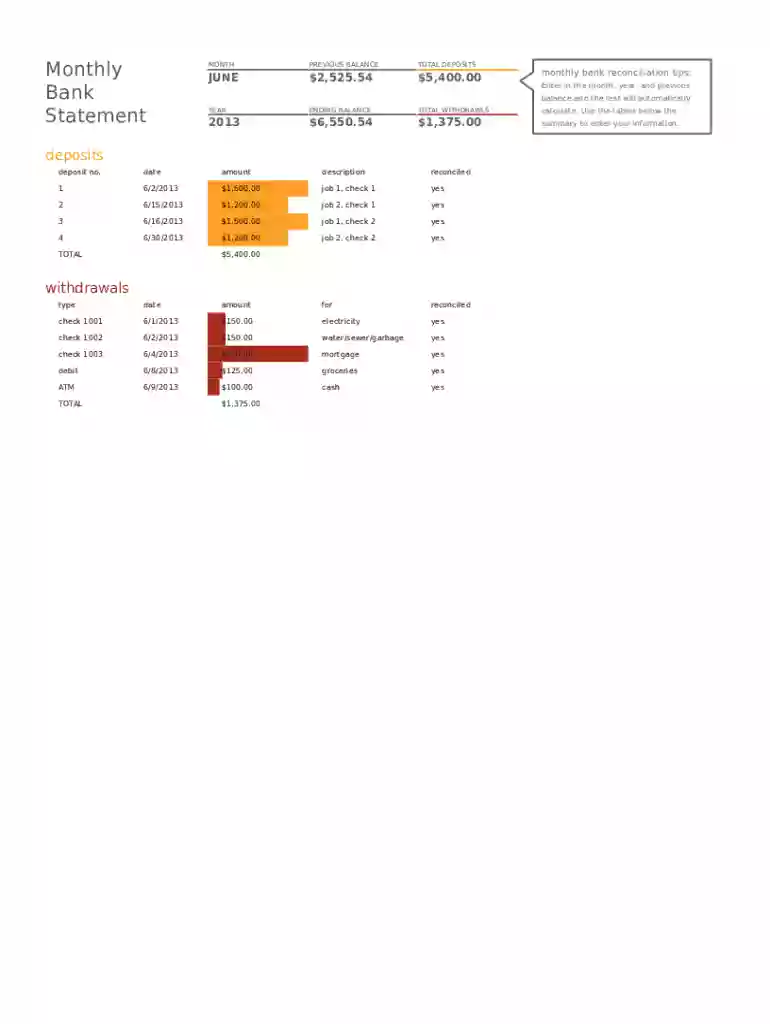
Type text, add images, blackout confidential details, add comments, highlights and more.

Draw your signature, type it, upload its image, or use your mobile device as a signature pad.

Send it via email, link, or fax. You can also download it, export it or print it out.
A monthly bank statement is a record provided by financial institutions summarizing all transactions of a customer's account over the course of a month. These documents are vital for personal financial management, allowing individuals and businesses to track their spending, monitor account balances, and verify the accuracy of bank transactions. They typically include detailed information such as deposits, withdrawals, checks, and the resulting balance, offering a comprehensive overview of financial activity.
Understanding how to navigate and utilize your monthly bank statement effectively can maximize its benefits. Begin by verifying that each transaction is accurate. Cross-reference with your personal records, noting any discrepancies for further investigation. This practice not only ensures data correctness but also prevents potential fraud or duplication errors.
Accessing your monthly bank statement can be done via several straightforward methods, which vary slightly by institution but generally follow the same process. Modern conveniences allow individuals to receive statements electronically or in a paper format.
Monthly bank statements include several critical pieces of information. Each component offers insight into different facets of an account, providing a rounded view of financial activities.
Consider a scenario where an individual notices an unexpected drop in their balance due in part to an overlooked subscription service. Reviewing the monthly statement allows them to swiftly identify the recurring debit, prompting the cancellation of an unused service and saving money in the long term.
In a business context, a small enterprise might use monthly bank statements to reconcile with internal accounting records. Discrepancies between the two would warrant further investigation to ensure no erroneous or fraudulent activity has occurred, safeguarding the company’s finances.
Monthly bank statements play a crucial role in legal and compliance aspects, both for personal and institutional users. These documents serve as proof of transaction and financial status, essential in legal disputes, audits, and compliance verifications.
Financial institutions are mandated by law to retain records of customer transactions for a specific duration, commonly seven years. This regulation ensures that documentation can be produced if required during audits or legal processes.
For non-compliance, penalties may apply, particularly for businesses failing to maintain proper transactional records. This oversight can lead to severe financial penalties, legal action, or reputation damage, emphasizing the importance of keeping accurate and accessible records for each fiscal period.
The choice between digital and paper bank statements often hinges on personal preference and convenience. Digital versions offer reduced environmental impact and easy storage, while paper statements might be preferred for personal archive purposes.
By understanding the strengths of each format, users can prioritize their preferences, aligning them with their financial organization strategy.
At DocHub, your data security is our priority. We follow HIPAA, SOC2, GDPR, and other standards, so you can work on your documents with confidence.
May 18, 2021 The first step to the reconciliation process is to gather documentation including your bank statement, deposit slips, receipts, and invoices forRead more
The Bank Statement Entry screen allows the user to add bank statement details based on the bank and date. Navigation: Main Menu Transactions Finance Read more
Yes, in many cases. If electronic fund transfers (EFTs) can be made to or from your account, banks must provide statements at least monthly summarizing anyRead more


