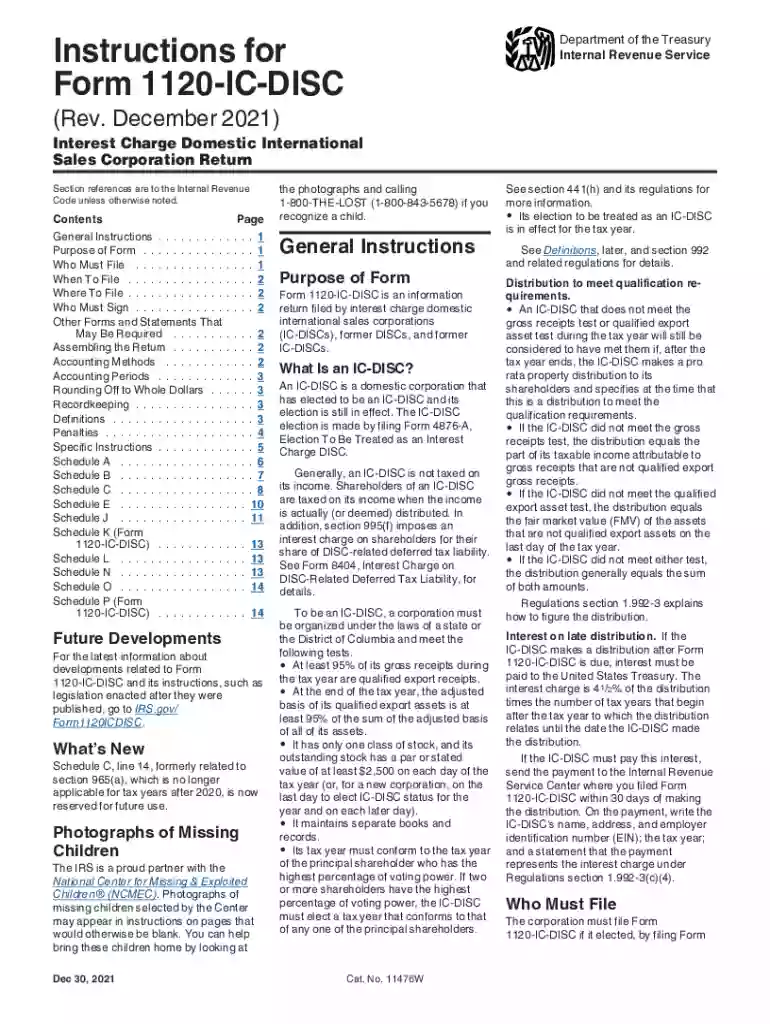
Definition & Importance of Form 1120-IC-DISC
Form 1120-IC-DISC is specifically designed for Interest Charge Domestic International Sales Corporations (IC-DISCs). These entities enable U.S. exporters to defer income taxes on export profits, achieving tax benefits through reduced tax rates on qualifying export income. Understanding and utilizing this form effectively is crucial for businesses looking to maximize their tax efficiency in compliance with federal regulations.
Key Features of an IC-DISC
- Tax Deferral: Allows deferral of taxation on export income.
- Reduced Tax Rates: By converting ordinary income into qualified dividends, businesses can benefit from lower tax rates.
- Separate Entity Requirement: Functions as a separate entity requiring distinct corporate records and compliance.
Crucial Considerations
- Eligibility: Must be a U.S. corporation with specific ownership and asset-related qualifications.
- Usage: Primarily serves businesses engaged in exporting U.S. goods.
Steps to Complete Form 1120-IC-DISC
- Gather Data: Collect all financial records and export-related documentation.
- Complete General Information: Provide corporate details including name, address, and federal identification number.
- Revenue and Expenses Section: Input in-depth details regarding income, deductions, and export-related expenses.
- Shareholder Information: Disclose shareholder information as required in the specific schedules.
- Calculation of Commission: Using set formulas, calculate the commission attributable to export sales.
Detailed Guidance
- Each section is interlinked; errors in calculation or omission of details could lead to penalties.
- Confirm accuracy of data, especially around income and deductions linked to exports.
Understanding IRS Guidelines for Form 1120-IC-DISC
IC-DISCs must adhere to specific IRS guidelines that outline their setup, operation, and reporting standards.
Key IRS Requirements
- Recordkeeping: Maintain extensive records demonstrating the corporation's qualification as an IC-DISC.
- Regular Filing: File Form 1120-IC-DISC on an annual basis.
Compliance Checks
- Ensuring proper documentation is vital to comply with IRS audits and reviews.
- Adhering to IRS guidelines not only avoids penalties but also maximizes the beneficial tax advantages of maintaining an IC-DISC.
Filing Deadlines and Important Dates
Meeting filing deadlines is crucial for avoiding additional charges or penalties.
Calendar Year Corporations
- Deadline: March 15 is generally the filing deadline for calendar-year corporations.
- Extensions: Corporations can request a six-month filing extension if necessary.
Fiscal Year Corporations
- Filing dates depend on the company’s fiscal year but are typically the 15th day of the third month following the close of the fiscal year.
Penalties for Non-Compliance
Failure to comply with filing and operational guidelines can lead to severe penalties.
Types of Penalties
- Monetary Fines: Ranges based on the missing or erroneous information.
- Loss of IC-DISC Status: Severe non-compliance can result in disqualification as an IC-DISC.
Required Documents & Submission Methods
While Form 1120-IC-DISC can be submitted via multiple methods, proper documentation is key.
Required Documentation
- Corporate Financial Records: Invoices, receipts, and related financial data supporting export operations.
- Export Sales Reports: Detailed information supporting the calculations on your tax form.
Submission Options
- Mail: Traditional mailing to designated IRS addresses.
- Electronic Submission: When available, ensures faster processing times.
Key Elements of Form 1120-IC-DISC
Focusing on major elements helps in efficient and accurate form completion.
Primary Components
- Income Calculation: Ensures domestic and international sales are appropriately categorized.
- Deduction and Costs: Accurate reporting of all deductible expenses related to export activity.
Schedules and Attachments
- Ensure all necessary schedules are completed and attached, such as Schedule P for inter-company pricing and Schedule Q for shareholder-related information.
Business Entity Types Benefitting From Form 1120-IC-DISC
IC-DISC status provides significant advantages for particular types of businesses.
Ideal Candidates
- Manufacturers: Who export goods internationally.
- Distributors: Engaged in regular cross-border trading activities.
Advantages
- Businesses can experience considerable tax savings by capitalizing on IC-DISC arrangements, mainly through reduction in effective tax rates on exporting activities.
Ensuring comprehensive knowledge of Form 1120-IC-DISC can greatly benefit businesses seeking efficient tax structures for their export revenues.