




01. Edit your form 1120 f online
Type text, add images, blackout confidential details, add comments, highlights and more.

Type text, add images, blackout confidential details, add comments, highlights and more.

Draw your signature, type it, upload its image, or use your mobile device as a signature pad.

Send 1120 f instructions via email, link, or fax. You can also download it, export it or print it out.
Form 1120-F is the U.S. Income Tax Return specific to foreign corporations with income sourced from the United States. This form is crucial for foreign corporations to report their income, deductions, credits, and to compute their tax liability. Understanding the full breadth of this form ensures compliance with IRS requirements, helping foreign corporations accurately represent their financial dealings within the U.S.
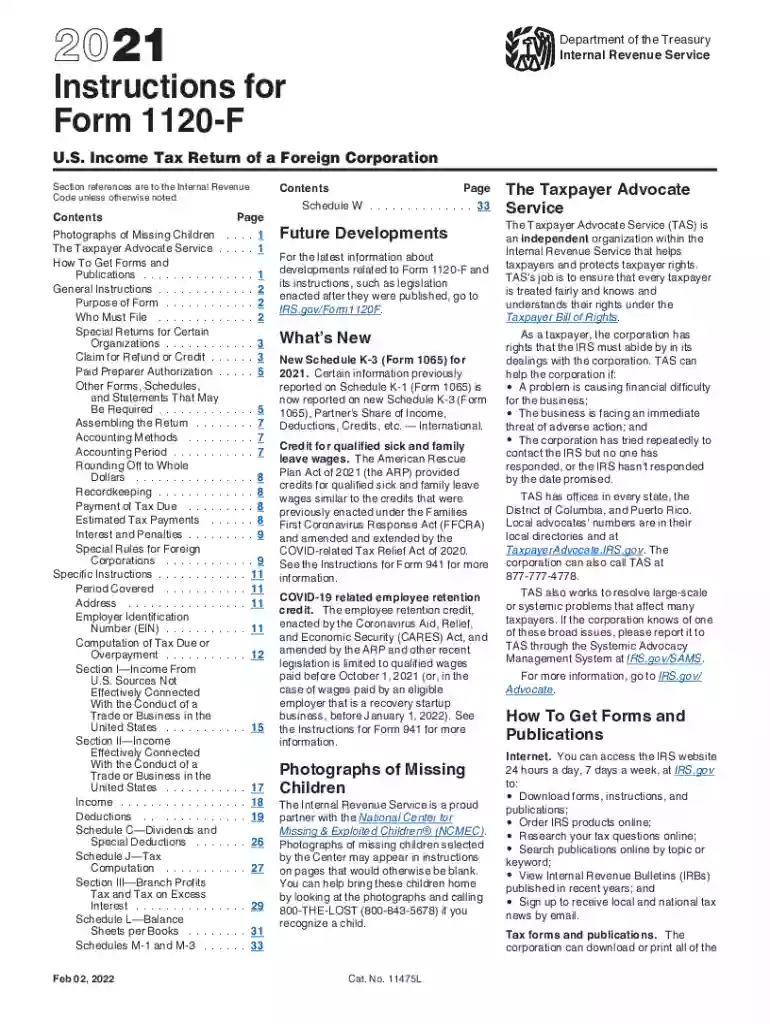
The instructions for Form 1120-F guide taxpayers through the process of completing the return accurately. These instructions provide detailed explanations of terms, line items, and the proper way to report income and deductions. Highlighted sections explain common scenarios and standard requirements, giving users a structured approach to form completion. By following the step-by-step instructions, foreign corporations can minimize errors and ensure accurate tax reporting.
Gather Required Documents: Before initiating the form, collect relevant financial documents reflecting U.S.-source income and expenses.
Review Eligibility Criteria: Confirm the entity qualifies as a foreign corporation subject to U.S. tax liabilities.
Follow Line-by-Line Instructions: Utilize the detailed guidance provided in each section of the instructions to accurately fill out respective form sections.
The instructions for Form 1120-F are readily available through several channels. They can be directly downloaded from the IRS website as a PDF, ensuring easy access to the most current version. Additionally, tax preparation software often includes integrated instruction guidelines to assist in the digital completion of the form.
Completing Form 1120-F involves understanding specific sections that pertain to reporting income, deductions, and taxes owed.
Fill in Basic Information: Enter corporate name, address, Employer Identification Number (EIN), and Tax Year beginning and ending dates.
Report Income: Declare all U.S.-sourced income, carefully segregating it from global revenue streams.
Itemize Deductions: List allowable deductions that pertain to U.S operations to compute the taxable income.
Calculate Tax Payable: Apply relevant tax rates to the taxable income to compute the final tax liability.
Submit the Form: Once completed, review for accuracy and submit through prescribed channels—electronic filing or via mail.
The instruction guide covers critical elements, including definitions of terms, step-by-step filing processes, and detailed descriptions of all form sections. It also highlights specific conditions that affect tax computations, deductions, and reporting requirements.
Failure to properly complete or timely file Form 1120-F can result in significant penalties. These may include fines for late submission, incorrect information, or inadequacy in paying the estimated taxes. Understanding the repercussions highlighted in the form's instructions is essential for foreign corporations to avoid unnecessary penalties.
Foreign corporations have the option to file Form 1120-F either digitally or via traditional paper forms. Each method has distinct benefits; digital submission allows for quicker processing and confirmation, while paper submission is suitable for those who prefer hard copies or encounter digital access limitations.
The IRS prescribes specific timelines for the submission of Form 1120-F, particularly highlighting the due dates to prevent penalties. Typically, the deadline aligns with the 15th day of the 4th month following the end of the fiscal year, though extensions may be available under certain circumstances.
Adhering to these guidelines ensures a smooth tax reporting cycle for foreign corporations operating in the U.S. By utilizing the comprehensive instructions, entities can fully comply with tax obligations while taking advantage of applicable deductions and credits.
We've got more versions of the form 1120 f form. Select the right form 1120 f version from the list and start editing it straight away!
At DocHub, your data security is our priority. We follow HIPAA, SOC2, GDPR, and other standards, so you can work on your documents with confidence.
Mar 31, 2026 A foreign corporation files this form to report their income, gains, losses, deductions, credits, and to figure their US income tax liability.Read more
Feb 1, 2018 Enter the appropriate form code in the boxes on line 1 to indicate the type of return for which you are requesting an extension. See. MaximumRead more
Instructions for Form 1120F, U.S. income tax return of a foreign corporation. Check request options from Main Library Government Information - Lower LevelRead more


