
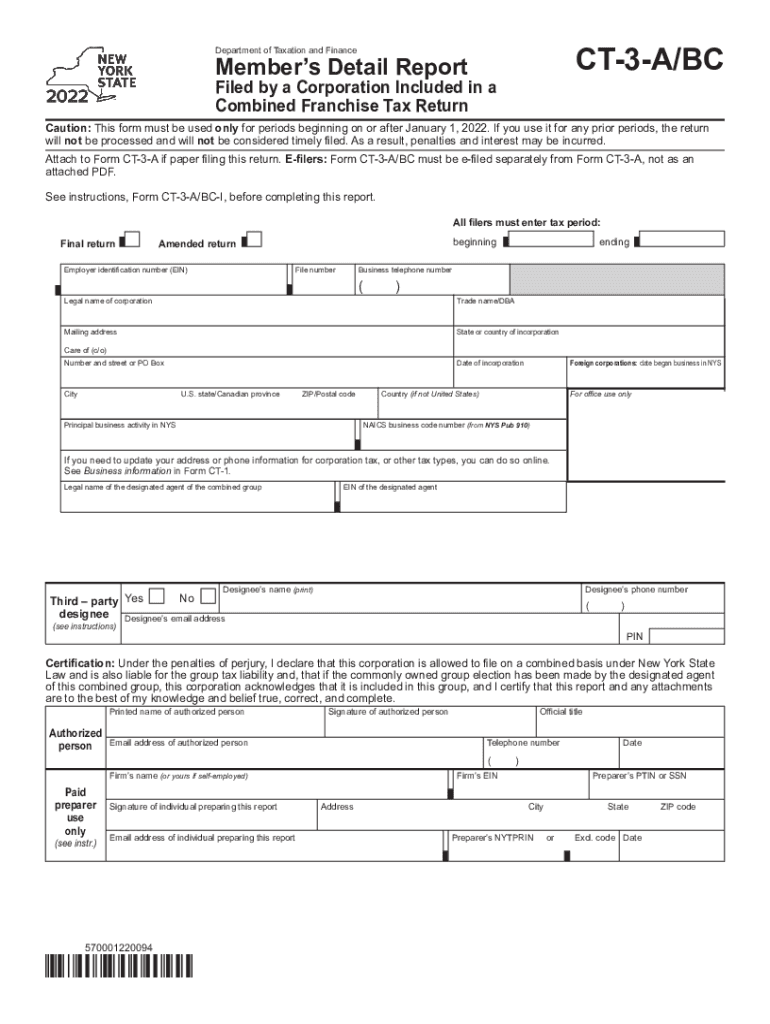







Definition & Purpose of Form CT-3-A/BC
Form CT-3-A/BC, also known as the Member’s Detail Report, is a crucial document required by the New York State Department of Taxation and Finance. It is specifically designed for corporations that are part of a combined franchise tax return. The form ensures compliance by capturing detailed information about each member corporation within a combined group, including tax periods, corporate details, and various tax-related questions.
Key Elements and Components
- Identification Section: Captures basic information such as the corporation's name, Employer Identification Number (EIN), and principal office address.
- Tax Period Details: Requires specifics about the tax year and fiscal period, ensuring all information is relevant and current.
- Fixed Dollar Minimum Tax Calculations: Involves calculations to determine the minimum tax liability, which is essential for compliance.
- Capital Base Line Items: Critical for assessing tax based on the company’s capital base, aiding in determining the correct tax amount.
- Business Apportionment Factors: Important for corporations with multi-state operations, detailing the allocation of income.
Steps to Complete Form CT-3-A/BC
- Gather Necessary Information: Collect all corporate and financial data relevant to the tax period, ensuring accuracy and completeness.
- Complete Identification and Tax Period Details: Fill out basic information and specify the tax year precisely.
- Calculate Fixed Dollar Minimum Tax: Use company financial records to determine the applicable minimum tax.
- Fill in Capital Base Details: Input all relevant capital figures and perform necessary calculations to determine liabilities.
- Determine Business Apportionment Factors: Calculate the proportion of income attributed to New York State based on business operations and state-specific guidelines.
- Review and Verify Information: Before submission, double-check all entries for accuracy.
- Submit the Form Appropriately: Depending on the method of submission—mail, online system, or in-person—ensure compliance with all submission guidelines.
Importance of Filing Form CT-3-A/BC
The submission of Form CT-3-A/BC is fundamental to maintaining compliance with state tax regulations for corporations. It prevents legal disputes and ensures accurate tax filings for corporations that are part of a combined group. Accurate completion of this form can also result in optimized tax assessments and avoid potential penalties.
Who Typically Uses Form CT-3-A/BC?
- Combined Group Corporations: Any corporation that is part of a combined reporting group in New York State.
- Tax Professionals and Accountants: Experts engaged by corporations to handle complex tax filing processes.
- Corporate Compliance Officers: Individuals responsible for ensuring all corporate filings meet state regulations.
Legal Use and Compliance
Legal compliance with Form CT-3-A/BC involves adhering to New York State’s tax guidelines for corporations in a combined group. Each member corporation within this group must report accurately to prevent discrepancies in tax obligations. Legal repercussions can include fines or more severe actions for inaccuracies or non-submission.
Filing Deadlines and Important Dates
- Annual Due Date: Typically aligns with the corporation's tax filing deadlines, requiring annual submission.
- Extensions: Corporations may apply for extensions, but this doesn't extend the time for tax payment, only for the form submission.
Required Documents and Information
- Financial Statements: Income statements, balance sheets, and other financial records.
- Corporate Information: Legal documents verifying the corporation's existence, EIN, and organizational structure.
- Worksheet Calculations: Backup documents showing the calculations for tax liabilities and apportionment factors.
Penalties for Non-Compliance
Failing to submit Form CT-3-A/BC can lead to substantial penalties. Corporations may face additional fines or interest on taxes due. In cases of willful neglect or fraud, harsher penalties, including legal actions, may be enacted.
Examples of Penalty Scenarios
- Late Filing: A fixed penalty plus interest on unpaid taxes.
- Underreporting Income: Additional taxes plus potential legal consequences.
- Omission of Required Information: Can result in the form being deemed incomplete or inaccurate, incurring additional fines.
Software Compatibility and Tools
Various software solutions such as QuickBooks or TurboTax help streamline the completion of Form CT-3-A/BC. These platforms offer compatibility with standard financial systems used by businesses, ensuring accurate data transfer and minimizing human error during the filing process.




