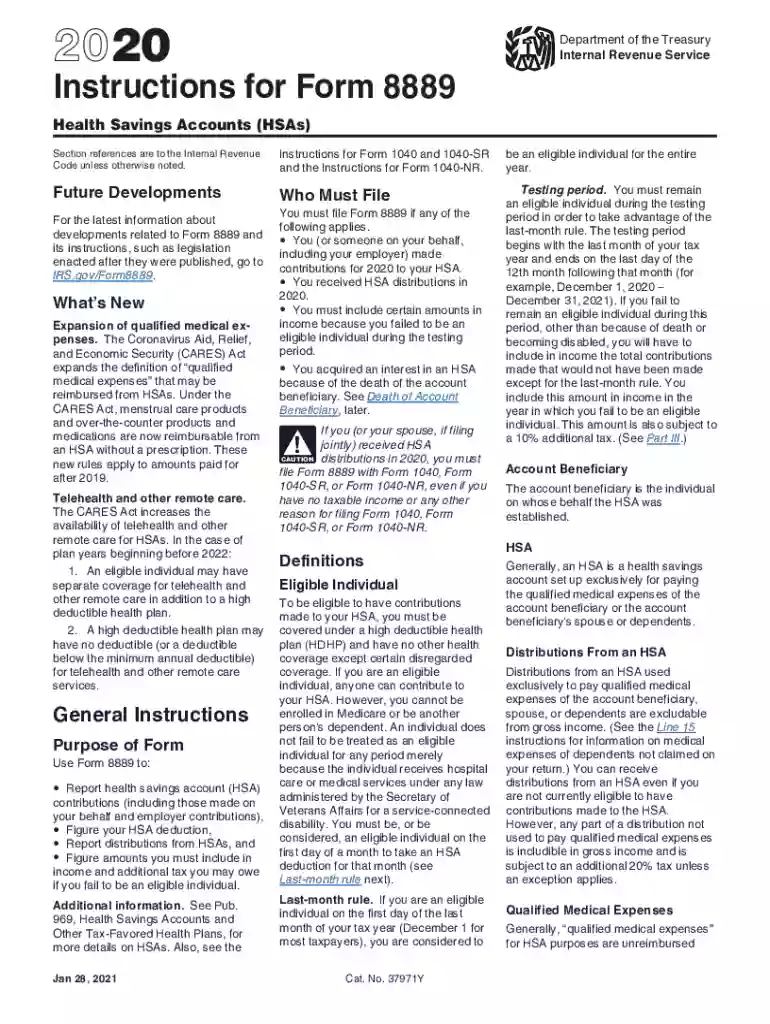
Irs instructions 8889 form-2026

Get Form
irs instructions 8889 form Preview on Page 1

Here's how it works

01. Edit your form online
Type text, add images, blackout confidential details, add comments, highlights and more.

02. Sign it in a few clicks
Draw your signature, type it, upload its image, or use your mobile device as a signature pad.

03. Share your form with others
Send it via email, link, or fax. You can also download it, export it or print it out.

Definition and Purpose of Form 8889

Form 8889 is utilized by individuals who have a Health Savings Account (HSA). Its primary purpose is to report contributions to and distributions from an HSA, helping taxpayers determine their tax responsibilities related to these accounts. This form is essential for calculating any additional tax owed due to excess contributions or for failing to maintain eligibility criteria.

Eligibility Criteria for Form 8889

To use Form 8889, an individual must be eligible to contribute to an HSA. Key requirements include having a high-deductible health plan (HDHP), not being covered by any other health plan that violates HSA rules, not being enrolled in Medicare, and not being claimed as a dependent on someone else's tax return.


decoration image ratings of Dochub

How to Use Form 8889

Detailed Steps for Completion

  1. Identify Personal Information: Begin by entering your name, social security number, and other identifying details.
  2. Contributions Reporting: Document all contributions made to your HSA throughout the tax year. This includes both personal contributions and those made by your employer.
  3. Adjustments for Excess Contributions: If you contributed more than the allowable limit, this excess must be reported, and you’ll need to calculate any related taxes or penalties.
  4. Distributions Information: Report all distributions taken from the HSA. It’s crucial to differentiate between qualified medical expenses and non-qualified withdrawals.
  5. Tax Calculations: Calculate net contributions, taxable HSA distributions, and determine any additional taxes on excess contributions or non-qualified distributions.

Examples of Usage

For instance, if you switched jobs during the year and both employers made contributions to your HSA, you must account for these on the form. Similarly, using HSA funds to pay for non-qualified medical expenses must also be carefully documented.

Obtaining IRS Instructions for Form 8889

Accessing Instructions

The IRS provides comprehensive instructions for Form 8889, which can be accessed directly from the IRS website or through tax preparation software. These instructions detail how to accurately fill out each section of the form and offer guidance on recent changes in tax law affecting HSAs.

Key Information Included

These instructions cover several critical areas, such as the latest contribution limits, changes from recent acts like the CARES Act, and the implications of these changes on your filing.

Key Elements of Form 8889

Main Sections of the Form

  • Part I: This part focuses on HSA contributions and deductions.
  • Part II: This area is dedicated to HSA distributions.
  • Part III: This section is relevant only if you are the beneficiary of a deceased account holder.

Important Considerations

It's important to ensure all calculations align with current tax limits and legal stipulations to avoid penalties.

Penalties for Non-Compliance

Implications of Incorrect Filing

Failing to properly complete Form 8889 can result in penalties. This includes the 6% tax on excess contributions and a 20% additional tax on non-qualified distributions.

Avoiding Common Mistakes

Double-check all figures related to contributions and distributions. Cross-reference with employer records if necessary and ensure only qualified medical expenses are claimed.

Taxpayer Scenarios for Form 8889

decoration image

Various Taxpayer Situations

  1. Self-Employed Individuals: Typically have greater flexibility in managing their HSAs and may contribute higher limits.
  2. Retired Individuals: May still need to complete Form 8889 if taking distributions from an HSA.
  3. Students: Should ensure that no other health coverage disqualifies them from using an HSA.

Application to Business Types

While Form 8889 is personal, businesses often need to understand its implications for employee benefits, especially concerning matching contributions.

Filing Deadlines and Important Dates

Important Timelines

  • End of Year Contributions: Contributions to an HSA can be made up until the tax filing deadline for the corresponding tax year.
  • Filing Deadline: Aligns with the general tax filing deadline, typically April 15.

Considerations for Last-Minute Filers

Make sure that any contributions made after the end of the tax year but before the deadline are credited to the correct year.

Digital vs. Paper Submission

Online Filing Advantages

Using tax software to submit Form 8889 simplifies the process, with automatic calculations reducing errors. The IRS allows for electronic submission through various approved software, ensuring a more streamlined experience.

Paper Filing Considerations

If you choose to file by paper, ensure all sections are complete and legible. Include any supporting documentation required, such as proof of HSA contributions or medical expenses.

In-Depth Understanding of Qualified Medical Expenses

Examples and Non-Examples

  • Qualified Expenses: Include doctor visits, prescription medications, and necessary medical equipment.
  • Non-Qualified Expenses: Such as cosmetic surgery or over-the-counter drugs without a prescription, can result in penalties if funded via an HSA.

Real-World Scenarios

Using the HSA card to pay for qualified expenses directly at the pharmacy or medical office ensures clear tracking and compliance with IRS guidelines.

See more irs instructions 8889 form versions

We've got more versions of the irs instructions 8889 form form. Select the right irs instructions 8889 form version from the list and start editing it straight away!
Versions Form popularity Fillable & printable
2023 4.4 Satisfied (49 Votes)
2022 4.9 Satisfied (28 Votes)
2021 4.8 Satisfied (41 Votes)
2020 4.8 Satisfied (79 Votes)
2013 4 Satisfied (25 Votes)
be ready to get more

Complete this form in 5 minutes or less

Get form

Got questions?

We have answers to the most popular questions from our customers. If you can't find an answer to your question, please contact us.
Contact us
Enter your own HSA contribution as a personal HSA contribution in the 1099-SA, HSA, MSA section of TurboTax. The contribution will appear on Form 8889 line 2 and the deduction will appear on Form 1040 line 25.
Yes, there are specific forms you will receive to properly complete your income tax return if you have an HSA.
File Form 8889 to: Report health savings account (HSA) contributions (including those made on your behalf and employer contributions).
Put simply, the IRS uses Form 8889 for HSA reporting. If you hold an HSA account (or are the beneficiary of a deceased HSA holder), youre required to attach Form 8889 to your Form 1040 when filing your personal income tax or information return. If you fail to do so, youll be unable to deduct your HSA contributions.
All contributions to your HSA are tax-deducible, or if made through payroll deductions, are pre-tax which lowers your overall taxable income. Your contributions may be 100 percent tax-deductible, meaning contributions can be deducted from your gross income.

Security and compliance

At DocHub, your data security is our priority. We follow HIPAA, SOC2, GDPR, and other standards, so you can work on your documents with confidence.

Learn more
ccpa2
pci-dss
gdpr-compliance
hipaa
soc-compliance
be ready to get more

Complete this form in 5 minutes or less

Get form

People also ask

You must always file a Form 8889 in any year you or an employer contributes money to your HSA or you make withdrawals from the account. The deduction you calculate on Form 8889 is taken on the first page of your income tax return.
This is caused by the fact that TurboTax does not acknowledge that an HSA could exist without a high deductible plan. Hence it will insist on you filling out a form 8889, even though there is nothing to put on it. When you try to not fill in the radio buttons on 8889, TurboTax will not let you e-file.
Use the amounts on Form 5498-SA to help calculate it. Report your deduction on Form 8889. Then, include that amount on line 13 of Schedule 1, Part II of your Form 1040 when filing your taxes.

Related links