




01. Edit your 1099a form online
Type text, add images, blackout confidential details, add comments, highlights and more.

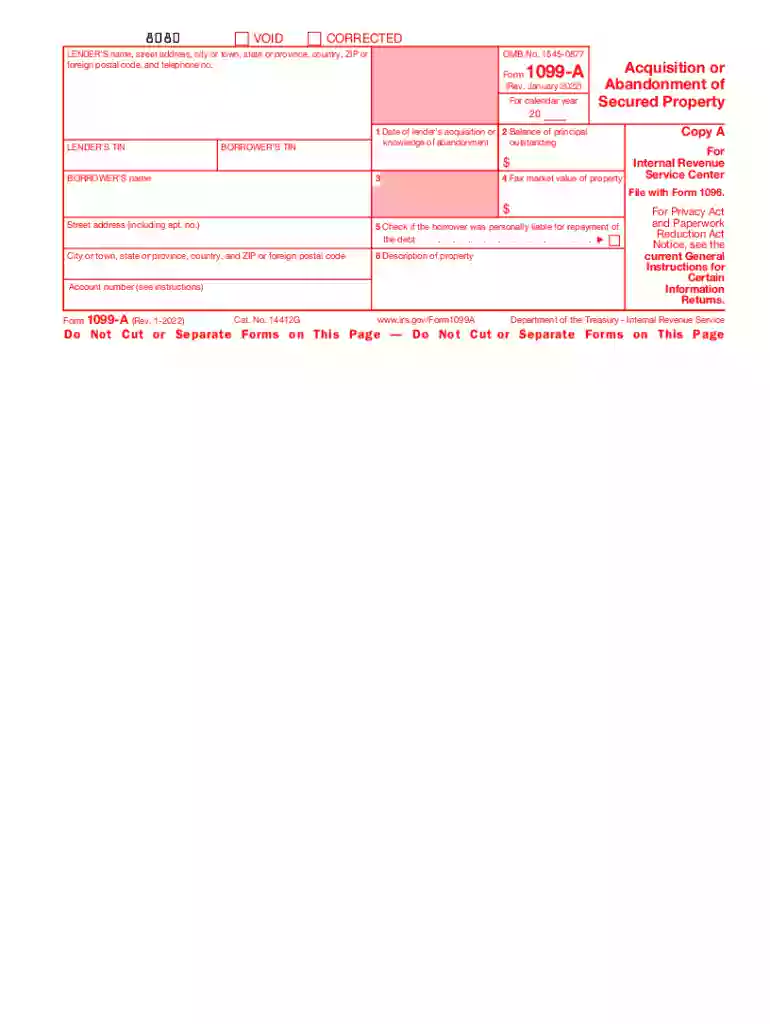
Type text, add images, blackout confidential details, add comments, highlights and more.

Draw your signature, type it, upload its image, or use your mobile device as a signature pad.

Send 1099 a form via email, link, or fax. You can also download it, export it or print it out.
Form 1099-A, known officially as "Form 1099-A (Rev. January 2022). Acquisition or Abandonment of Secured Property," is a document used by lenders to report the acquisition or abandonment of secured property. This form plays a crucial role when borrowers fail to meet their debt obligations, resulting in lenders acquiring the property or the borrower abandoning it. The information on Form 1099-A aids in declaring potential taxable events related to the discontinued use or foreclosure of property, which might lead to cancellation of debt income for the borrower.
Lenders must fill out and issue Form 1099-A to both the IRS and the borrower when a property is either acquired or abandoned. The borrower uses this form to evaluate potential tax implications, as the transaction might lead to a recognition of income or loss. For instance, if the property's market value exceeds the outstanding debt, the borrower could face income as a result of the debt cancellation. Conversely, if the outstanding balance surpasses the property's value at abandonment, a loss might be recognized.
The form ensures compliance with tax laws by documenting transactions involving secured properties' acquisition or abandonment. Its legal significance lies in the fact that it helps the IRS monitor potential taxable events due to property foreclosures or abandonments, aligning with federal laws governing the taxation of canceled debts.
The IRS mandates that Form 1099-A must be submitted by the lender when a secured property is acquired or abandoned. The guidelines underscore the necessity for providing accurate and timely information to prevent legal discrepancies and ensure compliance with tax obligations. Lenders must adhere to deadlines and maintain consistency in reporting the transaction details.
Form 1099-A has specific submission deadlines. Lenders are generally required to furnish the form to the borrower and the IRS by January 31st of the year following the calendar year in which the property was acquired or abandoned. Adhering to these deadlines is vital, as late submissions can lead to penalties or interest charges.
Failing to issue or file Form 1099-A can result in penalties. Lenders who neglect to file the form on time with the IRS or provide it to the borrower might incur fines that escalate based on the duration of the delay and the incompleteness of the submission. Understanding and avoiding these penalties is crucial for maintaining regulatory compliance.
Form 1099-A is typically used by lending institutions such as banks, credit unions, government agencies, and real estate lenders when they repossess or when there is abandonment of secured property. Borrowers, on the other hand, use this form to understand potential tax impacts and report the information correctly on their tax returns.


We've got more versions of the 1099a form form. Select the right 1099a form version from the list and start editing it straight away!
| Versions | Form popularity | Fillable & printable |
|---|---|---|
| 2022 | 4.5 Satisfied (31 Votes) | |
| 2021 | 4.7 Satisfied (87 Votes) | |
| 2020 | 4.1 Satisfied (64 Votes) | |
| 2019 | 4.4 Satisfied (101 Votes) | |
| 2018 | 4.2 Satisfied (98 Votes) | |
| 2017 | 4.4 Satisfied (745 Votes) | |
| 2016 | 4.4 Satisfied (574 Votes) | |
| 2015 | 4.4 Satisfied (46 Votes) | |
| 2014 | 4 Satisfied (33 Votes) | |
| 2013 | 4.2 Satisfied (36 Votes) | |
| 2012 | 4.2 Satisfied (69 Votes) | |
| 2011 | 4 Satisfied (50 Votes) | |
| 2010 | 4 Satisfied (54 Votes) | |
| 2008 | 4 Satisfied (35 Votes) | |
| 2007 | 3.9 Satisfied (52 Votes) |
At DocHub, your data security is our priority. We follow HIPAA, SOC2, GDPR, and other standards, so you can work on your documents with confidence.
Form 1099-C (canceled debt). Form 1099-A (acquisition or abandonment of secured property). Use Form W-9 only if you are a U.S. person (including a resident.Read more
You may have reportable income or loss because of such acquisition or abandonment. Gain or loss from an acquisition is generally measured by the differenceRead more


