





Definition & Purpose
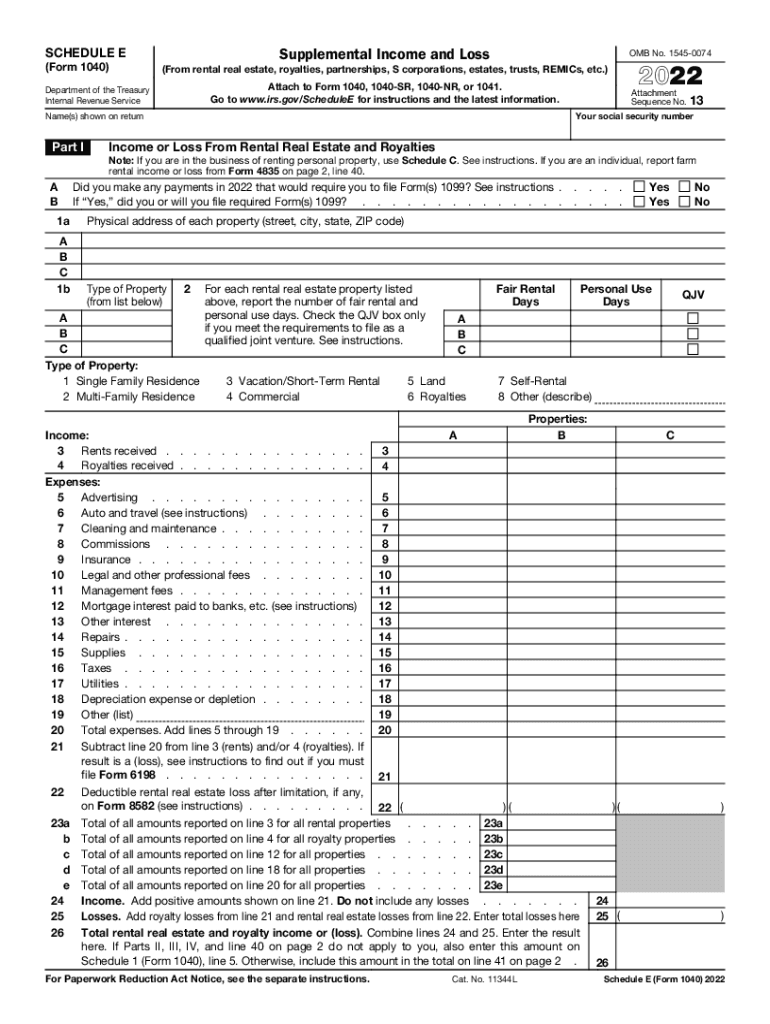
Schedule E (Form 1040) is utilized by taxpayers in the United States to report supplemental income and loss. This encompasses a variety of income sources such as rental real estate, royalties, partnerships, S corporations, estates, trusts, and REMICs (Real Estate Mortgage Investment Conduits). Taxpayers use Schedule E to detail incomes, losses, and expenses from these activities, and to calculate the totals to be transferred to their main tax return.
How to Obtain the 2020 Schedule E Form
The Internal Revenue Service (IRS) provides the 2020 Schedule E Form, which can be accessed online through the IRS website. Additionally, the form can be found in tax preparation software like TurboTax or QuickBooks, or obtained by visiting an IRS office. You can also request a paper copy by mail if preferred.
Steps to Complete the 2020 Schedule E Form
- Fill out Part I for Rental Real Estate and Royalties: Include total income, expenses, and depreciation.
- Move to Part II for Partnerships/S Corporations: Report income or loss from K-1 forms you receive.
- Complete Part III for Estates and Trusts: Reflect your share as indicated on K-1 forms.
- Use Part IV if you have Income or Losses from REMICs: Detail the related statement.
- Final Calculations in Part V: Summarize total income and losses, transferring the calculated figures to your Form 1040.
Key Elements of the Form
- Parts I to V: Dedicated sections for different income types or sources.
- Passive vs. Active Participation: Distinction for determining how losses are reported.
- Column Entries: Separate columns for various entities or types of income sources.
Important Terms
- Supplemental Income: Non-wage income like rentals or royalties.
- K-1 Form: A tax document provided by partnerships, S corporations, estates, and trusts to report an individual's share of income, deductions, and credits.
- Pass-through Entities: Business entities that pass income directly to owners to file on their personal tax forms.
IRS Guidelines
The IRS provides detailed instructions with the Schedule E Form, guiding taxpayers on how to accurately report their supplemental income. These guidelines specify how to account for different income types and explain essential tax concepts related to each section of the form.
Penalties for Non-Compliance
Failing to accurately complete Schedule E can result in penalties. Common issues include underreporting income or filing inaccuracies due to neglect or intentional misstatements. Taxpayers must adhere to IRS instructions to avoid fines or audits.
Taxpayer Scenarios
Individuals utilizing the Schedule E Form include landlords, partnership members, S corporation shareholders, and others receiving income from the specified sources. This form is crucial for anyone with income not covered by traditional wages or salaries.

Software Compatibility
Several tax preparation software suites, such as TurboTax and QuickBooks, support Schedule E. These programs streamline data entry, ensure compliance with IRS rules, and facilitate form submission electronically. For those filing manually, it is important to cross-check data for accuracy across related forms and schedules.