
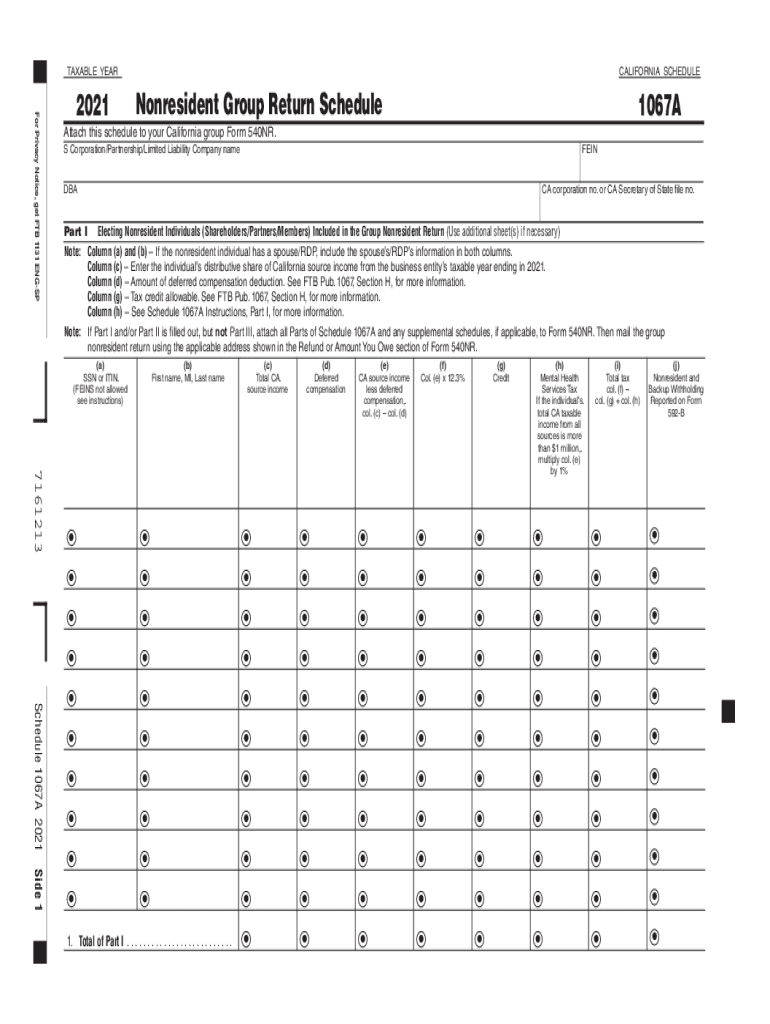







Definition and Purpose of the 2021 California Schedule 1067A
The 2021 California Schedule 1067A is a tax document utilized by S Corporations, Partnerships, and Limited Liability Companies (LLCs) to file a nonresident group return. This schedule is specifically designed for entities with nonresident individuals, directors, or aliens lacking Social Security Numbers (SSNs) or Individual Taxpayer Identification Numbers (ITINs) who elect to have their California source income taxed collectively. The form provides a structured approach for reporting deferred compensation deductions, applicable taxes, and tax credits on behalf of these nonresident members, streamlining their tax obligations under one consolidated filing.
How to Use the 2021 California Schedule 1067A
- Gather Information: Collect detailed data on each electing nonresident’s California source income, deductions, and any applicable tax credits.
- Complete Required Sections: Ensure all required fields, such as personal information, SSNs/ITINs, and income details, are accurately filled out.
- Calculate Taxes: Compute the total California state taxes due based on the provided income and allowable deductions.
- Verify Information: Cross-check the accuracy of all entered data and computations to prevent errors that could result in filing delays.
- Transmit the Schedule: Submit the completed schedule either online or via mail to the California Franchise Tax Board, as per submission guidelines.
Steps to Obtain the 2021 California Schedule 1067A
- Online Download: Access the form directly from the California Franchise Tax Board’s official website under the forms section.
- Tax Software: Utilize tax preparation software, like TurboTax or QuickBooks, to auto-populate and download the form.
- Tax Professional: Request the form from a certified tax professional or an accountant familiar with California tax laws.
Key Elements of the 2021 California Schedule 1067A
- Electing Nonresident Details: Includes sections for each participant's identification and income specifics.
- Income and Loss Sections: Distinct areas to declare California source income and any deductions or losses applicable.
- Tax Calculations: Defined methodology to compute the aggregated tax due for the group return.
- Credit Applications: Areas to apply for available California tax credits to reduce the total tax liability.
Legal Use and Compliance with the Schedule 1067A
- Authorization: Entities must have approval from all nonresident participants to include their information on the group return.
- Compliance with ESIGN Act: Ensure electronic signatures, if used, are compliant and legally binding.
- Record Maintenance: Retain copies of all completed forms and supporting documents for at least four years for audit purposes.
Who Typically Uses the 2021 Schedule 1067A
- S Corporations: Businesses seeking to simplify the tax process for nonresident shareholders.
- Partnerships and LLCs: Entities opting for collective filing for members or partners not residing in California.
- Tax Professionals: Accountants and tax preparers assisting clients with nonresident tax concerns.


Important Terms Related to the Schedule 1067A
- Nonresident Group Return: A tax return filed on behalf of multiple nonresident individuals by a business entity.
- California Source Income: Revenue generated from sources within the state, subject to California state tax.
- Deferred Compensation: A part of an employee's compensation that is set aside to be paid at a later date.
Filing Deadlines and Important Dates
- Annual Filing Date: Typically aligns with California's tax filing deadline for businesses, often due by March 15 or April 15.
- Extensions: Entities may apply for a filing extension, generally granting additional time up to six months but must apply before the initial deadline.
- Penalties for Late Filing: Failure to file by the deadline without an extension can result in significant financial penalties and interest on overdue tax.
Eligibility Criteria for the Schedule 1067A
- Business Entity Type: Must be an S Corporation, Partnership, or LLC registered in California.
- Nonresident Members: At least one member must be a nonresident of California electing to participate in the group filing.
- Consent Forms: Mandatory consent from all involved nonresidents to be included in the group return.

Form Submission Methods: Online, Mail, and In-Person
- Online Submission: E-file through the California Franchise Tax Board’s secure portal for faster processing.
- Mail: Send a physical copy to the appropriate California Franchise Tax Board address specified for nonresident tax returns.
- In-Person: Visit a local tax office for direct submission, ensuring you receive a stamped acknowledgment of receipt.
Penalties for Non-Compliance with the Schedule
- Monetary Fines: Imposed on entities for inaccurate reporting, late submission, or failure to file.
- Legal Repercussions: Potential audits and legal action for significant discrepancies in reported financials.
- Interest Accrual: Additional costs incurred from unpaid taxes due to late filing or inaccuracies on the form.
Software Compatibility with the Schedule 1067A
- TurboTax: Offers support for completing and filing the 2021 California Schedule 1067A.
- QuickBooks: Facilitates data integration and form preparation for business users.
- Other Tax Tools: Evaluate compatibility and support with other accounting and tax-management software solutions.
Real-World Scenarios and Examples
- Small Business Filing: An LLC owned by five nonresident investors uses Schedule 1067A to simplify tax filing.
- Complex Income Structures: A partnership with diverse income streams within California handles complex tax obligations through group filing.
- Nonresident Directors: An S Corporation files collectively to manage tax reporting for directors residing outside California.
By addressing the complexities and requirements associated with the 2021 California Schedule 1067A, this structured guide aims to assist businesses and tax professionals in understanding and efficiently managing nonresident group tax returns in compliance with California state laws.




