




01. Edit your form 17 rita online
Type text, add images, blackout confidential details, add comments, highlights and more.

Type text, add images, blackout confidential details, add comments, highlights and more.

Draw your signature, type it, upload its image, or use your mobile device as a signature pad.

Send irs form 17 via email, link, or fax. You can also download it, export it or print it out.
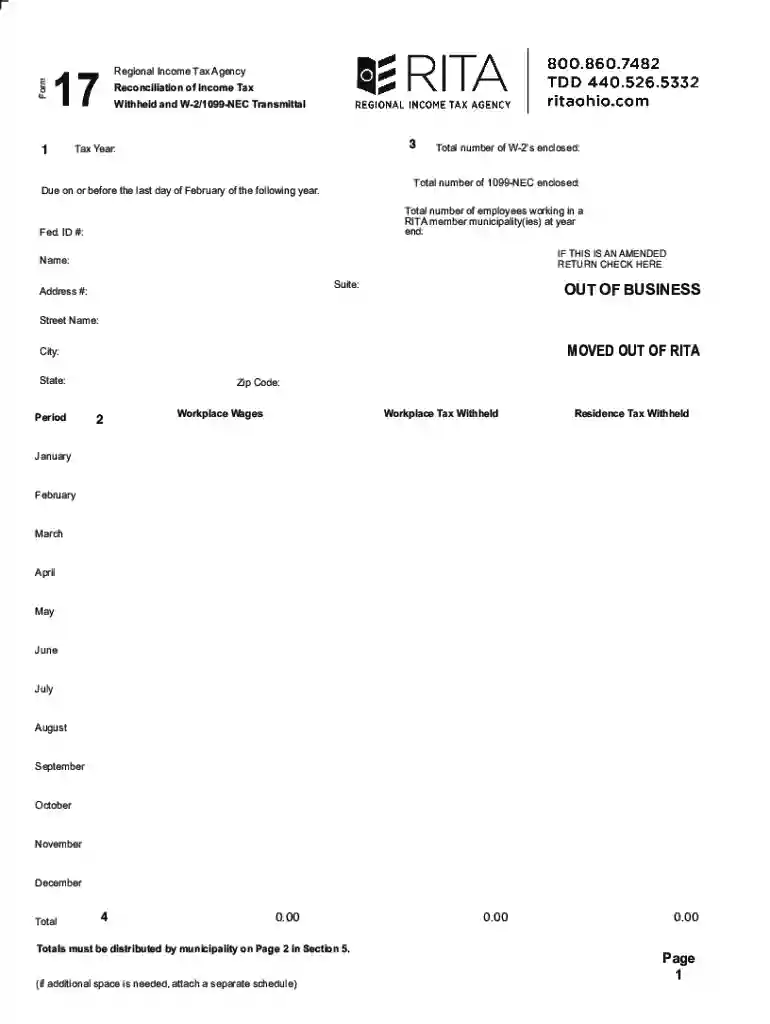
The Regional Income Tax Agency (RITA) tax form is a crucial document used in the state of Ohio to reconcile income tax withheld and transmittals of W-2 or 1099-NEC forms. This reconciliation is necessary for municipal income taxes, specifically for the municipalities that are RITA members. The form requires detailed information about workplace wages, the total amount of taxes withheld, and the count of employees within these municipalities for a given tax year. This documentation ensures that businesses comply with local tax regulations and helps them avoid potential penalties for inaccuracies or non-compliance.
When using DocHub to fill and sign the RITA tax form, the process is designed to be straightforward and efficient. Users can upload the fill-and-sign PDF form of the RITA tax document directly onto the DocHub platform from their computer or connect through cloud services like Google Drive. The intuitive interface allows the addition of text and figures, ensuring that all required sections are completed accurately. After filling out the form, users can electronically sign it via the platform's signature tools, which include options to draw, type, or upload a signature image. Once completed, users can securely share or export the document.
Using the RITA tax form through DocHub adheres to legal requirements under the ESIGN Act, which ensures that electronic signatures are legally binding. This alignment with legal standards makes it a reliable method for businesses to comply with Ohio’s municipal tax regulations. Additionally, businesses are advised to keep copies of all completed forms and submission receipts for their records to provide proof of compliance if ever required by tax authorities.
The RITA tax form must be filed by the end of February for the previous tax year. This deadline is essential to ensure compliance and avoid penalties. Businesses should plan ahead to gather all necessary data well before this deadline to ensure accuracy and completeness.
Failure to submit the RITA tax form accurately and on time can result in penalties ranging from monetary fines to interest charges on unpaid taxes. Non-compliance may also lead to audits or additional scrutiny from tax authorities, highlighting the importance of timely and correct submissions.
Submissions for the RITA tax form can be carried out in several ways:
DocHub provides unique advantages for completing the RITA tax form, including the elimination of printing and mailing delays, simplified digital signing, and streamlined document management. These features enable businesses to maintain compliance while focusing on productivity and operational efficiency.
We've got more versions of the form 17 rita form. Select the right form 17 rita version from the list and start editing it straight away!
| Versions | Form popularity | Fillable & printable |
|---|---|---|
| 2025 | 4.3 Satisfied (52 Votes) | |
| 2024 | 4.9 Satisfied (21 Votes) | |
| 2023 | 4.3 Satisfied (28 Votes) | |
| 2022 | 4.9 Satisfied (23 Votes) | |
| 2021 | 4.6 Satisfied (60 Votes) | |
| 2020 | 4.8 Satisfied (183 Votes) | |
| 2019 | 4.4 Satisfied (195 Votes) | |
| 2018 | 4.4 Satisfied (129 Votes) | |
| 2016 | 4.3 Satisfied (118 Votes) | |
| 2012 | 4.3 Satisfied (43 Votes) |
At DocHub, your data security is our priority. We follow HIPAA, SOC2, GDPR, and other standards, so you can work on your documents with confidence.


