







Definition and Purpose of Form 1120-W
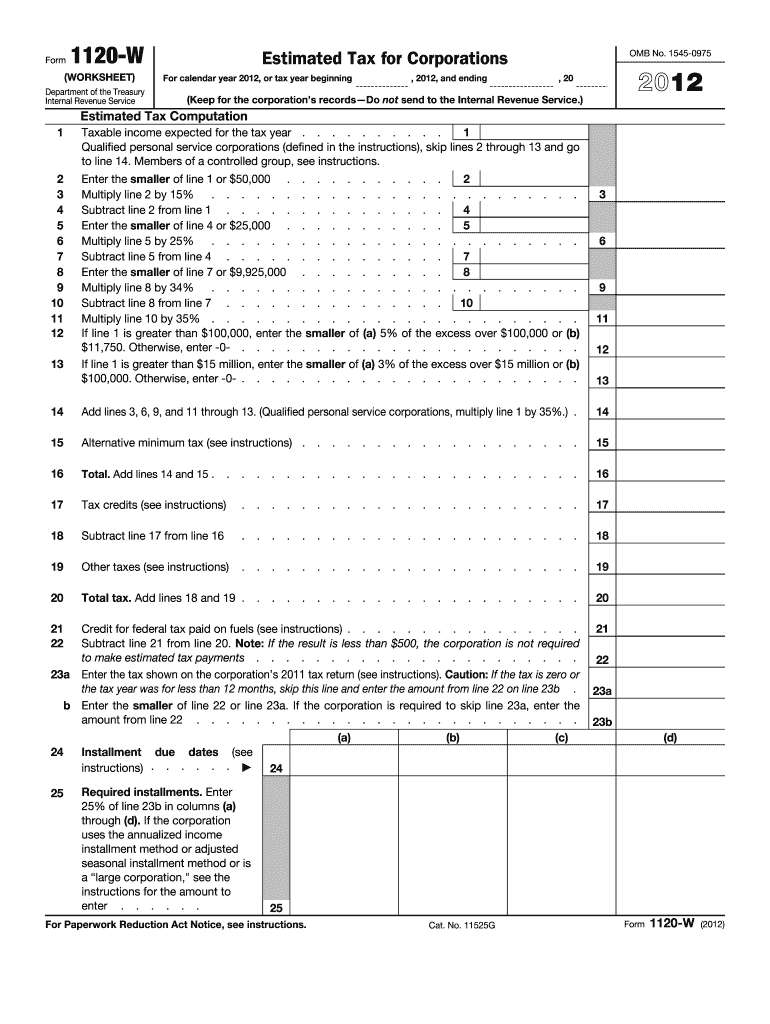
Form 1120-W, commonly referred to as the Corporate Estimated Tax Worksheet, is provided by the Internal Revenue Service to aid corporations in calculating their estimated tax for a given year. Specifically, this guide focuses on the version from the year 2012. The form's primary function is to help corporations determine their tax liabilities by computing taxable income, applying the appropriate tax rates, and determining required installments based on various income scenarios throughout the tax year.
Components of Form 1120-W
- Taxable Income Calculation: Form 1120-W allows corporations to calculate their taxable income by including expected income, deductions, and credits for the tax year.
- Tax Rate Application: It outlines the corporate tax rates applicable to different income brackets, enabling accurate tax liability forecasting.
- Installment Determination: Corporations can determine their required installments through this worksheet by considering estimated tax payments across the year, inclusive of adjusted seasonal and annualized income scenarios.
How to Obtain Form 1120-W
Corporations can access Form 1120-W in several ways, making it easy to procure and start using for tax calculations. The form is available on the official IRS website, where it can be downloaded directly as a PDF. This ensures accessibility to the most recent and updated version.
- Online Access: The IRS website provides downloadable PDF versions of Form 1120-W.
- IRS Offices: Physical copies can be acquired by visiting local IRS offices.
- Tax Software Integration: Many tax software packages include Form 1120-W as part of their corporate tax solutions, allowing businesses to work through the form digitally.
Steps to Complete Form 1120-W for 2012
Completing Form 1120-W involves a detailed process, aimed at ensuring accurate tax estimations and compliance with IRS regulations.
- Gather Financial Documents: Compile all relevant documents, including profit and loss statements, to ensure the accuracy of taxable income calculations.
- Calculate Expected Income: Determine your estimated income for the tax year, taking into account past performance and future projections.
- Apply Deductions and Credits: Identify applicable deductions and credits to reduce taxable income, such as charitable contributions and business expenses.
- Determine Tax: Utilize the specified tax rates to calculate the estimated tax liability.
- Plan Installments: Determine the estimated tax installments based on projected seasonal or annualized income.
- Review and Double-check: Ensure that all calculations are accurately done and complete necessary verification before submission.
Key Elements of Form 1120-W
Tax Computation
The core of Form 1120-W lies in calculating the estimated tax, which involves applying corporate tax rates to expected taxable income. The form facilitates this by providing detailed instructions on how to project earnings and apply tax statutes effectively.
Installment Payments
Corporations must make estimated tax payments in four equal installments, unless they qualify for a different method like adjusted seasonal installment method. Calculating these payments is a crucial part of utilizing Form 1120-W correctly.
Instructions for Adjustments
The form allows for flexibility by accommodating adjustments for over- or under-estimation of income, ensuring payments align with actual income levels.
Who Typically Uses Form 1120-W
Form 1120-W is primarily used by domestic corporations, including C corporations and certain limited liability companies taxed as corporations.
- C Corporations: These entities are major users of Form 1120-W as they navigate corporate tax liabilities.
- Tax Professionals: Accountants and tax advisors frequently use the form to advise their corporate clients on estimated tax payments.
- LLCs Opting for Corporate Taxation: Limited Liability Companies that choose to be taxed as corporations will also employ Form 1120-W for their tax preparations.
Important Terms Related to Form 1120-W
Estimated Tax
Refers to the advance payment on the annual tax liability, broken into scheduled payments based on the predicted annual income.
Taxable Income
Income on which tax must be paid, calculated by adjusting gross income for deductions and credits.
Required Installments
These are quarterly tax payments that corporations must make; Form 1120-W helps determine the amount due for each installment.
Examples of Using Form 1120-W
To illustrate the application of Form 1120-W, consider a corporation with an estimated annual profit of $5 million. With factored deductions and applicable tax credits, if the taxable income stands at $4.5 million, the corporation would utilize the form to determine each quarterly payment, using the provided tax rate schedules to estimate its obligations accurately.
Scenario 1: Seasonal Business
A corporation that experiences peaks during holiday seasons might use the adjusted seasonal installment calculation to align its payments more closely with periods of higher income.
Scenario 2: New Corporations
New corporations in their formative years might rely heavily on Form 1120-W to forecast financial obligations and adjust initial tax strategies.
IRS Guidelines for Form 1120-W
The IRS has set out guidelines for the correct completion and submission of Form 1120-W. Corporations must ensure compliance with these instructions to avoid potential penalties.
Filing Requirements
Corporations are expected to follow precise instructions on submitting their estimated payments, including adhering to deadlines for each installment.
Penalties for Inaccuracies
While the form facilitates estimated tax calculations, inaccuracies can lead to penalties. Thus, careful completion and verification are crucial.
By following these detailed instructions, corporations can effectively use Form 1120-W to manage their estimated tax obligations for the 2012 tax year and beyond, ensuring compliance with IRS requirements and optimizing financial planning.




