




01. Edit your form online
Type text, add images, blackout confidential details, add comments, highlights and more.

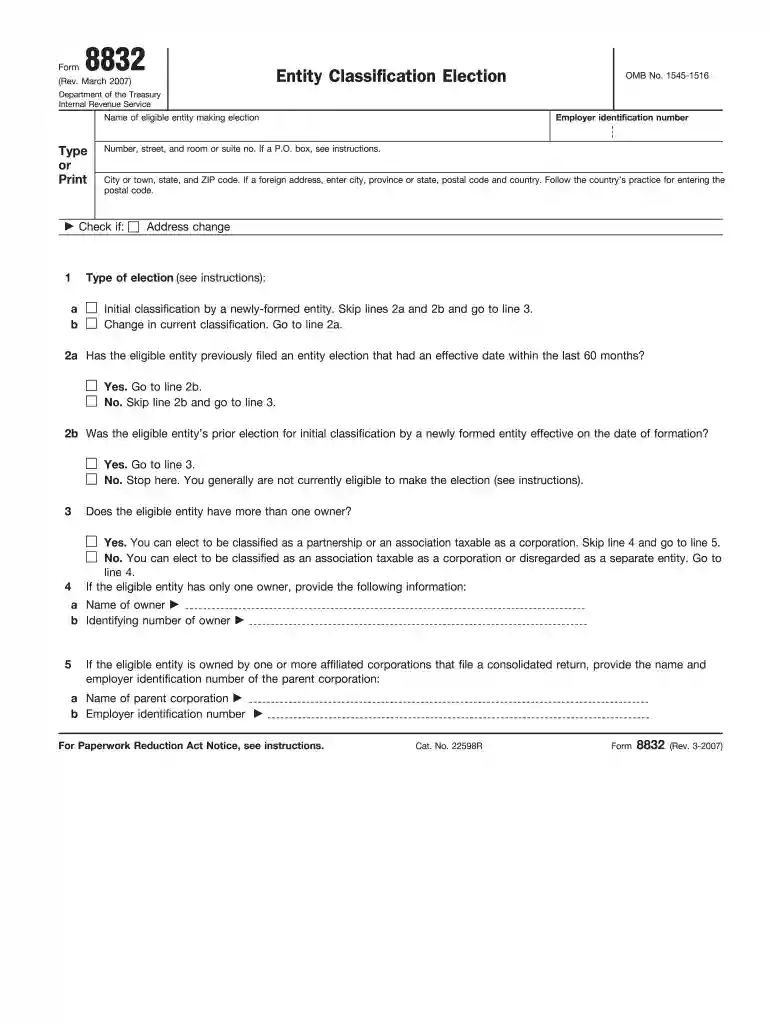
Type text, add images, blackout confidential details, add comments, highlights and more.

Draw your signature, type it, upload its image, or use your mobile device as a signature pad.

Send it via email, link, or fax. You can also download it, export it or print it out.
Form 8832, officially known as the Entity Classification Election, is a document used by eligible entities to elect their federal tax classification. This form allows an entity to choose whether it will be taxed as a corporation, a partnership, or a disregarded entity. The classification election is critical as it determines how the entity will be taxed under federal law, which can have significant implications for tax liability and compliance requirements. Businesses that wish to change their tax classification must do so by filing the Form 8832 with the Internal Revenue Service (IRS). Additionally, making this election can also impact state tax obligations.
Identify Your Entity Type: Determine whether your entity is eligible to file Form 8832. Typically, this includes most domestic and foreign business entities such as LLCs, corporations, or partnerships.
Filling Out Entity Information: Fill out the entity's name, mailing address, and employer identification number (EIN) accurately. Ensure consistency with IRS records to avoid processing delays.
Select Classification Type: Indicate the desired classification—corporation, partnership, or disregarded entity—and provide the effective date of the classification or change.
Owner Information and Consents: Include details about the entity’s owners or members, ensuring each owner signs the consent statement required for the change.
Finalize and Submit: Review the information for accuracy before signing and dating the form. Submit to the designated IRS office, considering submission methods such as mail or electronic filing where applicable.
Electing a tax classification with Form 8832 is important because it allows for control over how your business is taxed. Choosing the appropriate classification can lead to advantageous tax treatment, potentially reducing the overall tax burden. For example, an LLC that elects to be treated as a corporation might benefit from lower corporate tax rates or avoid pass-through taxation. In contrast, electing to be taxed as a partnership could allow profits to be taxed at individual rates. Understanding and strategically selecting the right classification may have lasting financial implications.
Disregarded Entity: A business entity with a single owner that is not considered separate from its owner for tax purposes. The income and expenses are reported on the owner's individual tax return.
Effective Date of Election: This is the date when the tax classification takes effect. It can be no more than 75 days before or 12 months after the date the form is filed.
Default Classification: The classification assigned by the IRS if no Form 8832 is filed. For example, an LLC with one member is classified as a disregarded entity, while one with multiple members is classified as a partnership.
Entity Identifier Number (EIN): A unique number assigned by the IRS to identify a business entity for tax purposes.
Timely filing is essential when submitting Form 8832 to avoid unintended tax consequences. The effective date of the election cannot be more than 75 days before or 12 months after the filing date. This time frame allows businesses some flexibility to plan their tax situation. Understanding the deadlines ensures compliance and mitigates potential late filing penalties. It’s crucial to align the effective date with financial planning and business needs.
The IRS provides comprehensive instructions for completing Form 8832, detailing eligibility, specific filing instructions, and guidance on answering each section of the form. Careful adherence to these guidelines is essential for successful submission. Missteps can result in processing delays or tax status rejections. Consulting the IRS’s official guidelines, available on their website, can provide clarity and prevent errors.
Failure to file or incorrectly completing Form 8832 can result in the IRS defaulting your business's tax classification, which may not be advantageous. Moreover, not adhering to filing requirements can also lead to penalties or interest on taxes owed. Businesses may face complications in reversing a default classification, highlighting the importance of timely and accurate filing.
Eligible entities include domestic LLCs, partnerships, and corporations that wish to change their tax classification. Not all business entities may change classification. Therefore, it’s important to check eligibility based on IRS criteria prior to submission. Considerations include the entity's current classification and the strategic benefits of switching to a different status. Understanding eligibility ensures that the entity takes full advantage of available tax benefits.


We've got more versions of the form 8832 rev march 2007 form. Select the right form 8832 rev march 2007 version from the list and start editing it straight away!
Most eSignature solutions require users to have a paid subscription. With DocHub, there are two options for you to add an electronic signature to your form 8832 rev march 2007 free of charge:
The second option, however, has restrictions on the number of signatures, sign requests, emails, and forms for editing available per month. You can check for full information here.
As a comprehensive document modifying platform, DocHub is available on mobile devices. Open DocHub in your choice of mobile internet browser and use our intelligent mobile-friendly toolset to complete your form 8832 rev march 2007.
At DocHub, your data security is our priority. We follow HIPAA, SOC2, GDPR, and other standards, so you can work on your documents with confidence.
An entity that elects to be classified as a corporation by filing Form 8832 can make another election to change its classification (see the 60-month limitation.Read more
Jan 8, 2013 Listing of All Files from GEnie Apple II Roundtable Bulletin Boards. File: AllGEnieFiles. Page 1. Report: TimeOut Print2PDF. January 8, 2013.Read more
Form 8832, Entity Classification Election. file Form 8832. A domestic LLC that will be filing Form 8832 to elect of the date on which the organization was


