




01. Edit your form online
Type text, add images, blackout confidential details, add comments, highlights and more.

Type text, add images, blackout confidential details, add comments, highlights and more.

Draw your signature, type it, upload its image, or use your mobile device as a signature pad.

Send it via email, link, or fax. You can also download it, export it or print it out.
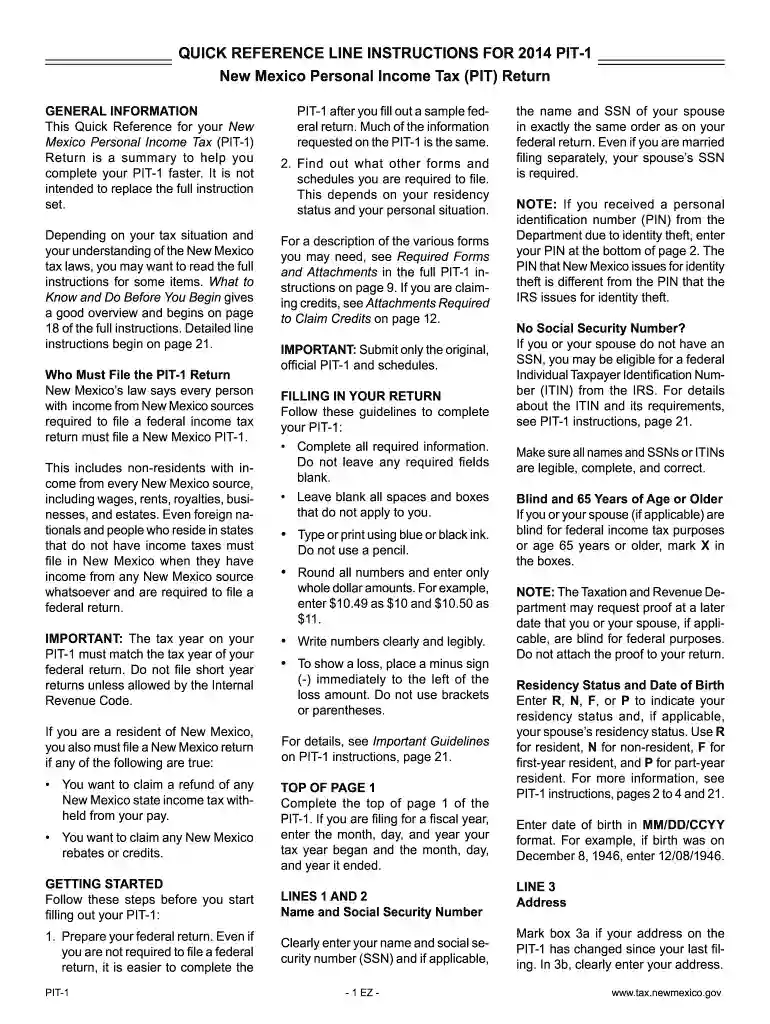
The 2014 PIT-1 Form, officially known as the New Mexico Personal Income Tax Return, is a tax document used by residents of New Mexico to file their state individual income taxes. This form allows taxpayers to report their annual income and calculate taxes owed to the state government. The PIT-1 Form captures vital taxpayer information including income sources, allowable deductions, exemptions, and available tax credits. This process is essential for ensuring correct tax payments and compliance with state tax regulations.
Using the 2014 PIT-1 Form involves several steps to accurately report your income and determine tax liability. Begin by gathering all relevant financial documents, such as W-2s, 1099s, and records of any deductions or credits. Next, fill in the personal information section, followed by entering your total income from various sources. Calculate your deductions and exemptions to determine your taxable income. Apply any tax credits you are eligible for before calculating the final amount of taxes owed or refund due.
You can obtain the 2014 PIT-1 Form through multiple channels. Visit the official New Mexico Taxation and Revenue Department (TRD) website to download a PDF version of the form. Forms are also available at local TRD offices. Alternatively, your tax preparation software may provide a digital version.
The filing deadline for the 2014 PIT-1 Form typically aligns with federal tax deadlines, which is April 15th of the following year. If the deadline falls on a weekend or holiday, it may be extended to the next business day. You can request an extension if unable to meet the original deadline, but this does not extend the time to pay any taxes owed.
Filing the 2014 PIT-1 Form requires comprehensive documentation to substantiate reported income, deductions, and credits. Essential documents include:
Filing the PIT-1 Form is a legal obligation for residents of New Mexico who meet certain income thresholds. Compliance with tax regulations involves accurate reporting and timely submission of the form. Non-compliance can result in penalties, interest accrual on owed taxes, and potential audits. It is advisable to consult tax professionals or the New Mexico TRD for guidance in complex tax situations.
You can submit the completed 2014 PIT-1 Form using several methods:
We've got more versions of the 2014 pit 1 form form. Select the right 2014 pit 1 form version from the list and start editing it straight away!
| Versions | Form popularity | Fillable & printable |
|---|---|---|
| 2025 | 4.1 Satisfied (57 Votes) | |
| 2024 | 4.4 Satisfied (41 Votes) | |
| 2023 | 4.6 Satisfied (50 Votes) | |
| 2022 | 4.9 Satisfied (45 Votes) | |
| 2021 | 4.3 Satisfied (58 Votes) | |
| 2020 | 4.8 Satisfied (90 Votes) | |
| 2019 | 4.2 Satisfied (38 Votes) | |
| 2018 | 4.4 Satisfied (56 Votes) | |
| 2017 | 4.2 Satisfied (59 Votes) | |
| 2016 | 4.4 Satisfied (188 Votes) | |
| 2015 | 4.1 Satisfied (58 Votes) | |
| 2014 | 4.9 Satisfied (30 Votes) | |
| 2014 | 4 Satisfied (29 Votes) | |
| 2013 | 4 Satisfied (34 Votes) | |
| 2013 | 4 Satisfied (25 Votes) |
At DocHub, your data security is our priority. We follow HIPAA, SOC2, GDPR, and other standards, so you can work on your documents with confidence.
Oct 16, 2022 This round I believe I was sitting at table 2, Michael Yue who was also playing vs an 8-Cast opponent was at table 3 and Max Carini at table 4.Read more
The Gemini Phase I Tool (PIT) must be used for proposal preparation and submission. Each Gemini participating country runs its own Phase I proposal process.Read more
Everyone who is required to file a New Mexico personal income tax return must complete and file a form PIT-1, New Mexico Personal Income Tax Return.Read more


