




01. Edit your form online
Type text, add images, blackout confidential details, add comments, highlights and more.

Type text, add images, blackout confidential details, add comments, highlights and more.

Draw your signature, type it, upload its image, or use your mobile device as a signature pad.

Send it via email, link, or fax. You can also download it, export it or print it out.
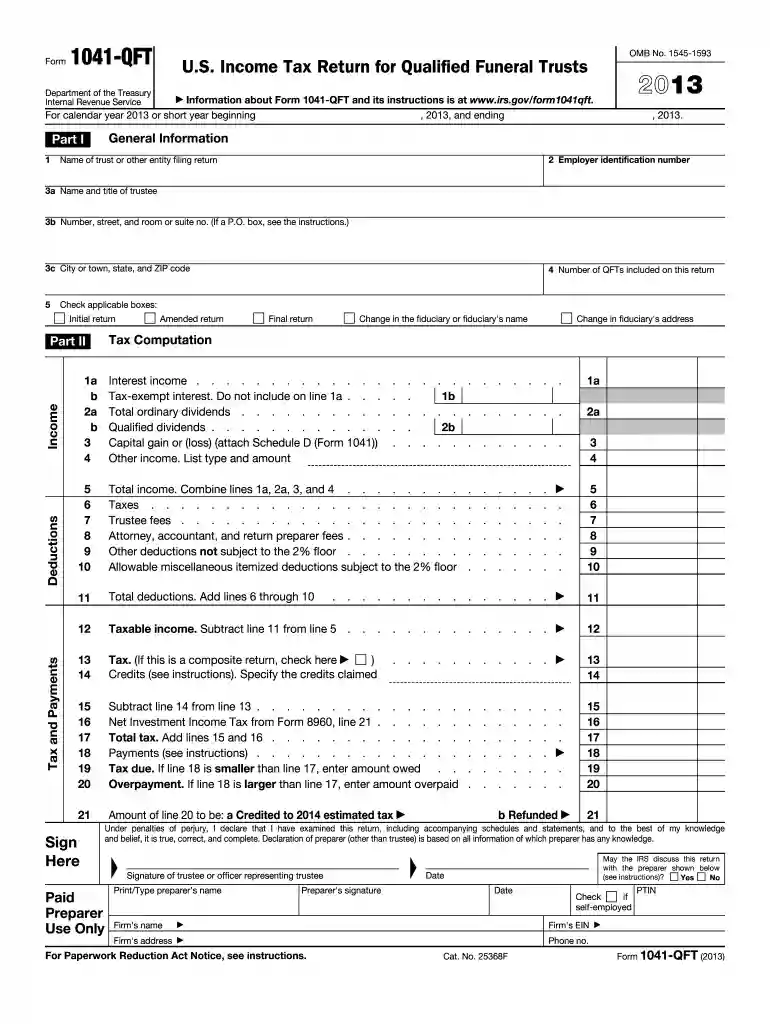
The 2017 Form 1041-QFT, or U.S. Income Tax Return for Qualified Funeral Trusts, is a federal tax document used by trustees to report the income, deductions, gains, losses, and tax liabilities associated with qualified funeral trusts (QFTs). A QFT is a type of trust established to hold and manage funds on behalf of individuals for their future funeral and burial expenses. This form is essential for ensuring compliance with IRS regulations regarding the management and taxation of these specific trust funds.
Filing the 2017 Form 1041-QFT involves several key steps, ensuring accurate reporting and compliance with federal tax requirements. Trustees must determine all income and expense aspects to calculate the correct tax liability.
Completing the 2017 Form 1041-QFT requires a methodical approach to ensure that all information is accurate and comprehensive.
Understanding the essential components of the 2017 Form 1041-QFT will aid in accurate form completion and compliance.
Adhering to stipulated deadlines for the 2017 Form 1041-QFT is crucial to avoid penalties.
To complete the 2017 Form 1041-QFT, compiling necessary documents is essential for accurate reporting and verification.
Failing to file the 2017 Form 1041-QFT or submitting incorrect information can lead to significant penalties and interest charges.
Various scenarios may affect how trustees report and manage funds using the 2017 Form 1041-QFT.


Leveraging digital tools can simplify the process of preparing and filing the 2017 Form 1041-QFT.
We've got more versions of the 2017 Form 1041-QFT. U.S. Income Tax Return for Qualified Funeral Trusts form. Select the right 2017 Form 1041-QFT. U.S. Income Tax Return for Qualified Funeral Trusts version from the list and start editing it straight away!
| Versions | Form popularity | Fillable & printable |
|---|---|---|
| 2025 | 4.1 Satisfied (23 Votes) | |
| 2024 | 4.3 Satisfied (33 Votes) | |
| 2023 | 4.4 Satisfied (58 Votes) | |
| 2022 | 4.9 Satisfied (38 Votes) | |
| 2021 | 4.8 Satisfied (59 Votes) | |
| 2020 | 4.2 Satisfied (44 Votes) | |
| 2019 | 4.1 Satisfied (69 Votes) | |
| 2018 | 4.2 Satisfied (79 Votes) | |
| 2017 | 4.2 Satisfied (95 Votes) | |
| 2016 | 4.4 Satisfied (573 Votes) | |
| 2015 | 4.1 Satisfied (74 Votes) | |
| 2014 | 4 Satisfied (27 Votes) | |
| 2013 | 4 Satisfied (23 Votes) | |
| 2012 | 4.3 Satisfied (43 Votes) | |
| 2011 | 4 Satisfied (34 Votes) |
At DocHub, your data security is our priority. We follow HIPAA, SOC2, GDPR, and other standards, so you can work on your documents with confidence.
Mar 30, 2026 The trustee of a trust that has elected to be taxed as a qualified funeral trust (QFT) files Form 1041-QFT to report the income, deductions, gains, losses, etc.Read more
Form 1041, U.S. Income Tax Return for Estates and Trusts, will be allowed an automatic five and one-half month extension of time to file the return


