




01. Edit your schedule l online
Type text, add images, blackout confidential details, add comments, highlights and more.

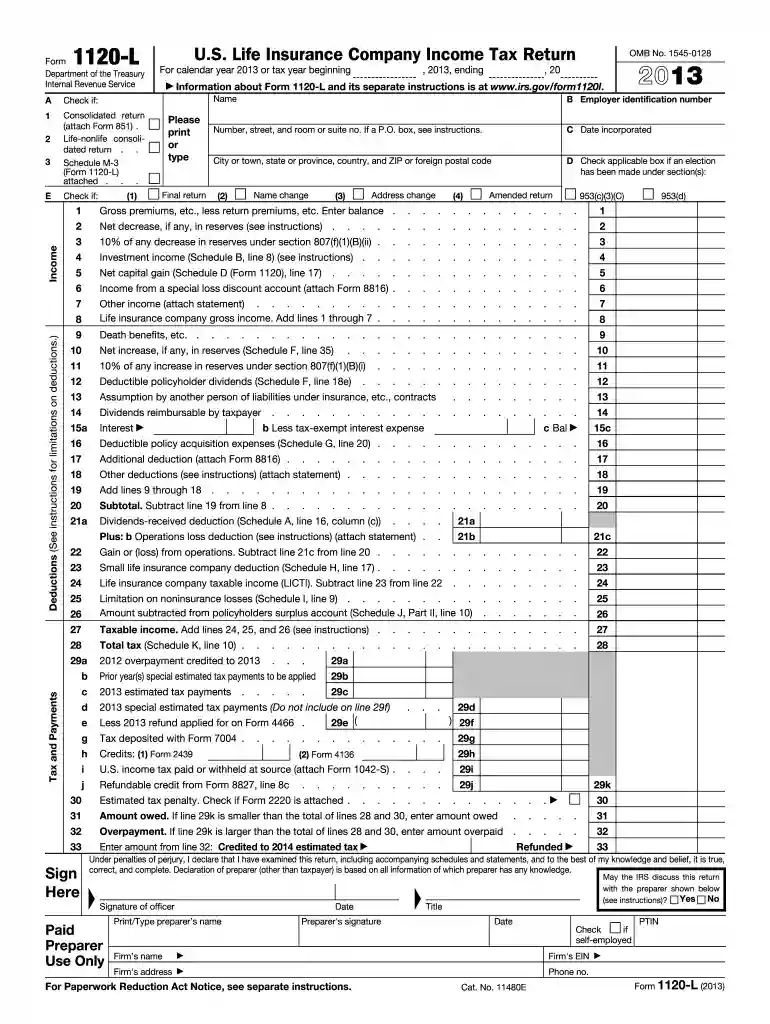
Type text, add images, blackout confidential details, add comments, highlights and more.

Draw your signature, type it, upload its image, or use your mobile device as a signature pad.

Send it via email, link, or fax. You can also download it, export it or print it out.
Form 1120 Schedule L 2013 is a critical component of the U.S. Corporate Income Tax Return, primarily used for reporting balance sheet information. This schedule provides a comprehensive snapshot of a corporation's financial position at the end of the tax year. It includes sections for detailing assets, liabilities, and shareholders' equity. Primarily aimed at life insurance companies, this form ensures that financial statements comply with IRS requirements for transparency in financial disclosures.
To effectively use Form 1120 Schedule L 2013, corporates must thoroughly document all financial data relevant to their balance sheet. This involves itemizing assets like cash, receivables, and investments, while accounting for liabilities such as loans and accrued expenses. It's crucial to ensure accuracy in these entries as they impact tax calculations and compliance. Corporations should coordinate with accounting professionals to verify that every entry reconciles correctly with other financial documents submitted to the IRS.
The IRS mandates that all corporations complete Schedule L when filing Form 1120, provided their total assets exceed $250,000. The guidelines emphasize accuracy and recommend aligning figures reported in the balance sheet with those on the income statement. Corporations should adhere to Generally Accepted Accounting Principles (GAAP) to maintain compliance and facilitate clarity for IRS assessments.
The standard deadline for filing Form 1120, including Schedule L, is March 15 for calendar year corporations. If the corporation operates on a fiscal year, the form is due on the fifteenth day of the fourth month after the fiscal year ends. Extensions can be requested via Form 7004, granting up to six additional months.
Primarily, C corporations operating in the United States are required to use Form 1120 Schedule L. This includes life insurance companies needing to report detailed financial data. It aids in providing the IRS with a complete financial overview, ensuring transparency and accuracy in income reporting.
Failing to accurately complete and submit Form 1120 Schedule L 2013 can result in penalties from the IRS. These may include fines for late filing or submission of inaccurate information. It's imperative for corporations to maintain precise records and promptly address any discrepancies to avoid these fines.
We've got more versions of the schedule l form. Select the right schedule l version from the list and start editing it straight away!
| Versions | Form popularity | Fillable & printable |
|---|---|---|
| 2025 | 4.1 Satisfied (46 Votes) | |
| 2024 | 4.2 Satisfied (51 Votes) | |
| 2023 | 4.5 Satisfied (38 Votes) | |
| 2022 | 4.1 Satisfied (50 Votes) | |
| 2021 | 4.9 Satisfied (49 Votes) | |
| 2020 | 4 Satisfied (25 Votes) | |
| 2019 | 4.1 Satisfied (26 Votes) | |
| 2018 | 4.4 Satisfied (223 Votes) | |
| 2017 | 4.3 Satisfied (143 Votes) | |
| 2016 | 4.4 Satisfied (180 Votes) | |
| 2015 | 4.2 Satisfied (70 Votes) | |
| 2014 | 4 Satisfied (37 Votes) | |
| 2013 | 4.3 Satisfied (65 Votes) | |
| 2012 | 4 Satisfied (54 Votes) | |
| 2011 | 4.2 Satisfied (39 Votes) |
At DocHub, your data security is our priority. We follow HIPAA, SOC2, GDPR, and other standards, so you can work on your documents with confidence.
Apr 15, 1976 income on the form or schedule on which you originally took the deduction (for example, Schedule C or F (Form 1040),. Form 1040, Form 1120, etc.)Read more
When preparing your 2013 tax return, you may complete the forms as if these contributions were made on. December 31, 2013, instead of in 2014. The contributionRead more
Type of Return and Return Information (Whole Dollars Only). Part I. Check the box for the return for which you are using this Form 8879-EO and enter theRead more


