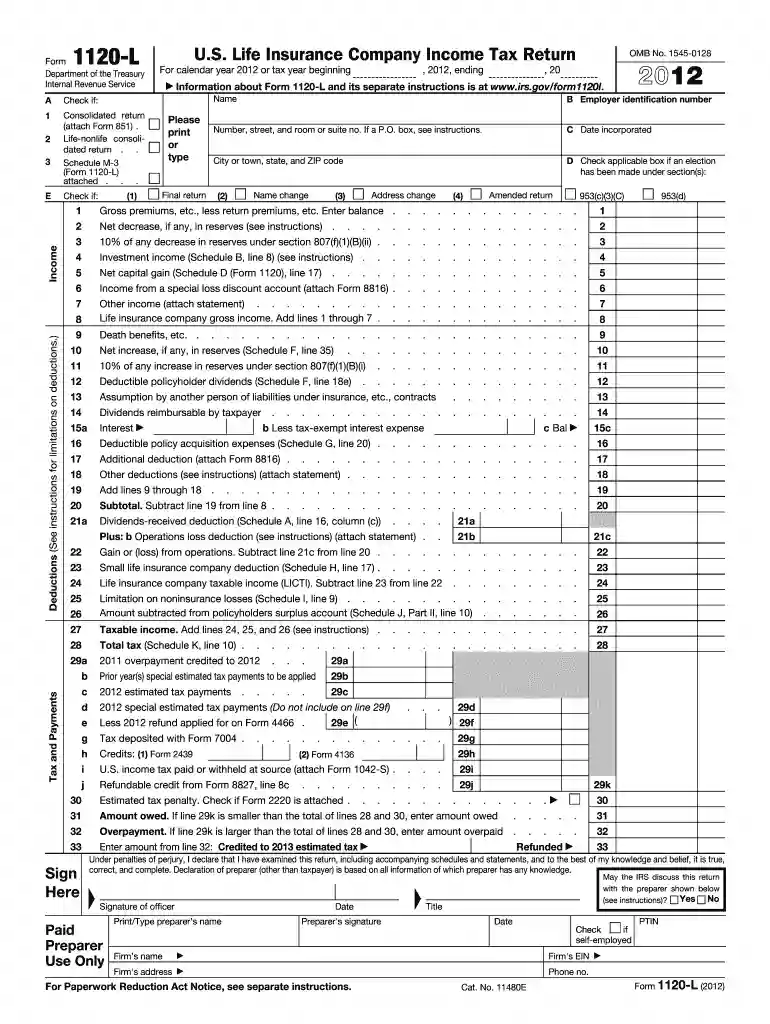
1120 l 2012 form-2026

Get Form
1120 l 2012 form Preview on Page 1

Here's how it works

01. Edit your form online
Type text, add images, blackout confidential details, add comments, highlights and more.

02. Sign it in a few clicks
Draw your signature, type it, upload its image, or use your mobile device as a signature pad.

03. Share your form with others
Send it via email, link, or fax. You can also download it, export it or print it out.

Definition and Meaning of Form 1120-L

Form 1120-L is the United States Life Insurance Company Income Tax Return specifically for the tax year 2012. This form is critical for life insurance companies to report their income, deductions, and tax liabilities to the Internal Revenue Service (IRS). It encompasses intricate details relevant to the unique financial operations of life insurance firms, distinguishing it from standard corporate tax returns.

Key components covered by Form 1120-L include:

  • Gross Premiums: Total premiums collected from policyholders, which form the foundation of the company's revenue.
  • Reserves: Funds that insurance companies set aside to pay future claims, reflecting a key aspect of their financial health.
  • Investment Income: Earnings generated from the pool of funds held by the insurance company, including interest, dividends, and capital gains.

Understanding these elements is essential for accurate reporting and compliance with federal tax obligations.

How to Use Form 1120-L

Using Form 1120-L involves a clear sequence of steps to ensure accurate completion and compliance with IRS guidelines. Here are the primary actions required:

  1. Gather Financial Data: Collect all relevant financial information, including income statements, balance sheets, and statements concerning reserves.
  2. Complete the Form Sections: Fill out various sections, detailing gross premiums, reserve amounts, investment income, and tax credits.
  3. Review and Calculate Taxes: Ensure all calculations for tax liabilities are correct before submission.
  4. File and Retain Copies: Submit the completed form to the IRS, retaining a copy for the company’s records.

Proper usage is essential to maintain compliance with tax laws and avoid penalties.

Tips for Completing the Form

  • Use accounting software to track relevant financial data throughout the year.
  • Consult a tax professional for complex tax issues related to insurance operations.
  • Verify the accuracy of each entry, especially in key financial areas.

Steps to Complete Form 1120-L

Completing Form 1120-L involves specific steps that must be followed meticulously to ensure accurate filings:

Step 1: Identify Your Business Structure

Determine whether your business is a corporation filing as a life insurance company. This identification sets the framework for how to proceed with the form.

Step 2: Collect Essential Information

Compile all necessary data including financial statements and previous tax returns. This information is crucial for completing the form accurately.

Step 3: Complete Each Section of the Form

Fill in the required sections, which typically include:

  • Income Section: Report gross premiums, investment income, and other income sources.
  • Deductions Section: Include reserves, dividends paid to policyholders, and other allowable deductions.
  • Tax Computation: Calculate the tax owed based on taxable income.

Step 4: Review for Accuracy

Check each section for completeness and accuracy. This step is critical for avoiding potential audits or penalties.

Step 5: Submit the Form

File the completed Form 1120-L by the IRS filing deadline, which is typically on or before March 15 of the year following the tax year being reported.

Important Terms Related to Form 1120-L

Understanding specific terminology related to Form 1120-L ensures clarity in the filing process and compliance requirements. Here are some critical terms:

  • Taxable Income: The amount of income that is subject to tax after deductions are applied.
  • Reserves: These are calculated amounts which insurers retain to pay policyholder claims in the future.
  • Non-admitted Assets: Assets that are not recognized for tax purposes, impacting the taxable income calculation.
  • Surplus: The excess of assets over liabilities, indicating the financial health of the insurance company.

Familiarity with these terms allows for a better understanding of the form’s requirements and implications.

Filing Deadlines for Form 1120-L

Adhering to filing deadlines is crucial for compliance with IRS regulations. For Form 1120-L, the standard deadline is March 15 following the end of the fiscal year in which the income was earned. Important considerations include:

  • Extensions: Companies may apply for an extension, which typically allows an additional six months for filing, pushing the deadline to September 15.
  • Penalties for Late Filing: Failing to file by the due date can result in penalties, which could accrue interest over time and impact the financial standing of the business.

Awareness of these deadlines helps insurance companies plan their reporting and ensure compliance.

Who Typically Uses Form 1120-L

Primarily, Form 1120-L is used by life insurance companies operating in the United States. Additional entities may include:

  • Mutual Insurance Companies: These are owned by the policyholders, often benefiting from lower premium rates and other advantages.
  • Stock Life Insurance Companies: These are publicly traded and must file as corporations, facing unique tax implications.

Understanding the demographics of form users helps in recognizing common practices and compliance strategies within the industry.

Examples of Using Form 1120-L

Real-world scenarios often illustrate how Form 1120-L functions in practice. Here are examples of typical use cases:

  • Case 1: Mutual Insurance Company Filing: A mutual insurance company compiles its financial data for the calendar year 2012, reporting its gross premiums of $5 million and total reserves of $1.5 million. The company meticulously fills out the form, ensures its deductions are accurate and files it within the deadline.

  • Case 2: Stock Company with Investment Earnings: A stock life insurance company reports $10 million in gross premiums and captures significant investment income through bonds, necessitating a thorough report of these earnings on the tax return. This report influences its overall tax liability.

Such scenarios exemplify the critical role that Form 1120-L plays in guiding companies in their tax compliance and financial reporting obligations.

See more 1120 l 2012 form versions

We've got more versions of the 1120 l 2012 form form. Select the right 1120 l 2012 form version from the list and start editing it straight away!
Versions Form popularity Fillable & printable
2023 4.5 Satisfied (38 Votes)
2022 4.1 Satisfied (50 Votes)
2021 4.9 Satisfied (49 Votes)
2020 4 Satisfied (25 Votes)
2019 4.1 Satisfied (26 Votes)
2018 4.4 Satisfied (223 Votes)
2017 4.3 Satisfied (143 Votes)
2016 4.4 Satisfied (180 Votes)
2015 4.2 Satisfied (70 Votes)
2014 4 Satisfied (37 Votes)
2013 4.3 Satisfied (65 Votes)
2012 4 Satisfied (54 Votes)
2011 4.2 Satisfied (39 Votes)
2010 4 Satisfied (49 Votes)
be ready to get more

Complete this form in 5 minutes or less

Get form

Got questions?

We have answers to the most popular questions from our customers. If you can't find an answer to your question, please contact us.
Contact us
Purpose of Form Use Form 1120-L to report the income, gains, losses, deductions, credits, and to figure the income tax liability of life insurance companies.
Yes, any of your clients that are corporations are generally required to file Form 1120 even if they did not earn any income during the tax year. The IRS mandates that all corporations file a tax return annually regardless of their financial activity, including those that report zero income.
Form 1120 is the U.S. corporation income tax return. It is an Internal Revenue Service (IRS) document that American corporations use to report their credits, deductions, losses, gains and income. It also helps corporations find out how much income tax they need to pay, according to the IRS.
Who Has To Complete Schedule L. For most C corporations, filing Schedule L with Form 1120 is necessary when their total assets exceed $10 million. This requirement, however, doesnt apply to S corporations or partnerships.
Understanding IRS Form 1120 Schedule L Schedule L, or Balance Sheets per Books, requires corporations to report their balance sheet data exactly as it appears in their records.
be ready to get more

Complete this form in 5 minutes or less

Get form

People also ask

Unless exempt under section 501, all domestic corporations (including corporations in bankruptcy) must file an income tax return whether or not they have taxable income. Domestic corporations must file Form 1120, unless they are required, or elect to file a special return.
If the corporations total receipts for the tax year AND total assets at the end of the tax year less than $250,000, Schedules L and M-1 are not required.

Related links