




01. Edit your form online
Type text, add images, blackout confidential details, add comments, highlights and more.

Type text, add images, blackout confidential details, add comments, highlights and more.

Draw your signature, type it, upload its image, or use your mobile device as a signature pad.

Send it via email, link, or fax. You can also download it, export it or print it out.
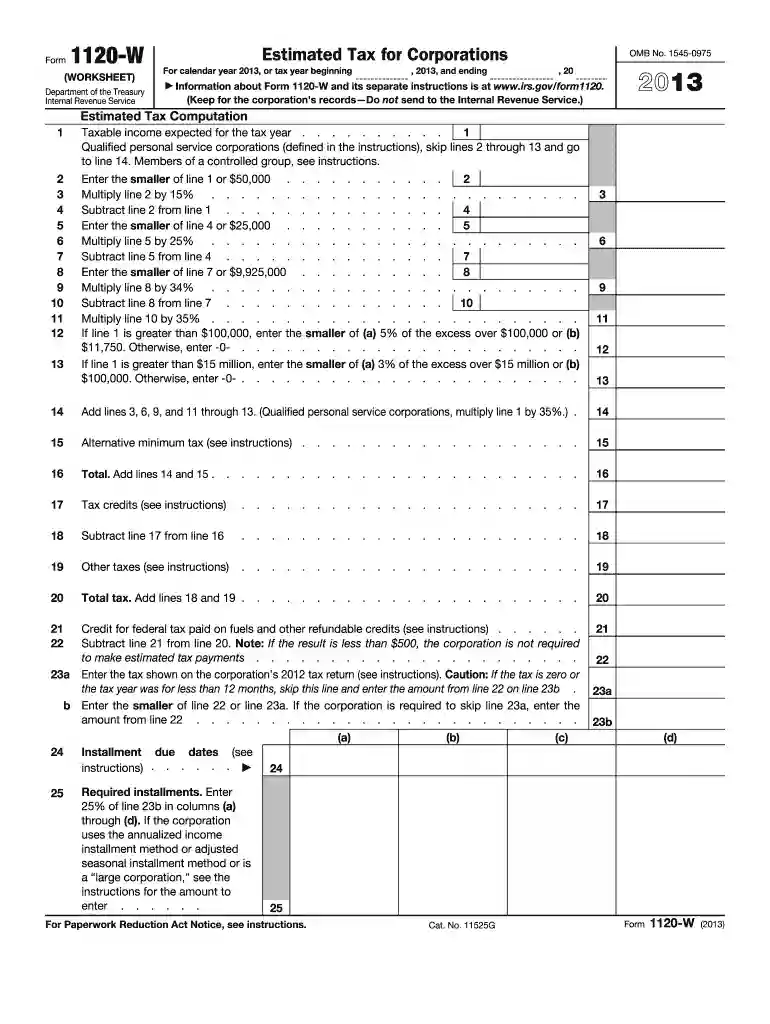
Form 1120-W is a worksheet issued by the Internal Revenue Service (IRS) specifically for corporations to estimate their tax obligations for the 2013 tax year. This form is designed as a calculation tool rather than a submission requirement. It helps corporations determine the amount of estimated tax they need to pay throughout the year to avoid penalties and interest on underpayment. Utilizing this form can assist corporations in managing their tax liabilities effectively, ensuring that they make accurate and timely estimated tax payments.
To utilize Form 1120-W effectively, corporations must first gather information about their expected income, allowing them to compute taxable income. This form provides sections to calculate the estimated tax by taking into account dividend distributions, corporate tax rates, and any applicable credits. Corporations should follow these steps:
This detailed approach ensures accurate projections and helps in aligning the tax payments with actual earnings.
Corporations can access Form 1120-W online through the official Internal Revenue Service website. Download the form directly in a printable PDF format, ensuring it is legible and complete. Alternatively, tax professionals and software platforms also provide access to this form as part of their tax preparation services. Keeping a digital version of the form allows easy modifications and updates as financial circumstances change throughout the year.
Completing Form 1120-W involves several steps to ensure accurate calculations:
Input All Sources of Income: Begin with a thorough listing of projected income sources, including revenue streams and gainful transactions.
Compute Adjusted Gross Income: Adjust for recognized deductions and credits that the corporation is eligible for.
Apply Corporate Tax Rates: Use the appropriate tax rates stipulated for the year 2013 to apply to the calculated taxable income.
Review for Completeness and Accuracy: Carefully check entries for miscalculations and ensure all required fields are filled.
Determine Due Installments: Divide the total estimated tax by the number of installments due, ensuring each payment is correctly timed.
By following these structured steps, corporations can maintain compliance with IRS requirements while effectively managing fiscal responsibilities.
The form encompasses various critical components and sections that need careful attention:
Each element is designed to ensure corporations can thoroughly calculate their tax payment requirements, thereby minimizing compliance issues.
Form 1120-W is predominantly utilized by corporate entities that anticipate a minimum income subject to federal taxes. This includes:
Each corporation type should tailor the use of the form to their respective financial scenarios, ensuring accurate tax calculations.
The IRS provides specific guidelines on the utilization of Form 1120-W, emphasizing compliance and accuracy. These guidelines cover:
Adhering to these IRS guidelines ensures corporations remain compliant and reduce the risk of incurring penalties.
To prevent penalties, corporations must adhere to specified deadlines for estimated tax payments:
Meeting these deadlines is crucial for maintaining good standing with IRS requirements and avoiding financial detriments due to missed payments.
We've got more versions of the form 1120 w 2013 form. Select the right form 1120 w 2013 version from the list and start editing it straight away!
| Versions | Form popularity | Fillable & printable |
|---|---|---|
| 2022 | 4.7 Satisfied (138 Votes) | |
| 2021 | 4.8 Satisfied (971 Votes) | |
| 2020 | 4.2 Satisfied (119 Votes) | |
| 2019 | 4.4 Satisfied (205 Votes) | |
| 2018 | 4.3 Satisfied (62 Votes) | |
| 2017 | 4.4 Satisfied (115 Votes) | |
| 2016 | 4.3 Satisfied (141 Votes) | |
| 2015 | 4 Satisfied (60 Votes) | |
| 2014 | 4.3 Satisfied (67 Votes) | |
| 2013 | 4 Satisfied (51 Votes) | |
| 2012 | 4.2 Satisfied (74 Votes) | |
| 2011 | 4 Satisfied (30 Votes) | |
| 2010 | 4.2 Satisfied (56 Votes) |
At DocHub, your data security is our priority. We follow HIPAA, SOC2, GDPR, and other standards, so you can work on your documents with confidence.
Corporations generally must make estimated tax payments if they expect their estimated tax (income tax less credits) to be. $500 or more.Read more
Apr 15, 1976 Enter here and as other income on the form or schedule on which 1040, Form 1120, etc.) Enter here and as other income on the form or schedule
Oct 15, 2013 The state of Illinois requires both individuals and C corporations to make estimated tax payments. Partnerships,.Read more


