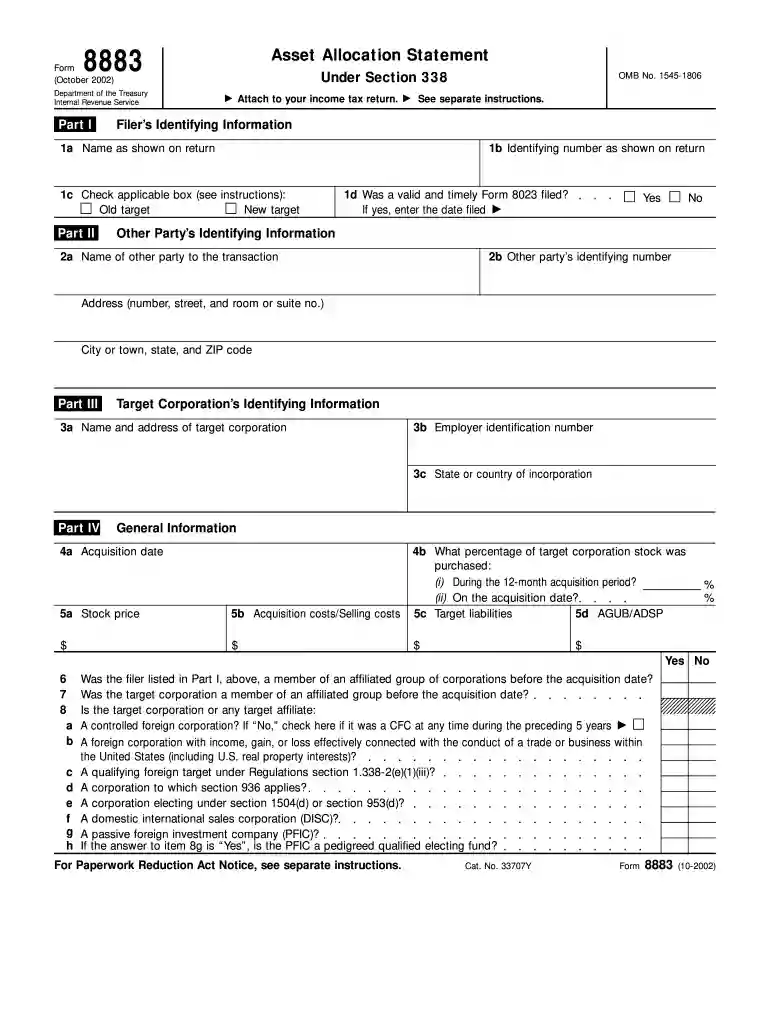
Form 8883 (Rev. October 2002) (Fill-In Capable). Asset Allocation Statement Under Section 338-2026

Get Form
form 8883 Preview on Page 1

Here's how it works

01. Edit your form 8883 online
Type text, add images, blackout confidential details, add comments, highlights and more.

02. Sign it in a few clicks
Draw your signature, type it, upload its image, or use your mobile device as a signature pad.

03. Share your form with others
Send 8883 via email, link, or fax. You can also download it, export it or print it out.

Definition & Meaning

Form 8883, officially titled "Asset Allocation Statement Under Section 338", is a document mandated by the Department of the Treasury, Internal Revenue Service, dated October 2002. It is primarily used by purchasers of corporate stock to report the allocation of assets following certain qualifying stock acquisitions. Section 338 of the Internal Revenue Code allows a corporation that has acquired at least 80% of another corporation's stock to treat the stock purchase as an asset purchase for tax purposes. This form enables the purchaser to document how the internal revenue code is applied in valuing and allocating the acquired assets.

Key Objectives of Form 8883

  • Facilitate the adjustment of tax attributes between involved entities.
  • Ensure compliance with the regulations under Section 338.
  • Support accurate reporting and calculation of tax liabilities for corporate acquisitions.

Steps to Complete the Form 8883

Completing Form 8883 involves a systematic approach and requires attention to detail.

Step-by-Step Instructions

  1. Identifying Information: Provide the basic information about the filing corporation and the target corporation, including names, addresses, and Employer Identification Numbers (EIN).
  2. Details of Acquisition: Specify the date of acquisition, and describe the type of transaction—whether a qualified stock purchase or another relevant type.
  3. Asset Allocation Details: List all assets acquired in the transaction, categorized appropriately, and denote fair market values.
    • Use categories such as tangible personal property, real property, inventory, and goodwill.
  4. Certification and Signature: Ensure the credibility of the form by certifying all provided information is true, complete, and correct to the best of your knowledge before signing.

Common Mistakes to Avoid

  • Misclassification of assets can lead to incorrect tax calculations.
  • Inaccurate valuations may result in penalties or adjustments by the IRS.
  • Omitting necessary signatures can lead to processing delays.

Key Elements of Form 8883

Understanding the primary sections of Form 8883 is crucial in ensuring thorough completion.

Essential Sections

  • Section 1: Basic Information
    • Lists information regarding the corporation making the purchase and the acquired target corporation.
  • Section 2: Transaction Details
    • Focuses on the acquisition date and nature of the transaction.
  • Section 3: Asset Schedule and Allocation
    • Requires detailed entries of asset categories and their fair market valuations.

Detailed Asset Breakdown

  • Tangible Property: Encompasses physical assets like machinery and buildings.
  • Intangible Property: Includes intellectual property and goodwill.

Who Typically Uses Form 8883

Form 8883 is commonly used in corporate transactions involving significant stock purchases.

Typical Users

  • Corporations Acquiring Companies: Especially where an election under Section 338 is made.
  • Tax Advisors and Accountants: Assisting clients with complex business acquisitions.
  • Legal Advisors: Ensuring compliance and proper documentation during mergers and acquisitions.

Business Entity Types

  • C Corporations: Most often engage in transactions requiring Form 8883.
  • S Corporations and LLCs: May also be involved when acquiring a majority stake in another corporation.

IRS Guidelines

The Internal Revenue Service publishes specific guidelines to assist in the proper completion of Form 8883.

Important Instructions

  • Guidance on Asset Valuation: The IRS provides standards for fair market valuation.
  • Filing Instructions: Specific instructions on how to submit the form, including relevant IRS mailing addresses.
  • Error Correction: Procedures for submitting corrected forms if errors are identified post-submission.

Benefits of Compliance

  • Avoiding Penalties: Adhering to IRS guidelines helps mitigate the risk of financial penalties.
  • Ensuring Tax Benefits: Proper allocation of assets can optimize tax outcomes under Section 338.

Filing Deadlines / Important Dates

Timeliness in filing Form 8883 is critical to avoid penalties and ensure compliance.

Critical Dates

  • Filing Deadline: Typically coincides with the corporation's tax return due date, including any extensions.
  • Transactional Deadlines: Be aware of election timelines under Section 338, which require timely form completion and submission.

Strategies for Timely Filing

  • Early Preparation: Start gathering necessary documents and valuations well before the filing deadline.
  • Organized Documentation: Maintain a well-organized repository of all transactional documents for easy access during form completion.

Penalties for Non-Compliance

Non-compliance with IRS requirements associated with Form 8883 can lead to various penalties.

Potential Consequences

  • Financial Penalties: Incorrect form submission or late filings can result in fines.
  • Tax Adjustments: Misreported or misclassified asset allocations can lead to additional tax liabilities.
  • Legal Repercussions: Significant non-compliance might necessitate legal recourse or result in IRS audits.

Mitigation of Risks

  • Regular Audits: Regular internal audits to ensure compliance with IRS rules.
  • Professional Consultations: Engage with tax professionals for reviews and advice.

See more Form 8883 (Rev. October 2002) (Fill-In Capable). Asset Allocation Statement Under Section 338 versions

We've got more versions of the Form 8883 (Rev. October 2002) (Fill-In Capable). Asset Allocation Statement Under Section 338 form. Select the right Form 8883 (Rev. October 2002) (Fill-In Capable). Asset Allocation Statement Under Section 338 version from the list and start editing it straight away!
Versions Form popularity Fillable & printable
2017 4.8 Satisfied (189 Votes)
2008 4.4 Satisfied (491 Votes)
2002 4 Satisfied (34 Votes)
be ready to get more

Complete this form in 5 minutes or less

Get form

Got questions?

We have answers to the most popular questions from our customers. If you can't find an answer to your question, please contact us.
Contact us

If you regularly work with documents stored in your Google Drive, DocHub is a superb option for you to easily and quickly complete, edit, and approve them. This editor integrates well with Google services, so you can export your 8883 form from your Google Drive to the editor without downloading and re-uploading it. Right-click on your file, choose Open With → DocHub PDF Sign and Edit. In our editor, add and assign Signature Fields for all people involved, then click on the Menu button above → Send → choose how you want to share your paperwork.

If you store your paperwork in Google Drive, there is no need to download your form 8883 instructions on the computer and upload it back to our editor. A significantly simpler way is to set up a browser extension developed by DocHub to streamline this flow. The extension allows editing PDFs right in your web browser. Alternatively, you may integrate your DocHub and Gmail accounts for more efficient modifying.

Security and compliance

At DocHub, your data security is our priority. We follow HIPAA, SOC2, GDPR, and other standards, so you can work on your documents with confidence.

Learn more
ccpa2
pci-dss
gdpr-compliance
hipaa
soc-compliance
be ready to get more

Complete this form in 5 minutes or less

Get form