



01. Edit your cus 1120 online
Type text, add images, blackout confidential details, add comments, highlights and more.

Type text, add images, blackout confidential details, add comments, highlights and more.

Draw your signature, type it, upload its image, or use your mobile device as a signature pad.

Send it via email, link, or fax. You can also download it, export it or print it out.
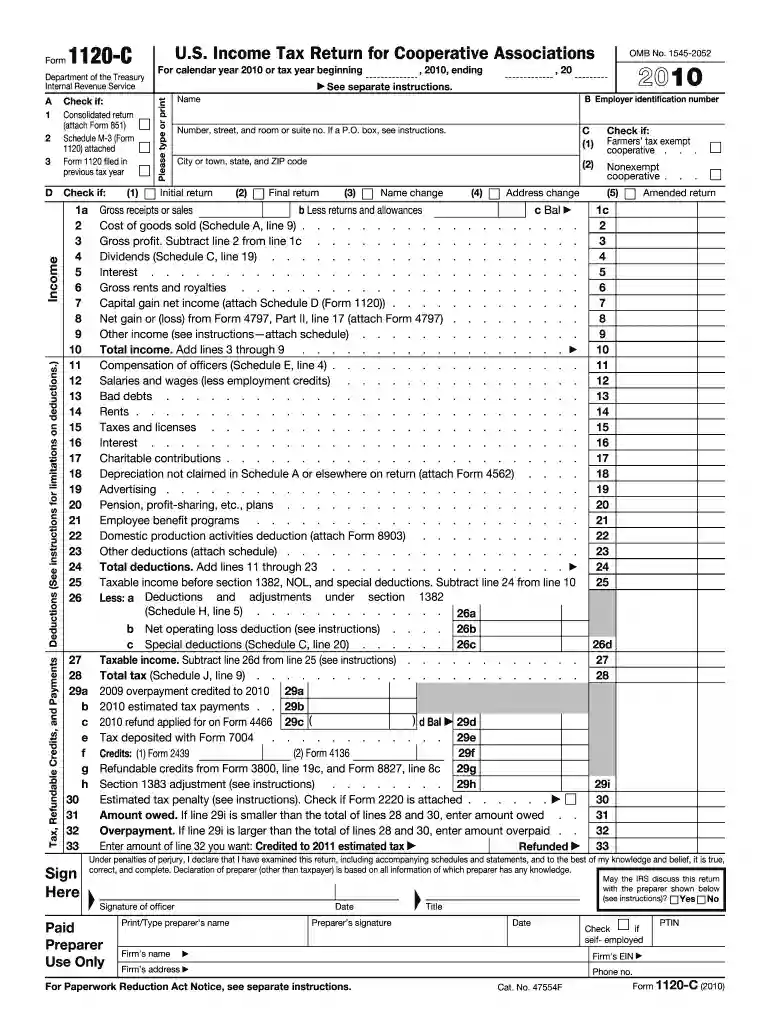
The 2010 Form 1120-C is used by cooperative associations in the United States to report income, deductions, and tax obligations. It is a legal requirement for these organizations to detail their annual financial activities to the Internal Revenue Service (IRS). This form encompasses sections on income, deductions, distribution of dividends, and compensation of officers, making it comprehensive for tax reporting needs.
Cooperatives must accurately input all financial data related to their operations to comply with federal tax laws. This involves gathering precise information on revenues and expenses incurred throughout the year, calculating the taxable income, and reporting this on the form.
This form is primarily used by cooperative associations. These organizations are typically member-owned and operate to meet the shared needs of their members, often in sectors like agriculture, finance, or purchasing.

The form can be accessed through various methods, ensuring availability for all cooperatives required to file.
Adhering to IRS guidelines is essential for compliance when using the 2010 Form 1120-C.
Failure to accurately complete and submit the form on time may result in penalties.
Filing deadlines are critical for compliance and avoiding penalties.
Cooperatives have options for submitting the form, tailored to their preferences and resources.
Gathering the right documentation is key to filling out the 2010 Form 1120-C efficiently.
In summary, the 2010 Form 1120-C plays a crucial role in the annual tax processes of cooperative associations in the U.S. By understanding its components, requirements, and proper filing methods, cooperatives can ensure compliance and accurately report their financial position to the IRS.
We've got more versions of the cus 1120 form. Select the right cus 1120 version from the list and start editing it straight away!
| Versions | Form popularity | Fillable & printable |
|---|---|---|
| 2025 | 4.6 Satisfied (37 Votes) | |
| 2024 | 4.7 Satisfied (24 Votes) | |
| 2023 | 4.4 Satisfied (31 Votes) | |
| 2022 | 4.4 Satisfied (36 Votes) | |
| 2021 | 4.8 Satisfied (181 Votes) | |
| 2020 | 4.4 Satisfied (138 Votes) | |
| 2019 | 4.1 Satisfied (81 Votes) | |
| 2018 | 4.3 Satisfied (301 Votes) | |
| 2017 | 4.3 Satisfied (105 Votes) | |
| 2016 | 4.3 Satisfied (55 Votes) | |
| 2015 | 4.1 Satisfied (59 Votes) | |
| 2014 | 4.2 Satisfied (40 Votes) | |
| 2013 | 4.4 Satisfied (37 Votes) | |
| 2012 | 4 Satisfied (42 Votes) | |
| 2011 | 4 Satisfied (30 Votes) |
At DocHub, your data security is our priority. We follow HIPAA, SOC2, GDPR, and other standards, so you can work on your documents with confidence.
Mar 1, 2021 an organization exempt from tax. Certain politi- cal organizations, however, must file an annual income tax return, Form 1120-POL, U.S. In-.Read more
Apr 15, 1976 Depreciation or amortization on any asset on a corpo- rate income tax return (other than Form 1120S, U.S. Income Tax Return for an S


