




01. Edit your form online
Type text, add images, blackout confidential details, add comments, highlights and more.

Type text, add images, blackout confidential details, add comments, highlights and more.

Draw your signature, type it, upload its image, or use your mobile device as a signature pad.

Send it via email, link, or fax. You can also download it, export it or print it out.
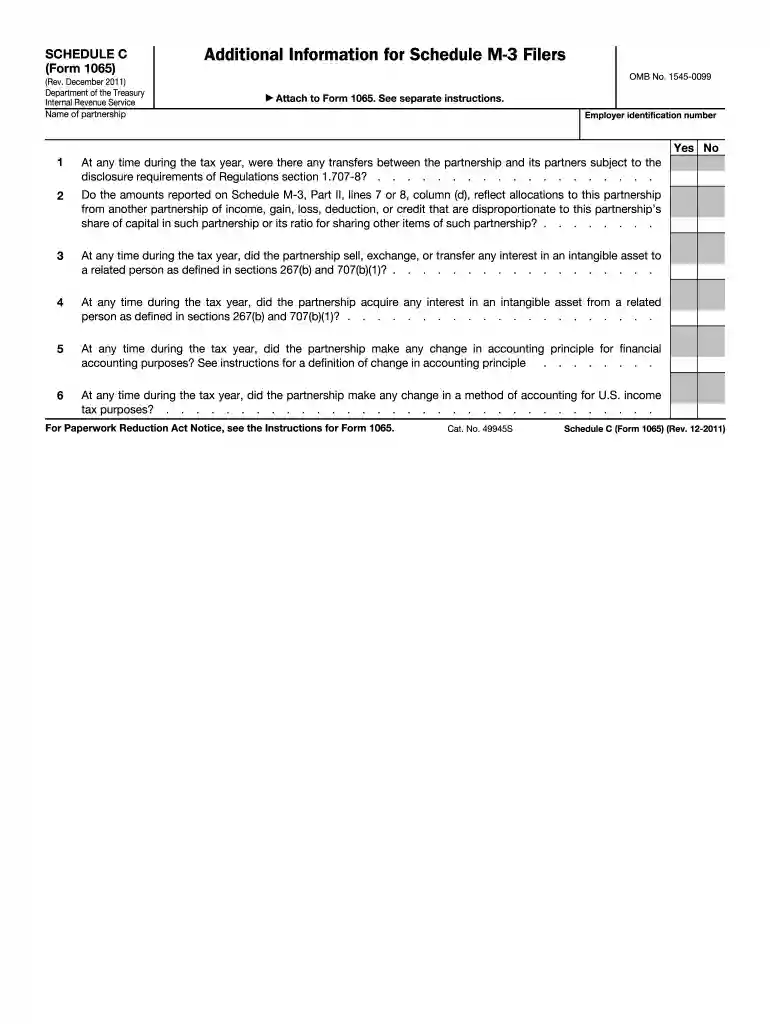
Schedule C (Form 1065) (Rev. December 2011) is designed for partnerships filing Schedule M-3 with the Internal Revenue Service. This schedule is essential for providing supplemental information regarding partnership activities and financial transactions. It captures data on significant financial aspects such as partner transfers, reallocation rights, and changes in accounting practices. Partnerships that fill out this form are ensuring detailed compliance with IRS requirements, promoting transparency in reporting their financial status and obligations.
The main components of Schedule C (Form 1065) focus on key financial activities of a partnership. Understanding these elements helps maintain compliance and accurately report the partnership's financial situation:
These elements are crucial for depicting how a partnership manages internal and affiliated financial activities.
Completing Schedule C (Form 1065) requires meticulous attention to detail:
By following these steps, partnerships ensure their financial activities are transparent and comply with IRS requirements.
To accurately complete Schedule C (Form 1065), partnerships must have specific documents available:
These documents facilitate the accurate completion of the form and support compliance with IRS expectations.
Schedule C (Form 1065) is predominantly used by partnerships that file Schedule M-3. These entities are typically partnerships with:
Such partnerships are required to disclose detailed financial information to maintain transparency and compliance.


Adhering to IRS guidelines for Schedule C (Form 1065) is crucial. Key guidelines include:
Compliance with these guidelines ensures avoidance of errors and potential penalties.
Filing Schedule C (Form 1065) within appropriate deadlines is essential for partnerships to stay compliant. Important dates include:
Meeting these deadlines is essential to prevent penalties and interest charges.
Failure to properly file Schedule C (Form 1065) can result in significant penalties:
Avoiding these penalties is crucial by ensuring accurate and timely filing of the form.
Understanding specific terms related to Schedule C (Form 1065) aids in accurate form completion:
By understanding these terms, partnerships can successfully fulfill their IRS reporting obligations.
We've got more versions of the Schedule C ( Form 1065 ) (Rev. December 2011 ) form. Select the right Schedule C ( Form 1065 ) (Rev. December 2011 ) version from the list and start editing it straight away!
At DocHub, your data security is our priority. We follow HIPAA, SOC2, GDPR, and other standards, so you can work on your documents with confidence.
Feb 17, 2012 Do not use Schedule C or C-EZ. Instead, file organization as an LLC. The members of an LLC are not. Form 1065, U.S. Return of Partnership IncomeRead more
Also use Schedule C to report (a) wages and expenses you had as a statutory employee,. (b) income and deductions of certain qualified joint ventures, and (c)Read more
Apr 15, 1976 Increased section 179 deduction dollar limits. The maximum amount you can elect to deduct for most sec- tion 179 property you placedRead more


