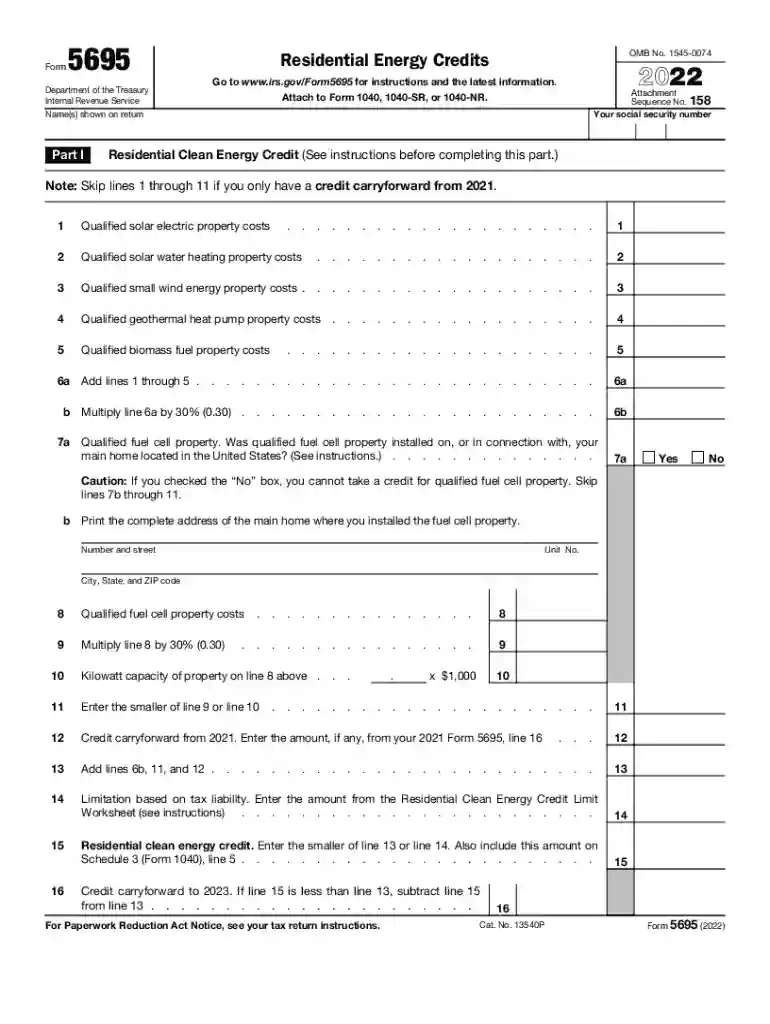
Definition and Purpose of Form 5695
Form 5695, officially known as "Residential Energy Credits," is an IRS form that allows taxpayers to claim credits for certain energy-saving home improvements. This form is critical for individuals seeking to reduce their tax liability by utilizing incentives designed to encourage energy efficiency in residential properties. The form encompasses two primary credits: the Residential Clean Energy Credit and the Energy Efficient Home Improvement Credit, which can significantly impact one's tax returns when proper eligibility is met.
Key Elements of Form 5695
Several critical components define the structure and functionality of Form 5695:
- Residential Clean Energy Credit: This credit covers expenditures for renewable energy sources like solar panels, wind turbines, and geothermal heat pumps.
- Energy Efficient Home Improvement Credit: This section includes costs for energy-efficient improvements such as insulation, windows, doors, and roofing.
- Credit Calculations: Detailed instructions are provided to calculate the allowable credit based on qualified expenditures.
- Attachment to Main Tax Return: The form must be attached to standard forms such as the IRS Form 1040, 1040-SR, or 1040-NR.
Steps to Complete Form 5695
- Gather Necessary Documentation: Collect all receipts and certifications for energy-efficient improvements.
- Fill Personal Information: Enter details such as name, address, and taxpayer identification number.
- Complete Credit Sections: Enter amounts spent on qualified improvements in the applicable sections.
- Calculate Credits: Follow the form instructions to determine the total credit amount.
- Review for Accuracy: Cross-check entries for errors or omissions.
- Attach to Tax Return: Submit the completed Form 5695 with your tax return.
How to Obtain Form 5695
- Download: Available on the official IRS website in electronic format for download and print.
- Paper Copies: Request via mail from the IRS or obtain from participating tax preparers.
- Online Platforms: Accessible through digital tax preparation software that supports IRS form submissions.
IRS Guidelines and Compliance
- Documentation Retention: Taxpayers must retain all related documentation and certifications for a minimum of three years.
- Accuracy and Verification: All claims are subject to verification by the IRS, which may audit taxpayers to validate the claimed credits.
- Amendments and Updates: Keep informed of IRS updates or changes to eligibility rules, as they can affect credit claims.
Penalties for Non-Compliance
Filing inaccuracies or incorrect claims on Form 5695 can result in penalties, including:
- Fines: Imposed based on the severity and nature of the misreporting.
- Interest Charges: On any outstanding tax liability due to disallowed credits.
- Reassessment of Liability: The IRS may reassess taxes due if fraudulent or erroneous claims are discovered.
Software Compatibility for Filing
- Digital Tools: Compatible with major tax software such as TurboTax and QuickBooks, which assist in accurately filling out Form 5695.
- Automatic Calculations: These platforms provide the benefit of automatic calculations and error-checking.
Examples of Using Form 5695
Consider a homeowner who installs solar panels costing $15,000. By using Form 5695, the homeowner can claim a percentage of this cost as a Residential Clean Energy Credit. Another example involves upgrading windows to more energy-efficient models, allowing a homeowner to claim the Energy Efficient Home Improvement Credit, reducing overall tax liability.
Important Terms Related to Form 5695
- Tax Credit: Directly reduces tax liability as opposed to a deduction which lowers taxable income.
- Qualified Expenditure: Costs that are eligible for credit considerations under IRS regulations.
- Certification: An official validation that an improvement meets specific energy efficiency criteria.
Selecting the right entries and understanding each regulation aspect ensures taxpayers optimize their available credits.