




01. Edit your 1041 qft online
Type text, add images, blackout confidential details, add comments, highlights and more.

Type text, add images, blackout confidential details, add comments, highlights and more.

Draw your signature, type it, upload its image, or use your mobile device as a signature pad.

Send are burial expenses tax deductible via email, link, or fax. You can also download it, export it or print it out.
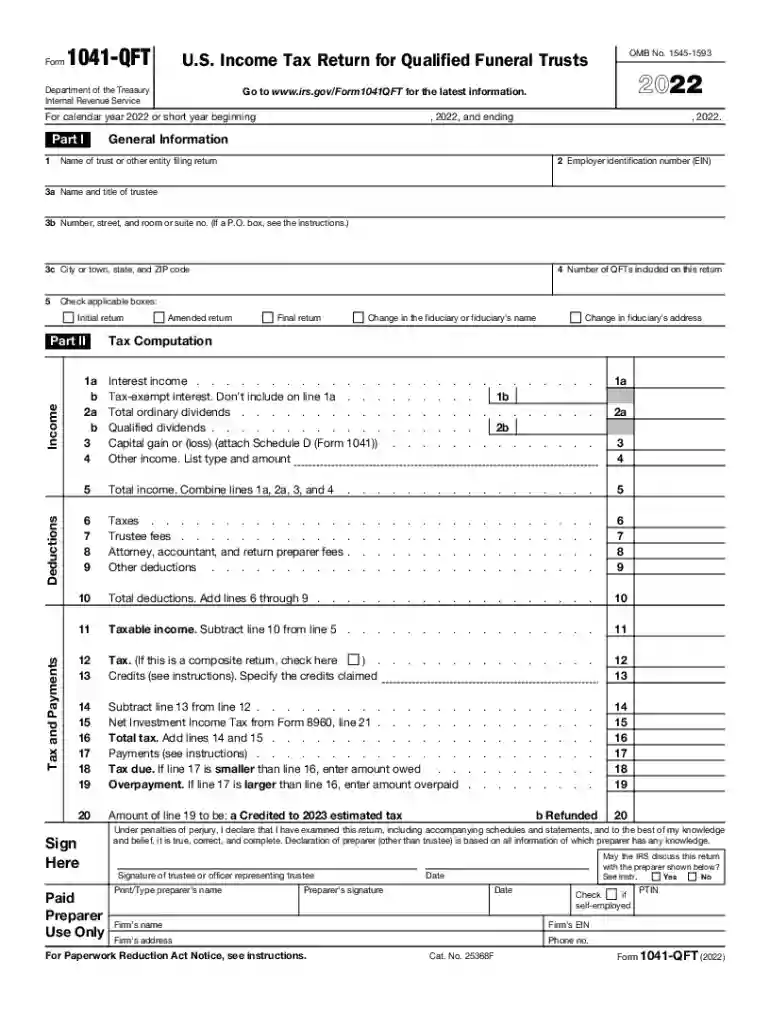
The 2022 Form 1041-QFT is specifically designed for reporting income, deductions, gains, and losses of Qualified Funeral Trusts (QFTs) in the United States. This tax form is filed by trustees managing QFTs to outline their tax liabilities. These trusts are created to manage and pay for funeral costs, with the form primarily used to ensure proper tax compliance and reporting of financial activities related to the trust.
Completing the 2022 Form 1041-QFT requires meticulous attention to detail to ensure compliance with IRS standards. Below are the detailed steps:
Qualified Funeral Trusts that meet specific criteria must file the 2022 Form 1041-QFT. Understanding these requirements is crucial to determine eligibility:


Adhering to IRS guidelines is essential for correctly filing the 2022 Form 1041-QFT. The guidelines offer crucial insights into the dos and don'ts of the form submission process:
Understanding the deadlines associated with the 2022 Form 1041-QFT is vital to ensure timely filing and avoid penalties:
The primary users of the 2022 Form 1041-QFT are trustees of Qualified Funeral Trusts:

Failing to comply with the guidelines and deadlines for the 2022 Form 1041-QFT can lead to several penalties:
The 2022 Form 1041-QFT can be filed both in digital and paper formats, each offering unique advantages:
To accurately file the 2022 Form 1041-QFT, trustees need to compile various documents:
We've got more versions of the 1041 qft form. Select the right 1041 qft version from the list and start editing it straight away!
| Versions | Form popularity | Fillable & printable |
|---|---|---|
| 2025 | 4.1 Satisfied (23 Votes) | |
| 2024 | 4.3 Satisfied (33 Votes) | |
| 2023 | 4.4 Satisfied (58 Votes) | |
| 2022 | 4.9 Satisfied (38 Votes) | |
| 2021 | 4.8 Satisfied (59 Votes) | |
| 2020 | 4.2 Satisfied (44 Votes) | |
| 2019 | 4.1 Satisfied (69 Votes) | |
| 2018 | 4.2 Satisfied (79 Votes) | |
| 2017 | 4.2 Satisfied (95 Votes) | |
| 2016 | 4.4 Satisfied (573 Votes) | |
| 2015 | 4.1 Satisfied (74 Votes) | |
| 2014 | 4 Satisfied (27 Votes) | |
| 2013 | 4 Satisfied (23 Votes) | |
| 2012 | 4.3 Satisfied (43 Votes) | |
| 2011 | 4 Satisfied (34 Votes) |
At DocHub, your data security is our priority. We follow HIPAA, SOC2, GDPR, and other standards, so you can work on your documents with confidence.
○ Qualified Funeral Trust - IRS 1041 - QFT. The trust arose as a result of a contract with a person engaged in the trade or business of providing funeral orRead more
Mar 30, 2026 The trustee of a trust that has elected to be taxed as a qualified funeral trust (QFT) files Form 1041-QFT to report the income, deductions, gains, losses, etc.Read more


