




01. Edit your form online
Type text, add images, blackout confidential details, add comments, highlights and more.

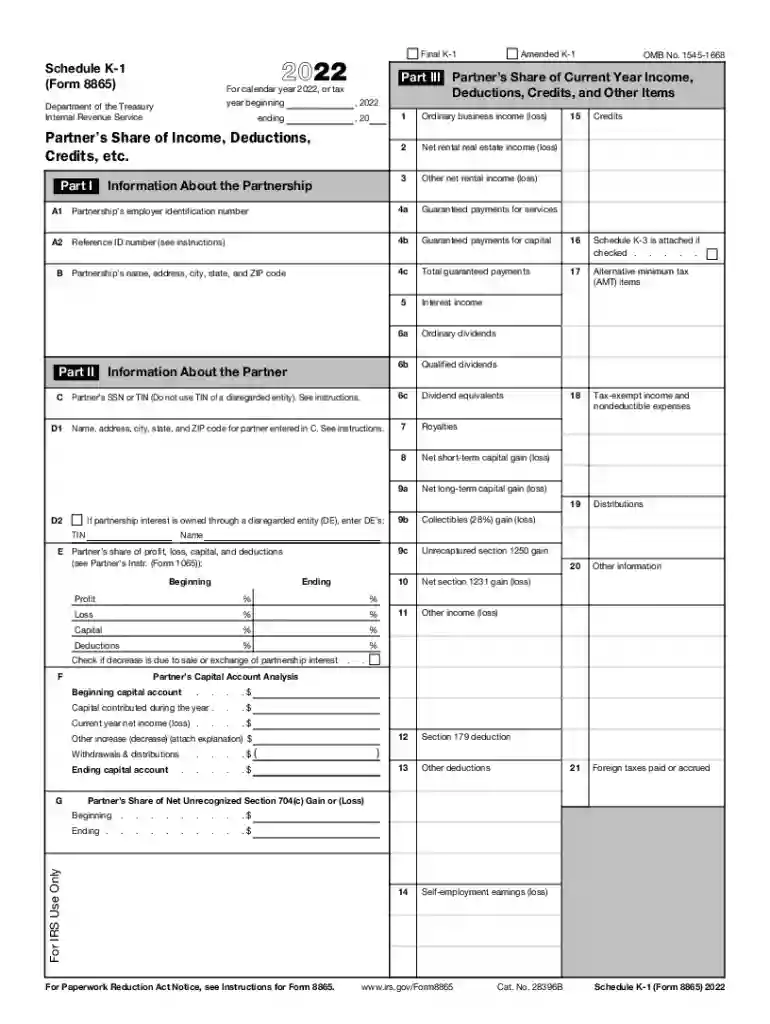
Type text, add images, blackout confidential details, add comments, highlights and more.

Draw your signature, type it, upload its image, or use your mobile device as a signature pad.

Send it via email, link, or fax. You can also download it, export it or print it out.
The Federal 8865 (Schedule K-1) is an informational tax form used to report a partner's share of income, deductions, credits, and other tax-related items from foreign partnerships. It is crucial for U.S. persons who are involved in partnerships outside of the United States. This form helps the IRS ensure that income earned through foreign partnerships is adequately reported and taxed according to U.S. tax laws.
U.S. persons use this form to determine how their involvement in foreign partnerships impacts their personal tax obligations. Accurate completion is vital for compliance with U.S. tax laws.
Obtaining Schedule K-1 involves several straightforward steps, depending on your role or partnership interest. Partners typically receive this form directly from the partnership entity.
Receiving Schedule K-1 on time is essential for partners to complete their personal tax returns accurately and promptly. Delays can lead to penalties or filing extensions.
Completing Federal 8865 (Schedule K-1) requires careful attention to detail. This process involves gathering accurate financial data from the partnership.
Schedule K-1 (Form 8865) is predominantly used by U.S. persons who are partners in foreign partnerships. Understanding who should file this form is critical for compliance.


The form contains detailed sections that cater to different tax reporting needs of partners in a foreign partnership.
These elements are used to report and calculate individual tax responsibilities based on their share in the partnership.
Adhering to the appropriate timelines is crucial when dealing with Federal 8865 (Schedule K-1). Missing deadlines can lead to penalties.
Failure to comply with reporting requirements through Schedule K-1 can result in substantial penalties.
Leveraging software solutions can simplify the completion and submission of Schedule K-1 (Form 8865).
We've got more versions of the Federal 8865 (Schedule K-1) (Partner's Share of IncomeFederal 8865 (Schedule K-1) (Partner's Share of IncomeAbout Form 8865, Return of U.S. Persons With Respect to Certain Foreign form. Select the right Federal 8865 (Schedule K-1) (Partner's Share of IncomeFederal 8865 (Schedule K-1) (Partner's Share of IncomeAbout Form 8865, Return of U.S. Persons With Respect to Certain Foreign version from the list and start editing it straight away!
Approving documents on a mobile device is quick, easy, and doesn’t require software installation when you have an account with DocHub. Sign in from any browser, fill in your blank fields with your information, and click on Sign → Create your signature. You can draw your eSignature just as you usually do on paper, add its picture to your Federal 8865 (Schedule K-1) (Partner's Share of IncomeFederal 8865 (Schedule K-1) (Partner's Share of IncomeAbout Form 8865, Return of U.S. Persons With Respect to Certain Foreign, or type in your name and stylize its look. No matter what option you select, your paperwork will be valid.
It is a no-brainer on a computer or via a mobile phone to complete a Federal 8865 (Schedule K-1) (Partner's Share of IncomeFederal 8865 (Schedule K-1) (Partner's Share of IncomeAbout Form 8865, Return of U.S. Persons With Respect to Certain Foreign with DocHub. All you need to do is open any installed web browser on your smartphone and proceed to the DocHub website. Once authenticated, add your file and open it in editing mode. Use our toolbar to make your edits and save modifications. Optionally, keep your document in your files or send it to a recipient on the spot.
At DocHub, your data security is our priority. We follow HIPAA, SOC2, GDPR, and other standards, so you can work on your documents with confidence.
Jul 1, 2016 Taxes are payments to a government that are not made in exchange for a particular good or service. Income Federal Adjusted Gross Income.Read more
Nov 7, 2025 Partners Share of Income, Deductions, Credits, etc. Department of Foreign taxes paid or accrued. For Paperwork Reduction Act NoticeRead more


