







Definition & Meaning
An Offer In Compromise (OIC) is a program facilitated by the Internal Revenue Service (IRS) and various state departments like the Colorado Department of Revenue. It allows taxpayers to settle unpaid tax liabilities for less than the full amount owed. The primary goal is to enable financially distressed taxpayers to resolve their tax debts through a negotiated agreement that reflects their ability to pay.
Components of an OIC
- Reasonable Collection Potential (RCP): The IRS calculates the taxpayer's ability to pay based on their income, expenses, and asset equity.
- Eligibility Requirements: To qualify, taxpayers must demonstrate that they cannot pay their full tax liability.
- Offer Amount: This is calculated based on the taxpayer’s income, assets, and living expenses.
How to Use the Offer In Compromise
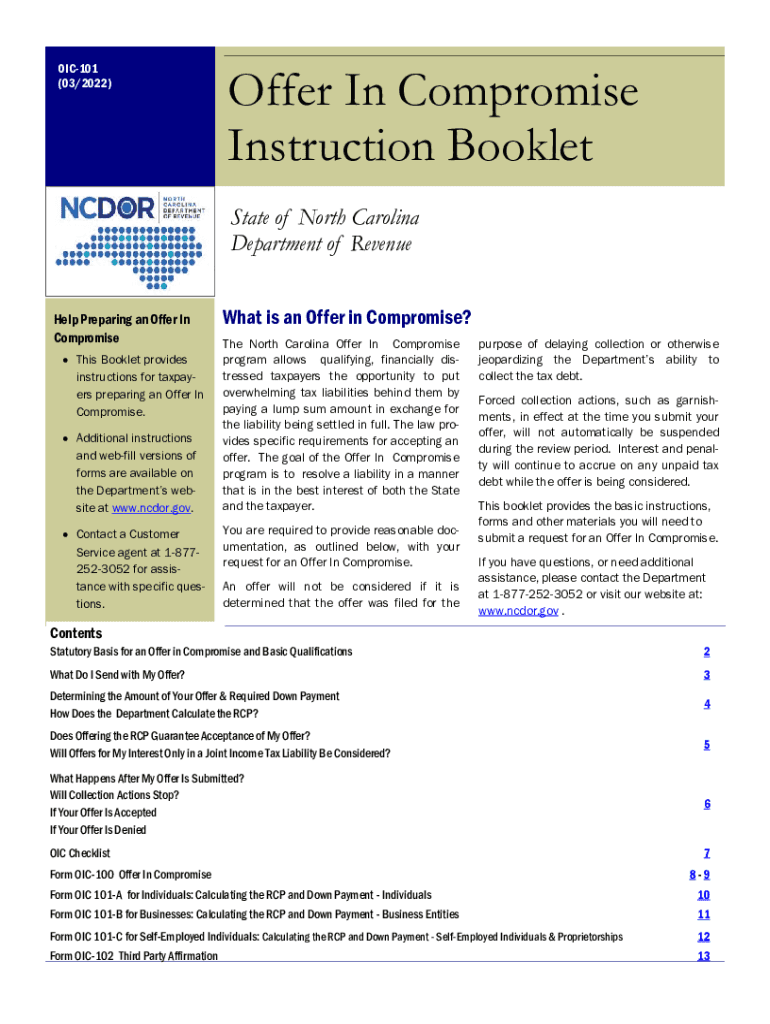
Taxpayers interested in an OIC must first complete Form 656, Offer In Compromise, and submit it along with the Colorado Offer In Compromise Instruction Booklet. This form provides detailed guidance on compiling necessary financial information to support the proposal.
-
Initial Steps:
- Gather financial documents, including income statements and asset details.
- Use the booklet’s worksheets to assess if you might qualify.
- Determine your RCP.
-
Submission Process:
- Complete Form 656.
- Include a non-refundable application fee unless you meet low-income guidelines.
Steps to Complete the Offer In Compromise
Completing an OIC involves several structured steps that require precision and attention to detail.
Step-by-Step Process
-
Financial Information Gathering:
- Collect all relevant income and asset information.
- Use the OIC Worksheet to detail assets and liabilities.
-
Form Execution:
- Fill out Form 656 accurately.
- Attach Form 433-A (OIC) or Form 433-B (OIC) as applicable, laid out in the instruction booklet.
-
Documentation:
- Include supporting documents such as bank statements and other evidence of income and expenses.
- Submit all paperwork to the IRS or Colorado Department of Revenue as directed in the instruction booklet.
Eligibility Criteria
Eligibility for the OIC involves specific financial hardship and inability to pay full tax liabilities.


Key Determinants
- Inability to Pay: Must prove that full payment would cause significant financial hardship.
- Accurate Documentation: Provide detailed financial accounts and records.
- Compliance: Must be current with all tax filing for prior years and have paid estimated taxes for the current year.
Required Documents
Documentation is crucial to substantiate your request for an OIC.
Necessary Paperwork
- Financial forms: Form 433-A (OIC) for individuals and Form 433-B (OIC) for businesses.
- Income records: Recent pay stubs, tax return copies, and bank statements.
- Proof of Living Expenses: Documentation of monthly expenses such as rent, utilities, and insurance.
State-Specific Rules for Colorado
While the overall process aligns with federal requirements, some state-specific guidelines apply.
Colorado Department of Revenue Specifications
- State RCP Calculations: May differ slightly based on local cost of living factors.
- Unique Forms: Utilize state-issued OIC forms in conjunction with the IRS forms.
Penalties for Non-Compliance
Failure to adhere to OIC guidelines can result in consequences.
Consequences
- Rejection of Offer: Due to incomplete submission or inaccurate information.
- Additional Penalties: Potential imposition of late fees or interest charges if requirements are not met.
IRS Guidelines
The IRS sets specific protocols for reviewing and approving OICs.
Approval Process
- Initial Assessment: IRS evaluates taxpayer’s RCP.
- Review Period: Often takes several months; patience is necessary.
- Notification: IRS provides formal acceptance or rejection notification.
Form Submission Methods
Submission options must align with IRS and Colorado Department of Revenue standards.
Available Methods
- Online Submission: Securely submit through IRS or state portals, if available.
- Mail: Send completed forms and documentation to the respective IRS or state address.
- In-Person: Visit a local IRS or tax office for direct submission.
Selecting the right blocks provides a comprehensive overview of the Offer in Compromise process, ensuring taxpayers have a clear path to addressing their tax liabilities effectively.




