
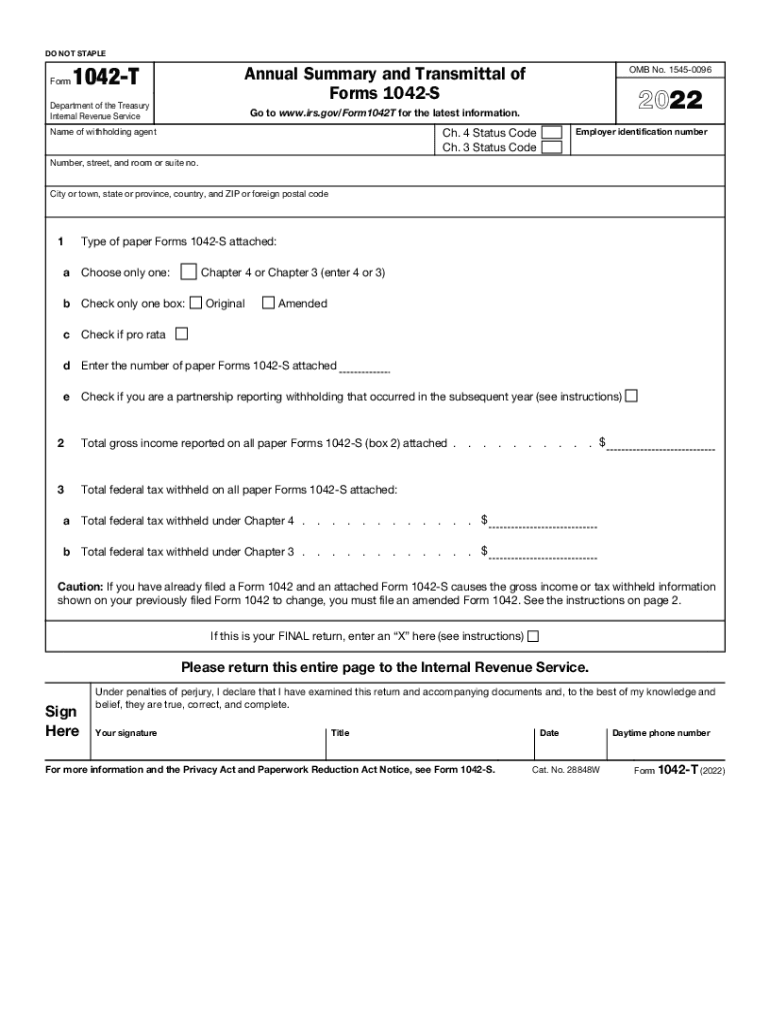







Definition & Purpose of Form 1042-T
Form 1042-T, known as the Annual Summary and Transmittal of Forms 1042-S, is utilized primarily for reporting U.S. source income that is subject to withholding tax for foreign persons. This form serves the critical function of summarizing the details provided in the accompanying Forms 1042-S before these forms are transmitted to the IRS. Through Form 1042-T, the IRS can efficiently track and ensure accuracy in the withholding and reporting processes for cross-border transactions.
Key Elements of Form 1042-T
Form 1042-T contains essential fields and information critical for proper submission:
- Transmittal Information: This includes the withholding agent's identifying details, such as name, address, and Employer Identification Number (EIN).
- Summary of Forms 1042-S: Summation of all individual Forms 1042-S being submitted.
- Responsible Party Contact Information: Contact details of the person responsible for the form submission.
Each element is designed to encapsulate the comprehensive summary required for accurate IRS reporting, representing multiple Forms 1042-S with a single transmittal form.
IRS Guidelines and Instructions
Adhering to IRS guidelines is crucial for the accurate completion and submission of Form 1042-T:
- Ensure Accuracy: All data must match the details in the individual Forms 1042-S.
- Verification: Double-check the withholding amounts to ensure correct reporting.
- Documentation Retention: Maintain copies of all submitted forms for a minimum of three years as per IRS retention requirements.
- Filing Deadlines: All forms should be filed by March 15, 2023, unless an extension has been granted.
These guidelines ensure compliance and mitigate potential issues stemming from discrepancies or omissions in form submissions.
Steps to Complete Form 1042-T
Completing Form 1042-T requires careful attention to detail:
- Gather Documentation: Collect all Forms 1042-S you need to summarize.
- Complete Identifying Information: Fill in your name, EIN, and contact information accurately.
- Enter Total Amounts: Sum up amounts from all Forms 1042-S and enter the total gross income, federal tax withheld, and credits allowed.
- Review & Validate: Verify all information is correct before submission.
- Submit the Form: Prepare to send the complete package to the IRS.
This structured procedure ensures a seamless filing process that's compliant with IRS mandates.
How to Obtain Form 1042-T
Form 1042-T can be obtained through several channels:
- IRS Website: Download the form directly in PDF format.
- Tax Software: Many tax preparation software suites include Forms 1042-T and 1042-S.
- Professional Tax Advisors: Obtain the form as part of a comprehensive tax preparation service.
Each method ensures accessibility to the accurate and most recent version of the form.
Who Typically Uses Form 1042-T
This form is primarily utilized by:
- Withholding Agents: Entities tasked with withholding taxes on U.S. source income paid to foreign individuals or businesses.
- Companies with Foreign Investments: Businesses engaged in transactions affecting non-U.S. entities.
- Financial Institutions: Organizations managing cross-border financial activities for clients.
Understanding the typical users helps contextualize the significance of the form within the broader tax ecosystem.
Filing Deadlines and Important Dates
Timely filing is imperative:
- Annual Deadline: March 15, 2023, marks the submission deadline for Form 1042-T and its associated Forms 1042-S.
- Extension Opportunities: Withholding agents may request an extension under certain conditions, though this is subject to IRS approval.
These deadlines ensure the IRS receives timely information, which is essential for processing and oversight.
Penalties for Non-Compliance
Failing to comply with IRS requirements can lead to substantial penalties:
- Late Filing Penalty: A penalty may be imposed for forms not submitted by the deadline.
- Incomplete Form Penalty: Submitting forms with incorrect or incomplete information can also incur penalties.
By understanding potential repercussions, withholding agents are better prepared to meet compliance obligations efficiently and accurately.


