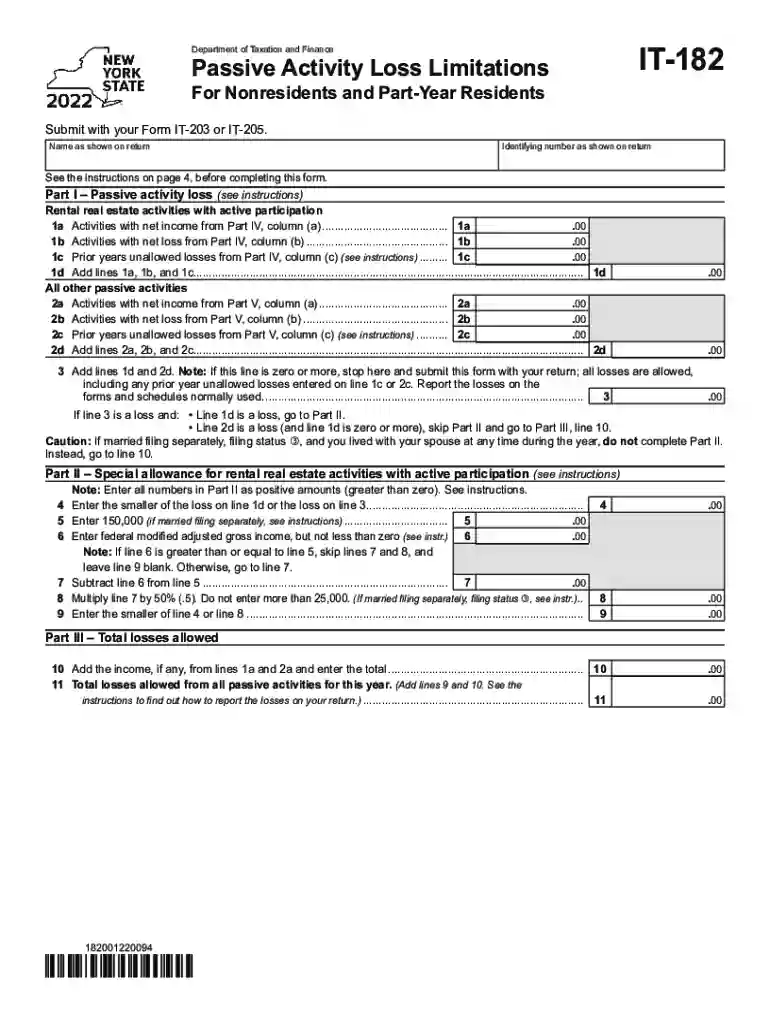
New York State Department of Taxation and Finance Passive Activity Loss ... 2026

Get Form
passive activities Preview on Page 1

Here's how it works

01. Edit your passive activities online
Type text, add images, blackout confidential details, add comments, highlights and more.

02. Sign it in a few clicks
Draw your signature, type it, upload its image, or use your mobile device as a signature pad.

03. Share your form with others
Send it182 via email, link, or fax. You can also download it, export it or print it out.

Definition and Meaning

The New York State Department of Taxation and Finance Passive Activity Loss form is a specialized tax document used by nonresidents and part-year residents to report passive activity loss limitations on their state tax returns. These losses typically originate from passive income-generating activities, such as rental real estate or limited partnerships, and are subject to specific limitations and reporting requirements distinct from federal guidelines.

Detailed Breakdown

  • Passive Activity Income: Income derived from sources like rental properties and businesses in which the taxpayer does not actively participate.
  • Loss Limitations: These are constraints imposed by New York State tax regulations aimed at limiting the amount of passive activity losses that can be deducted from state taxable income.
  • Purpose: Helps taxpayers accurately compute the allowable passive activity losses that can be claimed in a tax year, ensuring compliance with state tax laws.

Important Terms related to Passive Activity Loss

Understanding the terminology associated with the New York State Department of Taxation and Finance Passive Activity Loss form is crucial for accurate completion.

Key Concepts

  • Material Participation: Engagement level determining whether an activity is passive. A taxpayer is considered to have materially participated if they meet certain criteria, impacting how losses can be claimed.
  • Aggregation: Combining multiple passive activities for the purpose of calculating net passive income or losses.
  • Suspended Losses: Passive losses that exceed passive income and are not deductible in the current year but carried forward to future tax years.

Steps to Complete the Passive Activity Loss Form

Completing the New York State Department of Taxation and Finance Passive Activity Loss form involves several steps that require careful attention to detail.

  1. Gather Necessary Information: Collect documents related to all passive activities, including financial statements and previous tax returns.
  2. Calculate Passive Income and Losses: Determine the net income or loss for each passive activity.
  3. Apply State Adjustments: Adjust the federal calculations according to New York State-specific rules.
  4. Complete Form IT-182: Transfer calculated figures to the appropriate sections, ensuring accuracy.
  5. Review and Submit: Double-check for errors before submission via the appropriate method, whether online, by mail, or in person.

Guidance and Tips

  • Seek Assistance: Consider consulting a tax professional if unfamiliar with passive activity loss regulations.
  • Use Compatible Software: Software like TurboTax and QuickBooks can be beneficial for calculating and entering complex tax figures.

Key Elements of the Form

The form includes specific sections that need to be correctly filled out to ensure compliance with tax regulations.

  • Personal Information: Enter accurate taxpayer information, including name and identification numbers.
  • Passive Activity Details: List each passive activity, detailing the income, losses, and participant status.
  • State-Adjusted Figures: Input adjustments made from federal to state calculations.

Required Documents

The successful completion of the form requires several key documents.

  • Tax Returns from Previous Years: For comparison and calculation accuracy.
  • Financial Records for Passive Activities: Including income statements and expense records.
  • Federal Passive Activity Loss Worksheet: To serve as a baseline for state adjustments.

Preparing Documents

  • Ensure all documents are well-organized and easily accessible.
  • Keep digital copies for easy retrieval and submission.

Examples of Using the Passive Activity Loss Form

Various scenarios demonstrate the application of the form for different taxpayers.

Case Studies

  • Scenario 1: A part-year resident with multiple rental properties calculates losses to minimize state tax liability.
  • Scenario 2: A nonresident engaged in limited partnerships ensures compliance with passive loss limitations by detailed documentation.

State-Specific Rules

New York State has specific rules that differ from federal guidelines for passive activity losses.

Distinctions from Federal Laws

  • Nonresidents and Part-Year Residents: These taxpayers must consider state residency status when determining loss limitations.
  • Certain Income Types: Didactic rules outline which income types are considered passive under state law.

Penalties for Non-Compliance

Failure to comply with the regulations regarding passive activity losses can lead to financial penalties.

  • Late Fees: Imposed for failing to submit the form by the designated deadline.
  • Audit Risks: Increased likelihood of audits if discrepancies are found between federal and state submissions.
  • Interest Charges: Applied to any underestimated or unpaid tax amounts resulting from incorrect loss reporting.

See more New York State Department of Taxation and Finance Passive Activity Loss ... versions

We've got more versions of the New York State Department of Taxation and Finance Passive Activity Loss ... form. Select the right New York State Department of Taxation and Finance Passive Activity Loss ... version from the list and start editing it straight away!
Versions Form popularity Fillable & printable
2023 4.1 Satisfied (42 Votes)
2022 4.4 Satisfied (24 Votes)
2021 4.9 Satisfied (46 Votes)
2020 4.4 Satisfied (62 Votes)
2019 4.5 Satisfied (39 Votes)
be ready to get more

Complete this form in 5 minutes or less

Get form

Got questions?

We have answers to the most popular questions from our customers. If you can't find an answer to your question, please contact us.
Contact us
New York State Tax Law conforms to the passive activity loss rules for federal purposes.
How to Report Passive Activity Losses Schedule C (Form 1040), Profit or Loss From Business, Schedule D (Form 1040), Capital Gains and Losses, Schedule E (Form 1040), Supplemental Income and Loss, Schedule F (Form 1040), Profit or Loss From Farming, Form 4797, Sales of Business Property,
If the ventures are passive activities, the passive activity loss rules prevent you from deducting expenses that are generated by them in excess of their income. You cant deduct the excess expenses (losses) against earned income or against other nonpassive income.
Passive income is generally taxed at the taxpayers marginal tax rate, similar to active income. However, those with a modified adjusted gross income above a certain threshold may be subject to the Net Investment Income Tax (NIIT) of 3.8%.
State Taxes and Gambling Losses Some states allow you to deduct gambling losses, while others do not. For example, in New York, you can deduct gambling losses on your state tax return, but in California, gambling losses are not deductible.

Security and compliance

At DocHub, your data security is our priority. We follow HIPAA, SOC2, GDPR, and other standards, so you can work on your documents with confidence.

Learn more
ccpa2
pci-dss
gdpr-compliance
hipaa
soc-compliance
be ready to get more

Complete this form in 5 minutes or less

Get form

People also ask

Under the passive activity rules you can deduct up to $25,000 in passive losses against your ordinary income (W-2 wages) if your modified adjusted gross income (MAGI) is $100,000 or less. This deduction phases out $1 for every $2 of MAGI above $100,000 until $150,000 when it is completely phased out.
Passive activity loss rules state that passive losses can be used only to offset passive income. A passive activity is one in which the taxpayer did not materially participate during the year in question. Common passive activity losses may stem from leasing equipment, real estate rentals, or limited partnerships.

new york passive loss