




01. Edit your student worker early registration tamu online
Type text, add images, blackout confidential details, add comments, highlights and more.

Type text, add images, blackout confidential details, add comments, highlights and more.

Draw your signature, type it, upload its image, or use your mobile device as a signature pad.

Send tamu student worker early registration via email, link, or fax. You can also download it, export it or print it out.
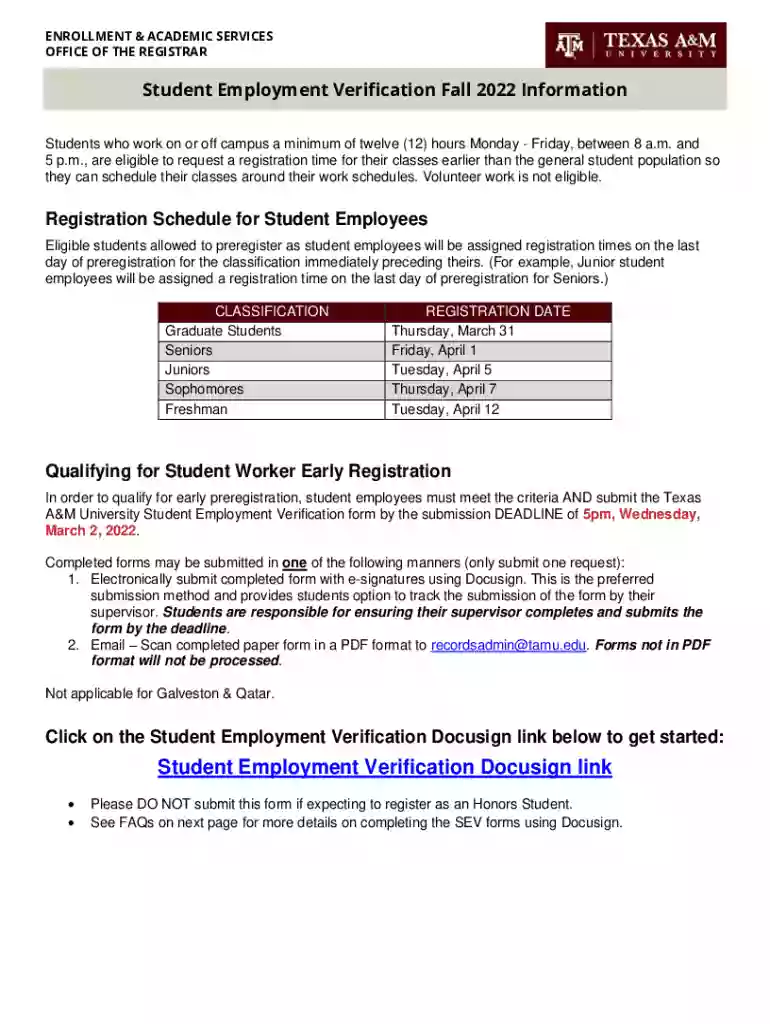
The "Student Worker Early Registration - Aggie One Stop" refers to a system designed to facilitate early course registration for student employees at Texas A&M University. It is intended to provide student workers with the opportunity to select classes ahead of regular registration periods, ensuring they can accommodate their work schedules. The process typically includes a verification form to confirm employment status, completed either through Docusign or email, and meets the eligibility criteria established by the university, such as working a minimum of twelve hours per week.
To utilize this early registration process, Texas A&M student workers must first confirm their eligibility. Next, they must complete a Student Employment Verification form, ensuring all required information is accurate and complete. After filling out the form, it must be submitted through approved channels, such as Docusign or email, to be processed. The final step involves waiting for approval confirmation before proceeding with early class registration, aligned with the schedule based on student classification.
Eligible students include those employed part-time at Texas A&M University, working a minimum of twelve hours each week. Eligibility is contingent on verified employment status, which must be confirmed through official documentation, such as a Student Employment Verification form. Students must also be in good academic standing and not subject to any holds on their university accounts.


Primarily used by student employees at Texas A&M University, this registration form benefits those who need to manage class schedules around their work commitments. It serves students in various roles, such as research assistants, lab technicians, and other part-time university jobs, providing them with the flexibility they need to fulfill both academic and employment responsibilities effectively.

We've got more versions of the student worker early registration tamu form. Select the right student worker early registration tamu version from the list and start editing it straight away!
At DocHub, your data security is our priority. We follow HIPAA, SOC2, GDPR, and other standards, so you can work on your documents with confidence.


