





Definition & Meaning
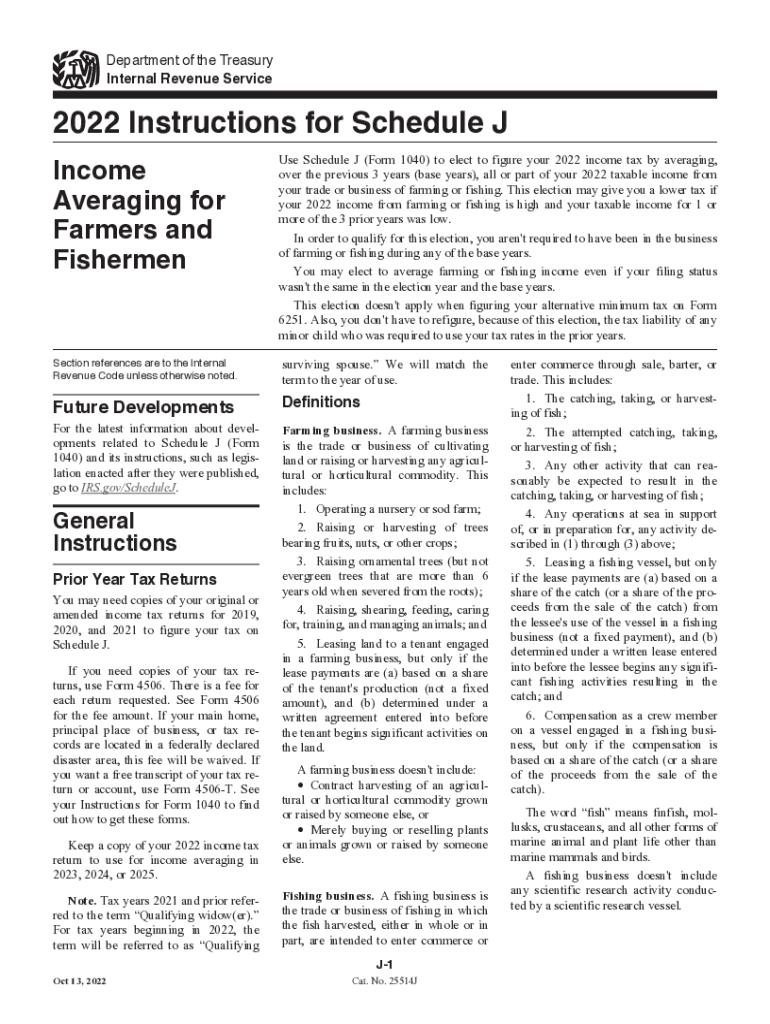
The Inst 1040 (Schedule J) is designed for taxpayers in the farming and fishing industries. It serves as a means for income averaging, allowing these professionals to smooth out their income fluctuations by averaging their taxable income over the past three years. This approach can help mitigate the impact of a particularly high-income year by distributing income taxes more evenly, potentially reducing overall tax liability due to lower marginal tax rates.
Importance of Income Averaging
- Tax Liability Management: By spreading income across multiple years, taxpayers may qualify for lower tax rates.
- Cash Flow Optimization: Stabilizes cash flow by lowering taxes owed in high-income years.
- Industry Support: Tailored primarily for industries with volatile income, like farming and fishing.
Historical Context
Income averaging was more broadly available until 1986, when it was mostly eliminated. However, it remains available for qualifying individuals in farming and fishing due to the unique nature of these industries.
Steps to Complete the Inst 1040 (Schedule J)
Completing the Inst 1040 (Schedule J) requires careful attention to detail and adherence to IRS guidelines.
- Gather Necessary Documents: Collect your previous three years' tax returns and income statements.
- Calculate Adjusted Income: Determine your current year’s taxable income from farming or fishing activities.
- Identify Base Years: Choose the three prior tax years to average your income.
- Compute Average Income: Divide your current high-income year by three to find the average amount to report.
- Adjust and File: Correctly apply the averaged figures on the appropriate lines in your IRS Form 1040, reflecting accurate average income and tax.
Example Calculation
- Year 1 Income: $30,000
- Year 2 Income: $40,000
- Current Year Income: $100,000
- Average Income: $100,000 / 3 = $33,333 per year
How to Use the Inst 1040 (Schedule J)
Using this form effectively involves understanding its nuances and applying its guidelines accurately.
- Eligibility Check: Ensure you qualify as a farmer or fisherman with fluctuating annual earnings.
- Form Selection: If eligible, choose Schedule J while filing IRS Form 1040.
- Data Entry: Accurately input averaged income figures and cross-check calculations for errors.
Practical Tips
- Use Software Tools: Tax software such as TurboTax and QuickBooks may simplify calculations.
- Consult Professionals: For complex scenarios, seeking advice from a tax professional is recommended.
Who Typically Uses the Inst 1040 (Schedule J)
The form is primarily used by:
- Farmers: Owners or operators of agricultural enterprises, including crop and livestock farming.
- Fishermen: Those engaged in commercial fishing operations, managing to catch and live bait businesses.

Additional Considerations
These professionals must also ensure their business activities qualify under IRS definitions to use Schedule J.
IRS Guidelines
The IRS provides specific guidelines to ensure compliance when using the Inst 1040 (Schedule J).
- Income Eligibility Criteria: Only income from farming or fishing activities qualifies for averaging.
- Record Keeping: Maintain meticulous records of income and deductions for accurate reporting.
- Filing Procedure: Follow IRS instructions to integrate calculations into the 1040 filing process correctly.
Common Errors
- Misclassification: Reporting non-qualifying income sources.
- Mistakes in Calculation: Incorrectly computing averaged income due to data entry errors.
Eligibility Criteria
To be eligible for the Inst 1040 (Schedule J), taxpayers must meet defined criteria:
- Industry Participation: Must actively participate in farming or fishing industries.
- Income Stability: Must have significant fluctuations in annual income warranting averaging.
- Prior Year Returns: Must have filed returns for the previous three years, with income eligible for averaging.

Nuanced Requirements
Understanding the definition of "farming" and "fishing" according to IRS rules is crucial. For example, owning land but not actively working it may not qualify.
Filing Deadlines / Important Dates
Adherence to strict filing deadlines ensures the Inst 1040 (Schedule J) is processed correctly.
- Standard Deadline: Typically April 15, unless extended by IRS announcements or personal circumstances.
- Extension Opportunities: File an extension request if additional preparation time is needed, normally until October 15.
Key Considerations
Filing on time avoids penalties and ensures any accounting inaccuracies are addressed promptly.
Penalties for Non-Compliance
Failure to comply with the requirements for filing the Inst 1040 (Schedule J) can result in penalties.
- Late Filing: Financial penalties for submissions past the due date.
- Incorrect Reporting: Additional taxes and interest if income is incorrectly averaged.
Minimizing Risk
- Quality Checks: Double-check all figures before submission.
- Seek Expert Advice: Engage a tax professional for guidance on complex income scenarios and compliance questions.
Legal Use of the Inst 1040 (Schedule J)
Understanding the legal implications of using the Inst 1040 (Schedule J) is vital for compliance.
- Legally Binding Requirements: Abiding by IRS guidelines ensures legal protection and prevents disputes.
- Documentation: Retain all relevant records for the required time for future audits or reviews.
Real-World Application
Legal advice can prevent misinterpretation of tax codes and ensure proper usage of the form, particularly during audits or disputes with the IRS.


