Definition and Meaning
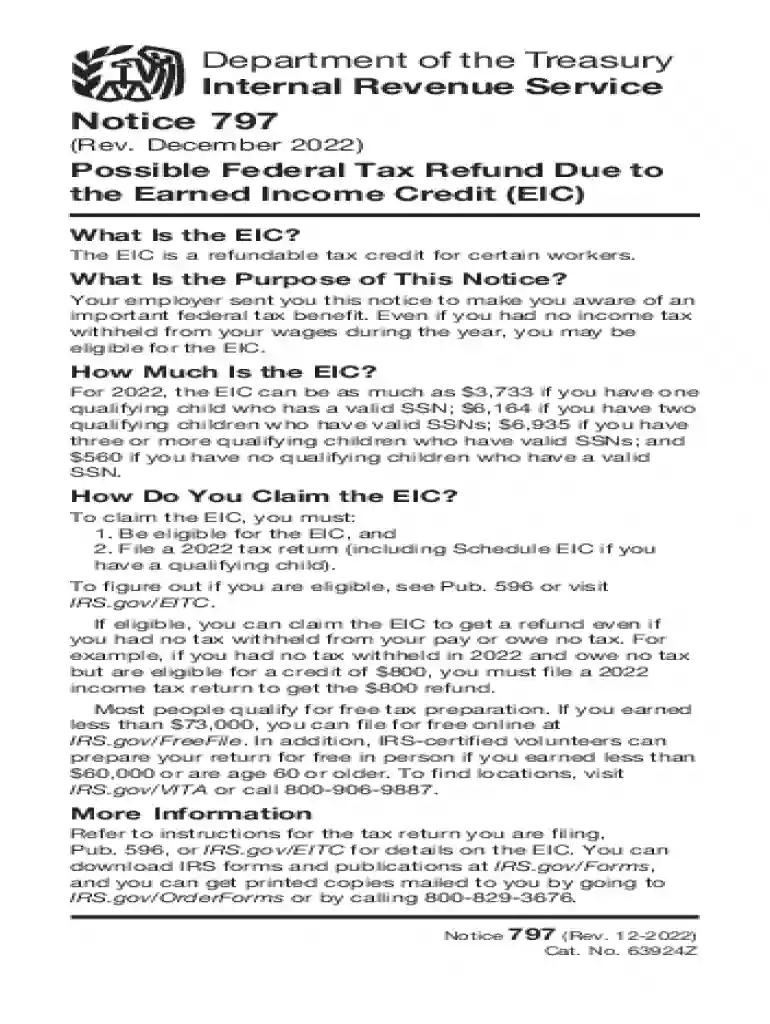
Notice 797 (Rev. December 2022) serves as a vital communication from the IRS to inform taxpayers about their potential eligibility for the Earned Income Credit (EIC), a federal tax credit designed to benefit low to moderate-income workers and families. The notice explains the credit's purpose, which is to reduce the tax burden on qualifying earners and provide a potential federal tax refund. This document details who might be eligible for this credit, along with the refund amounts, based on the number of qualifying children and other criteria.
Eligibility Criteria
To qualify for the Earned Income Credit under Notice 797, taxpayers must meet certain criteria:

- Income Requirements: The taxpayer's earned income and adjusted gross income (AGI) must fall below specific thresholds that vary based on filing status and the number of qualifying children.
- Qualifying Child Criteria: A taxpayer can claim the EIC for up to three qualifying children, each of whom must meet relationship, age, residency, and joint return tests.
- Filing Status: Eligible filing statuses include single, married filing jointly, head of household, or qualifying widow(er). Those who are married filing separately are not eligible.
- Citizenship Requirements: The taxpayer must be a U.S. citizen or a resident alien for the entire tax year.
- Investment Income Limit: There is an investment income cap which taxpayers must not exceed to qualify for the credit.
How to Use the Notice 797
Notice 797 is primarily used to determine a taxpayer's eligibility for the EIC and to guide them through the process of claiming the credit. Key steps include:
- Reviewing Eligibility: Verify personal circumstances against the eligibility criteria outlined in the notice.
- Calculating Potential Credit: Estimate the possible EIC amount by considering income levels and number of qualifying children.
- Gathering Required Documents: Collect necessary documentation such as W-2 forms, Social Security numbers for all family members, and proof of qualifying child eligibility.
- Completing the Tax Return: Fill out the relevant sections on Form 1040 or 1040-SR to claim the EIC.
- Utilizing IRS Resources: Use IRS tools and resources for free tax preparation services if needed.
Steps to Complete the Notice 797
To effectively use Notice 797, taxpayers should follow these steps:
- Verify Basic Eligibility: Confirm income and filing status against the criteria mentioned in the notice.
- Determine Child Qualification: Ensure each child claimed meets the necessary tests.
- Calculate Adjusted Gross Income (AGI): AGI should be calculated accurately based on IRS guidelines.
- Fill Appropriate Forms: Include EIC information on your federal tax return using Form 1040 or 1040-SR.
- Check Investment Income Limits: Ensure investment income does not surpass the specified limits.
Important Terms Related to Notice 797
Understanding key terms associated with Notice 797 is essential:
- Earned Income: Wages, salaries, and self-employment income that qualify you for the EIC.
- Adjusted Gross Income (AGI): Income calculated by subtracting certain adjustments from total income.
- Qualifying Child: A child who meets specific relationship, age, and residency criteria.
- Investment Income: Income from dividends, interest, and rent which must not exceed set limits for EIC eligibility.
IRS Guidelines
The IRS provides comprehensive guidelines for using Notice 797:
- Accurate Recordkeeping: Maintain accurate records of income and documents required for proving eligibility.
- Filing Accuracy: Double-check all figures and information entered on your tax return to avoid errors.
- Use of IRS Tools: Leverage IRS resources such as publications and online tools to understand and claim the EIC.
Filing Deadlines and Important Dates
Understanding critical dates is crucial for taxpayers claiming the EIC:
- Tax Filing Deadline: Typically, April 15 is the deadline for most taxpayers to file their returns and claim the EIC.
- Deadline Extensions: Taxpayers may apply for extensions, usually up to October 15, if more time is needed.
- Estimated Tax Payments: Ensure quarterly estimated taxes are paid if applicable to avoid penalties.
Form Submission Methods
Notice 797 can be utilized through various submission methods:
- Online Filing: Use IRS e-file services or tax preparation software like TurboTax or QuickBooks for electronic filing.
- Mail: Traditional postal mail remains an option for filing tax returns and claiming the EIC.
- In-Person Assistance: Visit IRS service centers or utilize certified tax preparation services for assistance.