
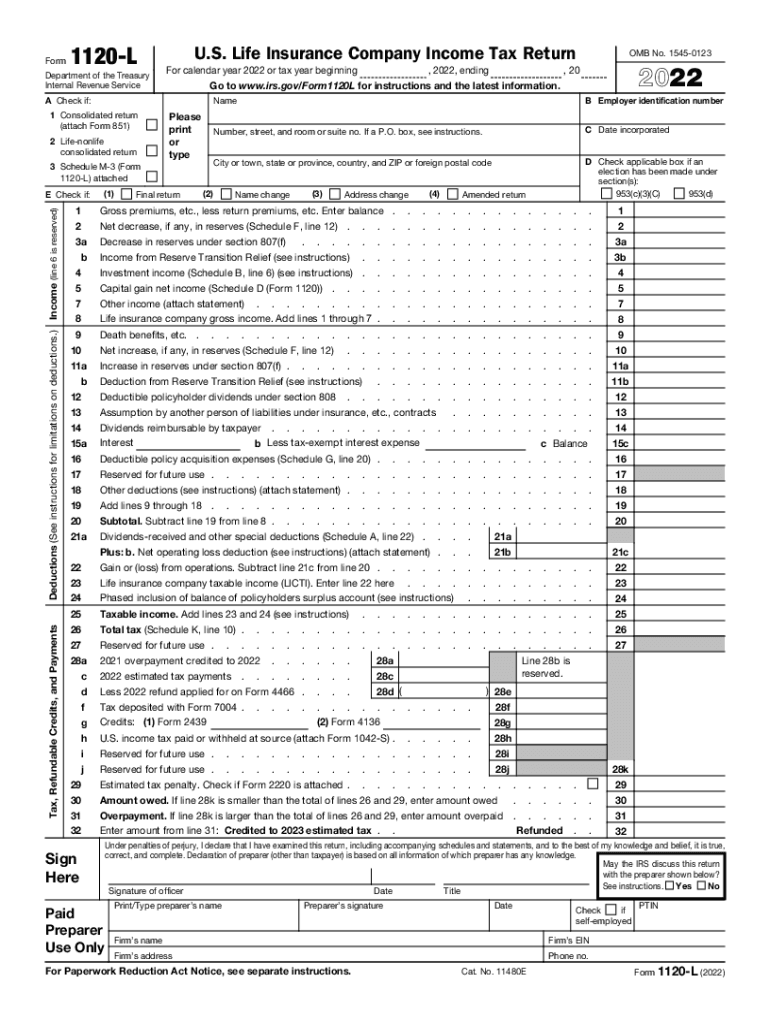







Definition and Purpose of Form 1120-L
Form 1120-L is specifically designed for U.S. life insurance companies to report their income, deductions, and tax obligations to the Internal Revenue Service (IRS). This form is essential as it captures detailed financial information that influences how life insurance companies are taxed. It covers aspects such as reserves, premiums, and dividends, which are unique to the insurance sector.
Key Sections
- Gross Income Reporting: Companies must detail all income sources, including premium receipts and investment earnings.
- Deductions: This includes allowable deductions such as benefit payments and increases in reserves.
- Tax Computations: The form outlines how to calculate taxable income after deductions.
Practical Implications
Life insurance companies rely on Form 1120-L to precisely calculate their federal tax obligations. This ensures compliance with U.S. taxation laws, aligning declarations with industry-specific accounting practices.
How to Obtain Form 1120-L
Downloading and Access
Form 1120-L can be obtained directly from the IRS website. The form is available as a downloadable PDF, ensuring broad accessibility. Businesses can also request a physical copy via mail if digital access is not feasible.
Steps to Access the Form Online
- Visit the IRS website.
- Navigate to the forms and publications section.
- Search for "Form 1120-L".
- Download the PDF version for completion.
Alternative Methods
Companies using tax preparation software like TurboTax can access the form through the platform, streamlining the process of filling and submission.
Steps to Complete the Form 1120-L
Detailed Guide
- Begin with General Information: Include the corporate name, address, and Employer Identification Number (EIN).
- Report Gross Income: Input total premiums, investment income, and other revenue.
- Deductions: Enter life insurance company-specific deductions such as policyholder benefits and increased reserves.
- Calculate Taxable Income: Subtract deductions from total income.
- Tax Computation: Apply the current corporate tax rate to determine tax liability.
Submission Options
- Electronic Filing (e-file): Preferred for speed and accuracy.
- Mail: Submit the completed form to the IRS address for your region.
Eligible Businesses for Form 1120-L
Target Audience
Form 1120-L is strictly for U.S. life insurance companies. These entities may include:
- Traditional life insurance providers.
- Companies offering annuities and similar products.
- Multinational corporations operating within the U.S. insurance industry.
Business Structures
Typically, these companies operate as corporations, given the form's accounting and legal requirements.
IRS Guidelines for Form Completion
Compliance Requirements
- Accurate Financial Information: Ensure all monetary figures are precise.
- Timely Filing: Adhere to IRS deadlines to avoid penalties.
- Supporting Documentation: Maintain records of income, deductions, and tax calculations for verification.
Best Practices
- Utilize tax professionals to validate entries.
- Leverage accounting software to maintain accuracy.
Filing Deadlines and Important Dates
Due Dates
Form 1120-L is due the 15th day of the fourth month after the end of the company's tax year. For calendar-year filers, this means an April 15 deadline.
Extensions
Companies can apply for a six-month extension if more time is necessary, using IRS Form 7004.
Penalties for Non-Compliance
Financial Repercussions
- Late Filing Penalties: Up to 5% of unpaid taxes for each month or part of a month the form is late, capped at 25%.
- Incomplete Information: May lead to additional penalties and interest on unpaid taxes.
Mitigating Risks
- Ensure timely and accurate submission.
- File for extensions proactively if deadlines cannot be met.
Software Compatibility and Assistance
Integration with Tax Software
- Form 1120-L is compatible with major tax preparation platforms like TurboTax and QuickBooks, which can facilitate data entry and calculations.
Technical Support
Many software packages offer support features to assist users in navigating form complexities, ensuring compliance, and completing submissions efficiently.
Business Entity Types and Form 1120-L
Form 1120-L is tailored specifically for life insurance companies organized as corporations. It is not applicable to other corporate types like LLCs or partnerships, which do not underwrite life insurance products.
Impact on Various Entities
Understanding entity-specific requirements is crucial for precise tax reporting. Corporations benefit most from tailored deductions and tax treatments detailed within Form 1120-L's framework.


