




01. Edit your form online
Type text, add images, blackout confidential details, add comments, highlights and more.

Type text, add images, blackout confidential details, add comments, highlights and more.

Draw your signature, type it, upload its image, or use your mobile device as a signature pad.

Send it via email, link, or fax. You can also download it, export it or print it out.
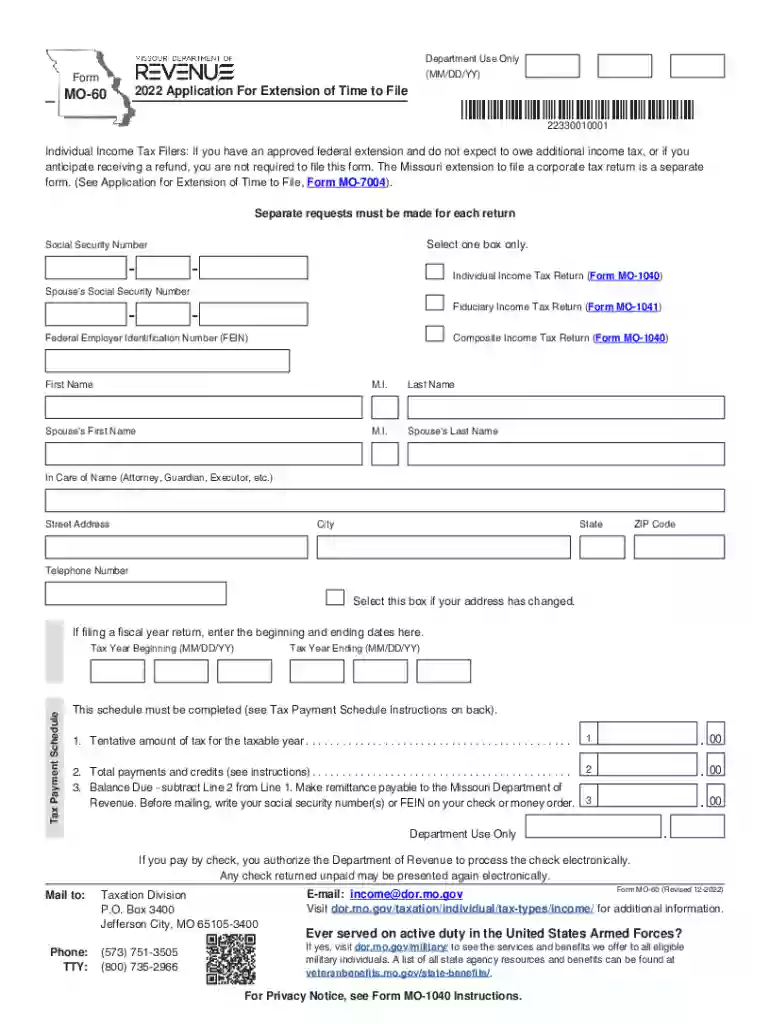
The Missouri Department of Revenue's 22330010001 form is a crucial document for residents and businesses in Missouri. This form is primarily used for applying for an extension of time to file individual and fiduciary income tax returns. By understanding its purposes, residents can effectively manage compliance with tax obligations in Missouri. The form allows taxpayers to request additional time to complete their filings when they anticipate an inability to meet the original deadline. Similar to federal extensions, this form does not postpone tax payment deadlines, emphasizing that any estimated taxes owed should be paid to avoid penalties.
Extensions are a necessary tool for taxpayers who require more time to gather accurate information for their filing. In the context of Missouri's tax filings, the 22330010001 form provides this extension, aligning with the federal automatic extension. However, taxpayers should be aware that these extensions do not exempt them from interest or penalties on any owed taxes not paid by the original deadline. Understanding the nuanced differences between Missouri’s state-level requirements and federal guidelines is essential for successful tax management.
Completing the 22330010001 form involves several critical steps, each ensuring the taxpayer's intent and eligibility are clearly communicated to the Missouri Department of Revenue.
Taxpayer Identification: Begin by providing your full identification details, including your social security number (SSN) or employer identification number (EIN) to securely match the extension request with your tax records.
Estimated Tax Payment: If you anticipate owing taxes, calculate your estimated tax liability accurately and include this payment when submitting your extension request. This prevents incurring interest or late payment penalties.
Filing Information: State the original due date of your income tax return and the extended deadline you are requesting. This clarifies the period during which you need the extension.
Signature: Ensure that the form is duly signed. A signature certifies that all information provided is accurate and the applicant understands the terms of the extension.
Failure to properly submit the 22330010001 form or omission of estimated payments could result in severe consequences. Taxpayers might face accrued interest on unpaid taxes and potential late-filing penalties, complicating their financial standing and increasing monetary obligations. Understanding compliance requirements mitigates these risks.
For example, if an individual anticipates an income fluctuation that might alter their tax liability significantly, securing an extension could provide the necessary window to adjust the filing accurately without immediate penalties.
A thorough comprehension of terminology associated with the 22330010001 form improves the capacity to correctly complete and utilize it.
The 22330010001 form is sanctioned and issued by the Missouri Department of Revenue. This state agency is responsible for ensuring tax compliance, administering tax laws, and providing necessary documentation for residents to meet their state tax obligations efficiently.
The Department provides guidance, processes extension requests, and audits submissions to maintain state revenue integrity. Being informed about their protocols facilitates smoother interaction and compliance for taxpayers.
Residency and filing obligations fundamentally dictate who should utilize the 22330010001 form. Primarily, this includes Missouri residents and business entities responsible for filing fiduciary and individual income tax returns who require an extension for their filing.


To successfully file the extension form 22330010001, taxpayers must gather essential documentation supporting their identity, tax liabilities, and amount already paid or owed. Keeping all relevant forms up to date ensures accurate and timely completion of the tax extension process.
The Missouri Department of Revenue offers multiple channels for submitting the 22330010001 form. Taxpayers can:
We've got more versions of the 22330010001 - Missouri Department of Revenue - MO.gov form. Select the right 22330010001 - Missouri Department of Revenue - MO.gov version from the list and start editing it straight away!
At DocHub, your data security is our priority. We follow HIPAA, SOC2, GDPR, and other standards, so you can work on your documents with confidence.


