




01. Edit your form 940 instructions 2022 online
Type text, add images, blackout confidential details, add comments, highlights and more.

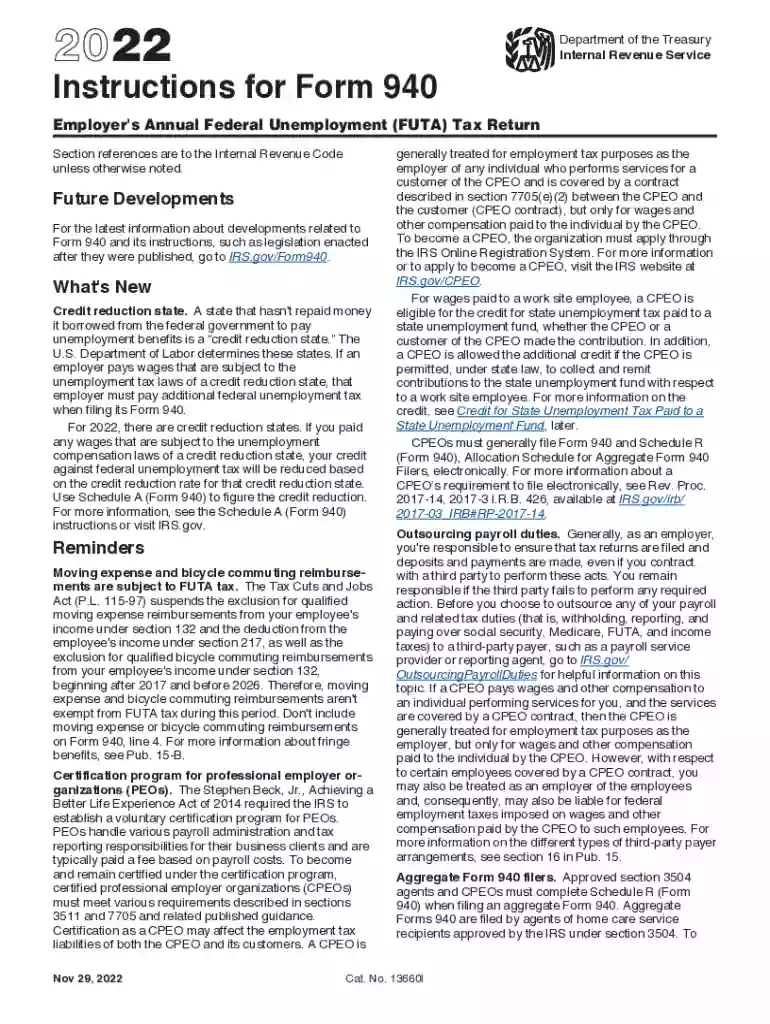
Type text, add images, blackout confidential details, add comments, highlights and more.

Draw your signature, type it, upload its image, or use your mobile device as a signature pad.

Send instructions 940 2022 via email, link, or fax. You can also download it, export it or print it out.
Form 940, known as the Employer's Annual Federal Unemployment (FUTA) Tax Return, is a crucial document used by employers in the United States to report their FUTA tax liability for the previous calendar year. The tax collected under FUTA finances unemployment compensation for workers who have lost their jobs. This annual tax return helps ensure that employers contribute to the federal unemployment fund, which supports unemployment benefits at the state level. Businesses must understand the specific requirements and implications of filing Form 940 to maintain compliance with federal employment tax laws.
Completing Form 940 involves a systematic process to accurately report your FUTA tax obligations. This process begins with entering your business's identifying information, such as name, address, and Employer Identification Number (EIN). Next, calculate the total payments made to employees during the tax year, excluding certain exempt wages like fringe benefits and retirement plan contributions. Employers must then determine the FUTA tax liability based on this payroll data, applying the 6% tax rate on the first $7,000 paid to each employee. If eligible, you can consider a reduction for state unemployment insurance contributions, leading to a lower effective FUTA rate. After completing the calculations and including any adjustments for prior under or overpayments, sign and date the form before submitting it to the IRS by the deadline.
Employers subject to FUTA tax are required to file Form 940. This includes businesses that paid wages totaling $1,500 or more in any calendar quarter or employed one or more workers for at least some part of a day in 20 different weeks during the year. Various business entities, including corporations, partnerships, and sole proprietorships, might need to complete this form. Additionally, nonprofit organizations, while often exempt from many federal taxes, may need to file if they meet the specific criteria for engaging in commercial activities that involve taxable employment.
Form 940 is due annually by January 31st of the year following the calendar year being reported. However, if the full FUTA tax liability is paid by the deadline, you are granted an automatic extension until February 10. Adhering to these deadlines is crucial as late filing or payment can lead to penalties and interest charges. Employers are advised to mark their calendars and ensure all calculations and payments are completed in advance of these dates to prevent compliance issues.
The IRS provides thorough guidelines to assist employers in correctly filing Form 940. These guidelines outline necessary instructions for each section of the form, including how to report wages and claim credits for state unemployment tax contributions. Updated annually, these instructions reflect any legislative changes or policy modifications pertinent to FUTA tax compliance. Employers should consult these guidelines as they prepare the form to ensure accuracy and completeness, and consider reaching out to a tax professional for complex situations or clarifications.
Understanding the terminology associated with Form 940 is critical for accurate completion. Key terms include:
Although Form 940 is a federal form, compliance may vary depending on state-specific rules. Credit reduction states, for example, affect how much FUTA tax employers can offset based on their state unemployment contributions. Employers operating in these states must adjust their calculations to reflect reduced credits, impacting their total federal liability. It is essential for businesses with multi-state operations to stay informed about varying state rules and account for any differences when preparing and submitting Form 940.
Employers can submit Form 940 to the IRS through various methods:
Choosing the appropriate submission method depends on factors like filing convenience, access to technology, and personal preference, ensuring timely and compliant delivery to the IRS.
We've got more versions of the form 940 instructions 2022 form. Select the right form 940 instructions 2022 version from the list and start editing it straight away!
| Versions | Form popularity | Fillable & printable |
|---|---|---|
| 2025 | 4.7 Satisfied (38 Votes) | |
| 2024 | 4.6 Satisfied (24 Votes) | |
| 2023 | 4.2 Satisfied (33 Votes) | |
| 2022 | 4.1 Satisfied (34 Votes) | |
| 2021 | 4.9 Satisfied (26 Votes) | |
| 2020 | 4.4 Satisfied (156 Votes) | |
| 2019 | 4.3 Satisfied (257 Votes) | |
| 2018 | 4.2 Satisfied (89 Votes) | |
| 2017 | 4.4 Satisfied (197 Votes) | |
| 2016 | 4.4 Satisfied (416 Votes) | |
| 2015 | 4.2 Satisfied (84 Votes) | |
| 2011 | 4.4 Satisfied (261 Votes) | |
| 1997 | 4 Satisfied (24 Votes) |
At DocHub, your data security is our priority. We follow HIPAA, SOC2, GDPR, and other standards, so you can work on your documents with confidence.
Mar 30, 2026 Use Form 940 to report your annual Federal Unemployment Tax Act (FUTA) tax. Together with state unemployment tax systems, the FUTA tax provides funds forRead more
May 2, 2017 Employment tax forms (for example, Form 941 or Form railroad retirement taxes apply), and on Form 940,. Employers Annual Federal UnemploymentRead more


